

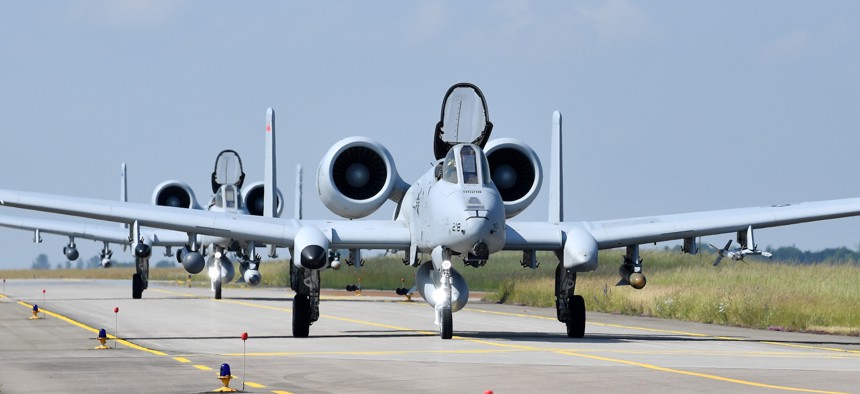
USAF A-10 Thunderbolt IIs taxi before the Air Defender 2023 military exercises on June 9, 2023, in Lechfeld, Germany. Alexander Koerner/Getty Images



What if the A-10 had AI & electronic-warfare gear?
House lawmakers wonder whether new missions could help keep the Warthog useful.

Lawmakers want to see if the Air Force’s venerable A-10 Thunderbolt IIs can be souped up with artificial intelligence, electronic-warfare gear, or better comms to keep it in the fight.
The House Armed Service Committee’s version of the annual defense policy bill included several Warthog-related provisions as part of an en bloc package. One would require a report on potential A-10 capabilities by Jan. 15, 2027, from Defense Secretary Pete Hegseth, Air Force Secretary Troy Meink, and the leaders of Air Combat Command and U.S. Central Command.
Proposed by Rep. Abraham Hamadeh, R-Ariz., the amendment directs officials to probe “potential incremental modernization options for the A-10 aircraft, including electronic warfare capabilities, decoy or stand-in effects delivery, aerial refueling enhancements, digital communications, sensor integration, precision weapons integration, survivability improvements, open-systems architecture, and human-machine teaming applications” to see if that would “improve the operational return on continued sustainment” for the program.
The HASC proposals are the latest in a decades-long string of congressional efforts to prevent the Air Force from retiring the A-10, which entered service in 1977 and has proven useful ever since. After the aircraft helped rescue a U.S. airman downed in Iran during this year’s Operation Epic Fury, Air Force leaders promised to keep some squadrons flying until 2030.
It is unclear how this promise might affect Hamadeh’s home state, where A-10 operations are slated to wind down at Davis-Monthan Air Force Base.
Air Force Chief of Staff Gen. Kenneth Wilsbach told lawmakers last month that the A-10 could be replaced on combat-search-and-rescue missions by F-15 Eagles or F-35 Lightning IIs. The HASC’s NDAA wants the service to investigate how existing or emerging platforms would absorb that high-profile mission and also asks for a study seeing if the aircraft can be upgraded with emerging technology for future fights.
Hamadeh’s amendment calls for an analysis “of whether currently programmed or planned Air Force capabilities are expected to replicate or improve upon the principal operational effects historically provided by the A-10 aircraft as rescue mission commander, close air support, armed overwatch, forward air controller-airborne, and personnel recovery support missions.”
The amendment also asks the service to probe if the platform’s mission success from the 1990s to the present could inform “human-machine teaming, autonomous collaborative or adjunct aircraft, artificial intelligence-enabled mission planning and targeting support, digital battlefield communications, distributed air-ground integration, and other emerging capabilities.”
Another amendment from the Arizona Republican asks the Air Force to consider making A–10 aircraft and equipment available for research on “autonomous or semi-autonomous aircraft integration, mission systems development, digital battlefield communications, or other related capabilities.” An Air Force report detailing those findings would be due roughly six months after the passage of the National Defense Authorization Act.
Another lawmaker, Rep. John McGuire, R-Va., inserted an amendment that would evaluate the “potential transfer of certain A-10 aircraft” slated for retirement to other military services.
The A-10 en bloc amendments passed by voice vote, and the House Armed Service Committee’s version passed 44-12 late Thursday evening. The A-10 provisions must receive further approvals from House and Senate lawmakers before making the final version of the NDAA.