

sponsor content What's this?

The Readiness Advantage - Operational Certainty at Machine Speed: Harnessing Agentic AI for Mission Assurance
By Rob Bocek, Chief Commercial Officer, Virtualitics
Presented by
Virtualitics

Presented by
Virtualitics
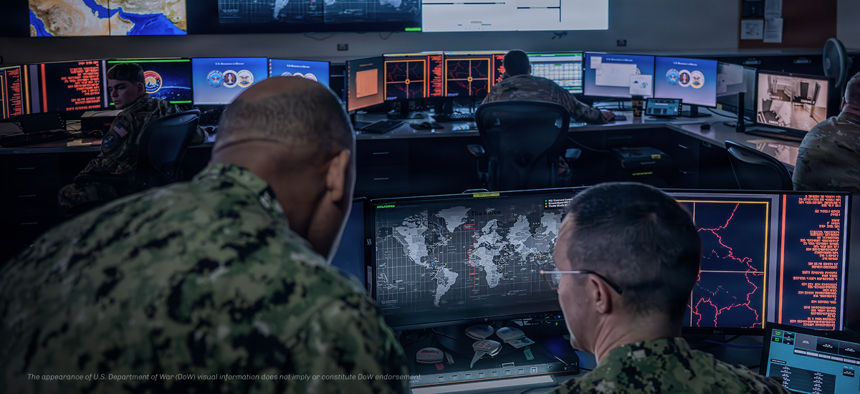
As a Naval Special Warfare officer and tactical commander, operational certainty was never a theoretical concept—it was a life-or-death imperative. It meant absolute, uncompromising alignment: elite personnel, precision intelligence, lethal equipment, and relentless preparation converging the exact second the mission went dynamic.
Forged in those zero-fail environments, that battle-tested mindset dictates how I evaluate today’s rapidly evolving global conflicts. They're a big reason I've spent my career helping decision-makers get the information they need to act faster and with greater confidence.
In today’s era of the Great Power Competition, military advantage depends on more than just platforms and personnel. The growing strain on U.S. munitions inventories is a reminder that readiness rarely breaks all at once. Small constraints accumulate until they become operational problems. Whether the challenge is maintenance, manpower, logistics, or munitions, leaders need to identify risk before it impacts the mission.
Data does not create military advantage. Decisions do.
The organizations that identify risk faster, orient swiftly, and act faster will hold the advantage over the opponent.
The Operational Certainty Challenge Has Changed
Today’s readiness environment across the defense ecosystem is defined by simultaneous demands across multiple theaters, increasing competition for resources, and zero margin for error. Success depends on anticipating problems before they affect operational readiness.
Most defense organizations don’t suffer from a lack of data; they suffer from a lack of clarity. Operational Certainty is the state of uninterrupted mission assurance and decision advantage achieved when an organization continuously anticipates risk, maintains total clarity of intent, and acts decisively before external conditions shift.
Achieving this requires breaking down data silos. Consider the effort to rebuild U.S. munitions inventories. Producing more munitions is not simply a manufacturing challenge—it requires coordination across suppliers, transportation networks, acquisition timelines, industrial capacity, and operational demand. Pressure in any one area creates consequences across the entire system.
By deploying Agentic AI—goal-directed software agents that reason, plan, and execute complex workflows—leaders gain a unified decision advantage across silos. Instead of passively reporting past events, agentic systems aggregate multi-domain data streams to detect vulnerabilities, simulate threat vectors, and initiate predictive readiness and risk preemption in logistics or sustainment long before bottlenecks disrupt operational capability. Leaders who see risk building gain time to act. Leaders who cannot are left reacting after the damage is done.
Why Trust Matters Most: Governed Autonomy & Explainable AI
In military operations, "trust me" is not a strategy. As defense organizations adopt AI-enabled decision support, trust becomes the primary prerequisite for adoption.
Realizing operational certainty requires moving beyond simple chatbots or static dashboards. Agentic AI must operate under governed autonomy and high-trust guardrails. Leaders need to understand why a recommendation was made, what assumptions informed it, and how changing conditions alter the outcome.
Effective agentic AI pairs high-speed probabilistic reasoning with deterministic governance—strict policy rules, regulatory boundaries, and explicit authority levels. High-stakes decisions automatically trigger Human-in-the-Loop (HITL) approval thresholds, ensuring systems remain secure, explainable, and accountable to human authority.
Making AI accessible is about far more than adding software layers. Technology must understand operational context and be immediately usable by operators, planners, and logisticians—not just technical specialists. If leaders and frontline personnel cannot trust the output, they will not use it when the stakes are highest. The best technology creates clarity: it helps users cut through the noise, evaluate tradeoffs, and act with confidence.
Operational Certainty Is the Next Military Advantage
The fundamentals of military readiness have not changed. Leaders still need the right people, equipment, intelligence, sustainment, and support available at the precise point of need and time.
What has changed is the required speed of response. Through machine-speed execution and adaptive workflows, agentic AI enables systems to re-evaluate tasks in real time as conditions shift, compressing decision cycles so leaders can move before the environment dictates terms.
AI does not replace human judgment; it amplifies it. It grants commanders the operational certainty needed to identify risk sooner, evaluate options faster, and execute with precision.
Leading U.S. Navy SEAL Teams through four combat deployments in zero-fail environments taught me a fundamental truth: certainty isn't given—it's forged. It requires mastering the mission, anticipating risk, and acting before the environment dictates your terms. That mindset remains unchanged.
Operational certainty cannot be reserved for analysts and technical specialists. It must belong to the commanders, operators, planners, logisticians, and readiness leaders responsible for mission outcomes every day. Military advantage has always belonged to those who adapt fastest. In today's dynamic threat environment, powered by agentic AI, Operational Certainty is how that advantage is won.
This content is made possible by our sponsor Virtualitics; it is not written by and does not necessarily reflect the views of Defense One's editorial staff.
NEXT STORY: Beyond the Exam: How Technology Is Transforming Military Health Readiness