

sponsor content What's this?
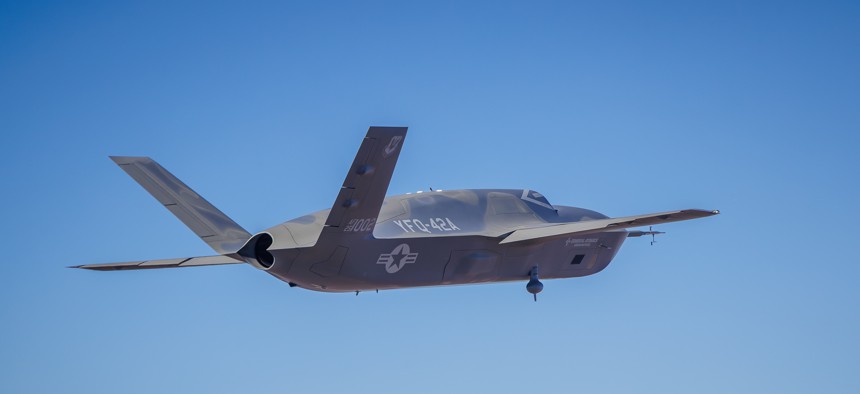
A photo of the FQ-42 in flight. Image courtesy of GA-ASI.


Altering the adversaries’ calculus with the FQ-42 Vengeance CCA
Semi-autonomous control means the FQ-42 Vengeance Collaborative Combat Aircraft (CCA) delivers operational dominance even in denied conditions.
Presented by
General Atomics Aeronautical Systems, Inc.

Presented by
General Atomics Aeronautical Systems, Inc.
A new era of technology hasn’t only made semi-autonomous fighters possible — it has created the conditions in which they are essential.
High-cost legacy fighters, high-threat adversaries, and high-capability uncrewed aircraft — along with their autonomous control systems — mean that the FQ-42, built by General Atomics Aeronautical Systems, Inc. (GA-ASI), can’t work like a legacy uncrewed aircraft.
Mike Shortsleeve, a former U.S. Air Force colonel and current vice president of DoD business development at GA-ASI, notes that in austere, contested environments, the assumption of persistent connectivity is a strategic vulnerability.
“We must operate under the presumption that our networks will always be contested,” said Shortsleeve. “If two crewed aircraft are flying, the pilots can execute a shared mission plan even if communications are lost. We need that same level of capability across uncrewed systems. Our UAS must be able to see, sense, and execute on pre-tasked mission parameters regardless of link availability or adversarial interference.”
This ability to task systems to continue amid denied, degraded, intermittent, or limited environments is becoming a crucial factor. As demonstrated in the battlefields and cities of Ukraine, communications are not assured; drones and UAS must be able to continue without the ability to call back to a central command hub.
Aircraft like the FQ-42 Vengeance CCA feature advanced software capabilities to ensure that even when communication is lost, our armed forces can fight and win at the edge, drawing on years of on-the-ground, mission-proven experience.
With nearly 10 million flight hours across numerous platforms, GA-ASI’s suite of solutions has conducted hundreds of thousands of automated takeoffs and landings, mission events, and redirects.
“It’s helped us understand what we can ask these systems to do,” explained Shortsleeve. “This has led us to build flight software for these aircraft that’s separate from the mission autonomy, so we can be confident that these jets will do what we want — and succeed.”
The FQ-42 acts as a force multiplier. Its autonomous architecture is designed for immediate threat detection: identifying incoming hazards, assessing intent, and executing a response within predefined rules of engagement.
“Over time, the edge is going to compound,” said Shortsleeve. “We’re going to have more of these things numerically. Our crews are going to get better and better at using them in large numbers, and our pilots are going to work alongside them and write new playbooks as they go. With a greater number of CCAs in a fighter squadron, you have more jets to use in new ways, more jets that can look from different angles, and more jets that can shoot and establish total domain control.”
See how the FQ-42 CCA is changing the future of aerial defense.
This content is made possible by our sponsor General Atomics Aeronautical Systems, Inc.; it is not written by and does not necessarily reflect the views of Defense One's editorial staff.
NEXT STORY: Beyond the manned fighter jet