

sponsor content What's this?
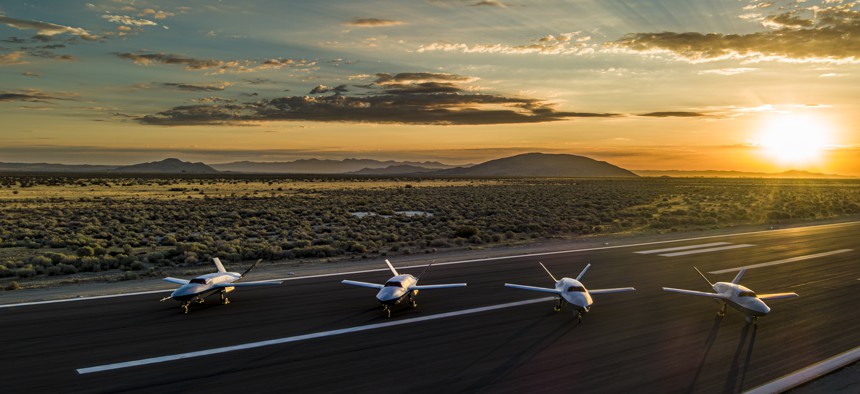
A photograph of several FQ-42 aircraft sitting on a runway. Image courtesy of GA-ASI.



Beyond the manned fighter jet
By augmenting legacy platforms with semi-autonomous systems, the USAF is moving to solve the dual crisis of platform cost and pilot shortage.
Presented by
General Atomics Aeronautical Systems, Inc.

Presented by
General Atomics Aeronautical Systems, Inc.
Western aerial dominance is reliant on a dwindling fleet of exquisite, high-cost platforms. For decades, these assets have been the primary means of deterrence and enforcement, but today that paradigm is at its breaking point.
The recent conflict in Ukraine demonstrates that national security can no longer rely on traditional salvos alone; rather, defending against incoming threats will require an integrated force structure consisting of both traditional and attritable systems.
One way the United States Air Force (USAF) plans to address this shift is through the deployment of semi-autonomous systems like General Atomics Aeronautical Systems, Inc.’s (GA-ASI) FQ-42. Engineered to operate as a “loyal wingman,” GA-ASI’s Collaborative Combat Aircraft (CCA) flies alongside fifth- and sixth-generation manned jets like the F-35 to help units reduce risk and deploy affordable mass.
“Legacy fighter programs are too expensive and there aren’t enough pilots to fly them,” said GA-ASI President Dave Alexander. “The airplanes themselves can cost hundreds of millions of dollars apiece, and for every aircraft that you’re building at the factory, you need to have a human being on a parallel track.”
If the service lacks either the platform or a pilot, the capability collapses.
“You can’t have an Air Force like this and build scale. You’ll go broke, and there aren’t enough human pilots. So, the Air Force came to GA-ASI and said, ‘we want to augment our human fighter pilots with a collaborative platform that can go along with the F-35, F-47, and other aircraft.’”
GA-ASI mobilizes to meet USAF needs
GA-ASI immediately mobilized to meet this moment, first by looking toward the success of the MQ-20 Avenger. After thousands of flight hours across a range of missions, the Avenger provided a proven foundation for the company to build on the program’s success.
Unlike the short-range, air-to-ground drones that are popular in Ukraine and the Middle East, the FQ-42 Vengeance CCA is a fast, high-performance jet built to take on sophisticated threat actors. Doctrinally, its mission is simple: See threats first, identify them, track them, assess their intentions, and, if it gets orders to do so, take action.
“There’s never been anything quite like the FQ-42. We invented, designed, and built a novel aircraft for a novel mission in partnership with the Air Force,” Alexander explained. “It’s a fighter, plain and simple. All that’s changed is the way it does things because it has semi-autonomous systems instead of a fighter pilot on board.”
As it soars over combat zones alongside F-35s, Vengeance’s architecture is built to prioritize constant communication. Instead of having to manually control a drone via remote link, a fighter pilot can manage several CCAs with simple, high-level commands, tasking their uncrewed wingmen to scout ahead and assume the highest risks.
“Sometimes people get tripped up on the term ‘autonomy.’ The CCA can’t do anything on its own. A person is always in the loop, telling it to take off and checking in with it as it flies and searches. But it's the FQ-42 that makes contact and potentially goes into danger first. In this context, it’s not our hero in her jet, but a semi-autonomous wingman that doesn’t have a husband, kids, or a dog waiting for her at home.”
This content is made possible by our sponsor General Atomics Aeronautical Systems, Inc.; it is not written by and does not necessarily reflect the views of Defense One's editorial staff.
NEXT STORY: Creating Decision Dominance with Agentic AI Planning & Simulations