

sponsor content What's this?
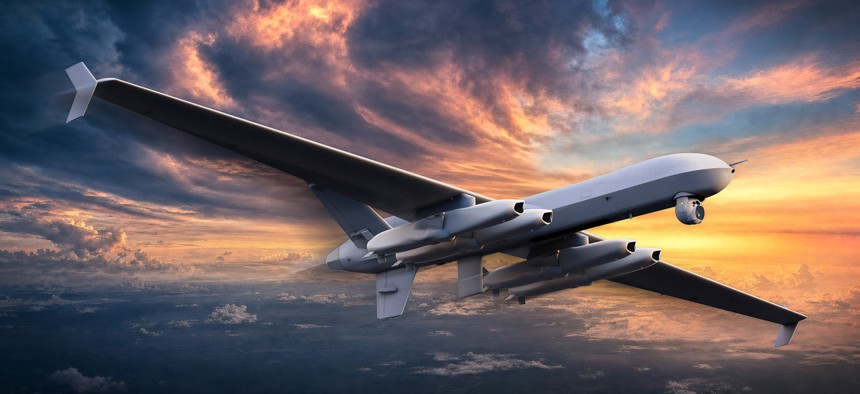
A rendering of the new Wildfire platform. Image courtesy of GA-ASI.


GA-ASI highlights new Wildfire UAS at AFA
GA-ASI underscores how new offering addresses mass and scalability requirements at AFA 2026.
Presented by
General Atomics Aeronautical Systems, Inc.

Presented by
General Atomics Aeronautical Systems, Inc.
The U.S. military arsenal relies on exquisite, technologically advanced systems. Although these are essential for domain dominance, these assets also often are ill-suited for the attrition rates of protracted warfare. Recent operations demonstrate how well adversaries can successfully neutralize expensive U.S. assets with low-cost, attritable systems.
As operational environments shift toward massed, modular capabilities, American reliance on high-value, hard-to-replace platforms creates a strategic vulnerability. To address this, the U.S. Air Force (USAF) is moving toward a more cost-effective model of achieving aerial dominance, one that combines exquisite systems with a mix of affordable, massed solutions.
At this year’s Air, Space & Cyber (AFA) Conference, General Atomics Aeronautical Systems, Inc. (GA-ASI), underscored how it’s leaning into this shift and supporting the USAF with the company’s newest aircraft: Wildfire.
What is GA-ASI’s Wildfire system?
With more than three decades of experience and nearly 10 million flight hours across its thousands of aircraft, GA-ASI’s Wildfire platform looks to build on the success of the MQ-9 Reaper. Wildfire is engineered to bridge the gap between reliability and the need for autonomous volume at scale.
“Wildfire is GA-ASI’s vision for a new uncrewed aircraft that combines high capability with affordable unit costs, in response to the U.S. Air Force’s request for a new type of aircraft,” a spokesperson explained. “Wildfire integrates the proven capabilities of the current MQ-9A model and MQ-9B aircraft, with some unconventional refinements and strict discipline around other features and missions.”
Wildfire is a medium-altitude, long-endurance (MALE) aircraft that’s designed to take the best of what the MQ-9A and MQ-9B have to offer and operate in concert with other semi-autonomous systems like GA-ASI’s new Collaborative Combat Aircraft, FQ-42A Vengeance.
“Wildfire takes a page from the FQ-42 and its heavy use government-reference autonomy, reducing the workload for human operators,” the spokesperson said. “When it comes to the MQ-9B, Wildfire builds on the MQ-9B’s class-leading onboard sensing and novel networking and communications infrastructure.”
At the same time, Wildfire is unique in the sense that it doesn’t have many of the common features or onboard systems that are expected of similar craft. This intentional design choice helps the USAF save on costs and is designed to give the service a more “mission-focused platform they’ll be able to field in higher quantities,” the company says.
The GA-ASI team at AFA.
The time to transition from a high-cost, low-output model is now. At AFA this year, GA-ASI showcased how its systems support this shift by enabling and promoting a more resilient airpower model.
GA-ASI also featured a full-scale model of the FQ-42A CCA, now in production and conducting flights for the company and the USAF. GA-ASI’s MALE platforms like the MQ-9A Reaper®, MQ-9B SkyGuardian®, and MQ-9B SeaGuardian® also were highlighted at the conference
“GA-ASI stands at the leading edge of what’s possible with uncrewed aircraft at every level, and we’re excited for Wildfire to join the lineup,” the company said.
This content is made possible by our sponsor General Atomics Aeronautical Systems, Inc., it is not written by and does not necessarily reflect the views of Defense One's editorial staff.