

sponsor content What's this?
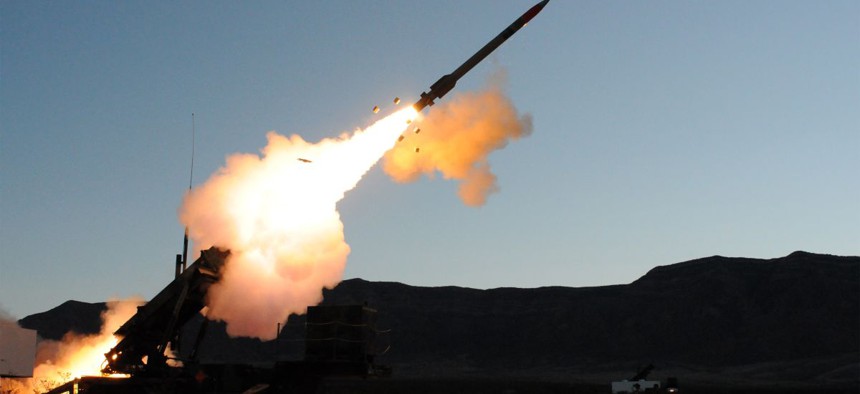
L3Harris is constructing new facilities across the United States to significantly expand propulsion production for critical munitions programs, including the PAC-3® Missile Segment Enhancement (MSE) interceptor. The appearance of U.S. Department of War (DoW) visual information does not imply or constitute DoW endorsement.



America can’t afford to slow its defense buildup
By: Ken Bedingfield, President, Missile Solutions, L3Harris Technologies
Presented by
L3Harris

Presented by
L3Harris
The need for America to ramp up production of critical munitions has emerged as a major topic of discussion for leaders in Washington. Senior administration officials and members of Congress from both parties have recognized the same reality: our nation’s ability to deter and defeat our adversaries depends not only on strategy and advanced technology, but also our capacity to produce the right capabilities for our warfighters at speed and scale.
Public debate often treats the defense industrial base as the primary obstacle to accelerating missile production. To be sure, rebuilding industrial capacity can’t happen overnight – especially after decades of uneven demand that stifled industry investment. The missile supply chain remains highly specialized, heavily regulated and capital-intensive.
However, there’s an important part of the story that isn’t being told: the defense industrial base is making real progress.
Prime contractors and suppliers are investing in new facilities, workforce expansion and long-lead materials. At L3Harris, we are modernizing production lines with automation, robotics and additive manufacturing capabilities. As a result, capacity is increasing, output is rising and competition is emerging. A supplier base that struggled for years under inconsistent demand and long cycle times is becoming faster, stronger and more resilient.
As the nation’s leading provider of solid rocket motors for U.S. and allied munitions, L3Harris is committed to supporting the warfighter and the mission. Unlike a traditional government contractor, our company is investing as a commercial business by building capacity to meet expected demand. We’re spending billions of dollars to construct approximately 60 facilities and add more than 1 million square feet of manufacturing and support space across our propulsion production sites in Alabama, Arkansas, California and Virginia. These investments will enable us to double, triple and in some cases more than quadruple solid rocket motor production rates for a range of critical munitions programs.
These new facilities aren’t theoretical. They’re under construction today. And when they start coming online this year and every year for the foreseeable future, they’ll add to the more than 115,000 rocket motors we already produce annually.
While L3Harris is proud to be doing its part with missile propulsion, the need to rebuild America’s Arsenal of Freedom is bigger than any single company or capability. We must bring our entire industrial base back onto a wartime footing – not because we seek war, but because we can preserve peace through industrial strength. To credibly deter increasingly capable adversaries, our nation needs an all-of-society effort to ramp up production of critical capabilities at a speed and scale not seen since the Manhattan Project.
Transforming the defense industrial base will ensure our warfighters are equipped to meet the challenges of our time. It will also drive economic success for communities across America. A prime example is the extraordinary story of growth unfolding in places like Camden, Arkansas, and Orange County, Virginia.
To staff the dozens of new facilities we’re building in Camden, L3Harris plans to add hundreds of jobs over the next few years – high-skill, high-wage careers that will support families, strengthen communities and secure America’s technological edge. Other defense contractors in the area are also boosting their workforces to meet customer demand. The local community college is building a training center to give people from the region the skills they need to compete for these new opportunities.
In rural Virginia earlier this year, we announced an agreement to further expand our solid rocket motor production capacity at our Orange County site. The more than $1 billion project, which builds on a previously announced expansion, is expected to more than double our manufacturing space there, which will also enable us to grow the number of employees at the site to 700 over the next five years.
The transformation we’re seeing in Arkansas, Virginia and communities across the country is a direct result of strong partnerships among companies of all sizes in the defense industrial base and elected officials at the local, state and federal levels. Partnerships like these provide a model for how our nation can come together to deter and defeat our adversaries in an increasingly dangerous world while also creating new opportunities for American workers.
Every stakeholder in America’s defense ecosystem must act with the urgency this moment requires. Industry must continue to invest in increased production capacity, and Congress must provide the funding needed to give defense tech companies confidence that they’ll receive a fair return on their investment. Together, we can rebuild the Arsenal of Freedom our warfighters need and deserve. And in the process, we can restore the industrial strength that made America the global superpower for the last century.
This content is made possible by our sponsor L3Harris; it is not written by and does not necessarily reflect the views of Defense One's editorial staff.
NEXT STORY: GA-ASI’s Gray Eagle® 25M and Mojave STOL UAS are ready today for the Army’s future fight