

sponsor content What's this?
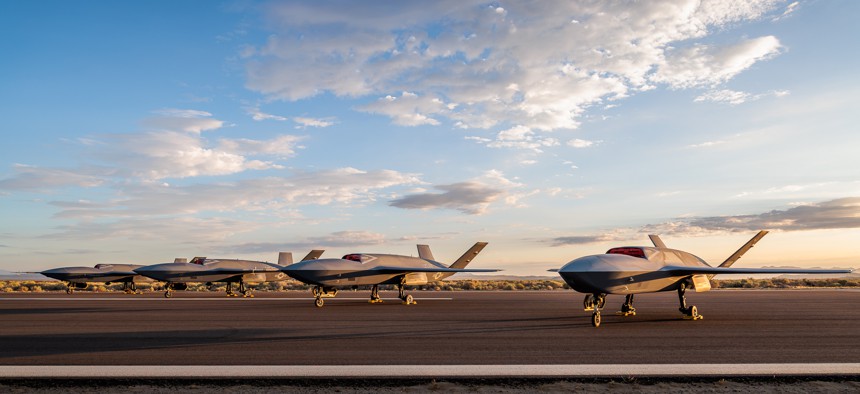
FQ-42s sit on the runway, ready for action. Image courtesy of GA-ASI.

CCA points to more integrated, more capable uncrewed future
Networked, semi-autonomous platforms are delivering greater speed and lethality.
Presented by
General Atomics Aeronautical Systems, Inc.

Presented by
General Atomics Aeronautical Systems, Inc.
The United States Air Force is buying a production run of pilotless fighter jets. That’s not aspirational. It’s not “on the horizon.” It’s happening today, right now, at this moment.
So, if that’s the present, what does the future hold?
“We’ve been doing this for more than three decades, and this is one of the most exciting periods we’ve ever had,” laughs David Alexander, president of category leader General Atomics Aeronautical Systems, Inc. (GA-ASI). “Strange to think of it this way, but we’re just getting started.”
GA-ASI invented or pioneered many of the technologies that have brought uncrewed systems to the current state of the art. Compact but powerful aircraft. Integrated networking. Offboard piloting from ground control stations. Multi-mission applications.
And although the U.S. Air Force’s FQ-42 Vengeance and other pending jets are in the works, they’re not even the first uncrewed combat jets. That distinction belongs to GA-ASI’s MQ-20 Avenger®, which has thousands upon thousands of flight hours over many years as an operational platform and an advanced testbed for combat autonomy software.
The question about where the technology heads next, then, is in some ways a speculative one, but there also are many signposts that show where the Air Force and other high-demand clients want to go.
“You’ll probably see more offloading of workload onto the aircraft and the mission systems. You’ll probably see mission operators controlling more and more aircraft at once. You’ll probably see much tighter integration between uncrewed platforms themselves,” Alexander says. “The main thing that won’t change is that people will always be in command.”
Unifying the work of uncrewed aircraft is likely to be a major focus, company officials say.
Imagine a scenario in which the U.S. Air Force and Navy have to work together against a threat in a big air and maritime domain. For example, one of GA-ASI’s MQ-9B SeaGuardian® uncrewed aircraft, equipped with a maritime search radar, might detect some hostile ships on the horizon.
If that happened today, human crewmembers would contact human supervisors and say, “Hey, we’ve seen something; we recommend you take action.”
In the not-too-distant future, MQ-9B might communicate directly with a flight of other uncrewed aircraft armed with anti-ship missiles and say, “I’ve identified some targets; can you fly to this position and release your weapons against them?” The other aircraft will say, “Yes, we can, if we receive that order.”
This proposed course of action would be presented to human troops on a watch floor or in the combat information center of a ship — greatly speeding up the response time. They would decide to attack, or not, or take some other action, with all the detection, assessing, and planning done in advance.
These quick actions work in other scenarios, too. An MQ-9B equipped with an airborne early warning radar system might detect hostile fighters, then get in touch with a flight of FQ-42A CCAs and say, “Here’s where the threats are; this is where you should engage if we get permission.”
A battle management system would show both the potential threat and the potential response to a supervisor at a command post or aboard a warplane in the region, rather than requiring a team of watchstanders to process what they were sensing, decide what action to take, look for friendly forces to respond to tasking, and so on.
Although the exact details aren’t fully clear as the new future of uncrewed combat still comes into focus, Alexander says the news is good for the U.S. and its allies.
“We know where we want to go, and we’re inventing the systems and the equipment to drive us there,” Alexander affirms. “The bottom line is that we’re never going to let American or friendly forces get into a fair fight.”
This content is made possible by our sponsor General Atomics Aeronautical Systems, Inc.; it is not written by and does not necessarily reflect the views of Defense One's editorial staff.
NEXT STORY: Modernizing Military Fire, EMS and Healthcare: Connecting Data Across the Emergency Response Mission