

sponsor content What's this?
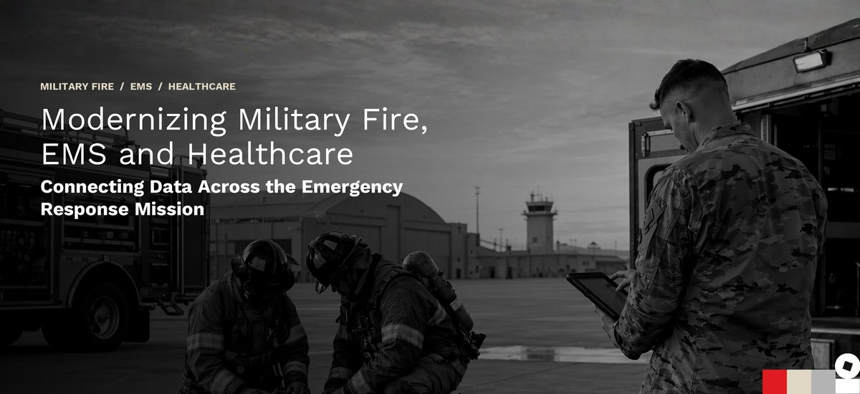

Modernizing Military Fire, EMS and Healthcare: Connecting Data Across the Emergency Response Mission
Presented by
ImageTrend

Presented by
ImageTrend
Military emergency response does not have a data shortage. It has a workflow and connectivity problem.
Fire crews generate incident, inspection, staffing and response data. EMS teams document patient assessments, treatments and transports. Military treatment facilities collect clinical, operational and outcomes data. Leaders across installations, commands and healthcare organizations have access to more information than ever.
The problem is what happens between those systems.
When information lives in separate applications, reports require repetitive work, patient data does not move easily from the field to the facility, and leaders have to assemble an operational picture from disconnected sources. More technology does not automatically solve that problem. In some cases, it simply creates another place for people to enter, find or reconcile information.
That is why modernization has to start with the workflow—not the software.
The U.S. Navy has already taken a step in that direction. In 2025, it selected ImageTrend as its nationwide provider for centralized EMS and fire reporting, with the ability to standardize data collection across operations while preserving control at the individual-base level.
For military leaders evaluating what comes next, that balance is critical: standardize what should be consistent, preserve flexibility where the mission requires it, and make the information collected at the operational level more useful to the enterprise.
Why Military Fire, EMS and Healthcare Leaders Are Rethinking Legacy Workflows
The need to modernize is not a vendor-created problem.
The Military Health System’s own Digital Transformation Strategy calls for integrated, reliable and accessible systems that reduce clinician burden. It specifically identifies the need to reduce redundancies and administrative burden, consolidate redundant digital systems, improve interoperability and streamline care processes. The strategy also calls for data that is visible, accessible, linked, trustworthy, interoperable and secure.
That challenge extends beyond the hospital.
Fire services nationwide have just undergone one of the largest reporting changes in decades. The U.S. Fire Administration retired the legacy National Fire Incident Reporting System (NFIRS) in 2026 and moved incident reporting to the National Emergency Response Information System, or NERIS. USFA says the previous system had become outdated and that NERIS was designed around interoperability, analytics, improved data integration and reduced burden on data contributors.
The line between Fire and EMS is also increasingly important operationally. Among incidents reported to NERIS during the first half of 2026, 62% required emergency medical services from fire departments, while about 4% involved a fire. That national figure does not describe every military installation, but it illustrates how closely intertwined fire and medical response have become across modern emergency services.
EMS has its own connectivity gap. The National EMS Information System notes that EMS has historically been left out of broader healthcare interoperability efforts: EMS providers often lack real-time access to patient history, EMS patient-care reports are often not available electronically inside the receiving hospital’s EHR, and EMS crews frequently do not receive hospital outcomes electronically afterward.
These are different environments, but the underlying problem is remarkably similar: important information is being collected, yet the workflow around that information can still depend on separate systems, manual steps and incomplete handoffs.
Modernizing Military Fire Operations Without Adding More Work
Modern fire operations extend far beyond completing an incident report.
Leaders may be responsible for staffing, inspections, licensing, permits, pre-incident planning, fire and rescue documentation, investigations, compliance and performance reporting. When those processes live in separate tools, the administrative work surrounding the mission can grow quickly.
Modernization should move in the opposite direction.
ImageTrend’s Fire platform is designed to connect those workflows across the incident lifecycle. Scheduling and workforce tools can support personnel management before the call. Visual Pre Plans can make building and hazard information available for response. Elite Fire supports configurable incident documentation and NERIS reporting, while investigations and analytics extend the value of that information after the incident.
The goal is not simply to replace paper with a screen. It is to eliminate repetitive work and allow information collected for one operational purpose to support another.
For leaders managing multiple installations, that creates an additional opportunity: give local teams tools that fit their operations while creating more consistent data and visibility at higher levels of the organization.
Modernizing Military EMS Around the Patient, Not the Form
EMS presents a different version of the same challenge.
The electronic patient care report (ePCR) is essential, but documentation should support patient care rather than compete with it. Modern systems can automate pieces of data capture using AI, apply validation rules, integrate information from other sources and structure records around NEMSIS standards. Those capabilities matter because accurate EMS data does more than satisfy a reporting requirement; it can support quality improvement, analytics, billing, medical oversight and eventually the next stage of the patient’s care.
ImageTrend Elite supports ePCR reporting, while Fire-based EMS organizations can combine fire and EMS reporting workflows through Elite Rescue. Continuous quality improvement tools can help reviewers identify documentation or performance issues, and ImageTrend’s Unified Analytics platform can connect operational, clinical and performance data so leaders can move beyond static reporting.
That changes the question from, “Did we complete the report?” to, “What can this information tell us about care, performance and readiness?”
Connecting EMS and Military Treatment Facility Data
The patient does not stop being the same patient when the ambulance reaches the hospital door. The information should not stop there either.
That principle aligns closely with the Military Health System’s stated direction. Its digital strategy calls for better interoperability and continuity as patients move across the continuum of military care, including transitions between deployed environments and definitive care.
For military treatment facilities, the practical challenge is making prehospital information available inside clinical workflows without creating another manual reconciliation process.
ImageTrend’s Carelytics platform is built around that connection. The platform supports EMS-to-hospital data exchange, automated patient-and-encounter matching, bidirectional outcome sharing, plus visibility into EMS transport and patient-flow patterns. It is designed to function as an integration layer between existing EMS and hospital systems rather than requiring organizations to replace their existing ePCR or EHR investments.
ImageTrend’s Healthcare Intelligence System also includes Patient Registry and Reporting Solutions for managing and analyzing trauma, burn, stroke and cardiac data, supporting quality improvement, compliance and operational reporting.
The larger opportunity is not simply moving an EMS report into an EHR. It is creating a more connected episode of care in which information gathered before arrival can support the facility, and meaningful outcomes can flow back to the teams responsible for prehospital care.
What Connected Military Emergency Response Should Look Like
Across Fire, EMS and healthcare, effective modernization should accomplish three things.
It should reduce or eliminate work before it adds technology. A new system that requires more duplicate entry, more reconciliation or another disconnected login has not meaningfully modernized the workflow.
It should connect information instead of creating another silo. Incident, patient and operational data become more valuable when they can move across the systems and teams that need them.
And it should turn reporting into operational intelligence. Leaders should be able to understand trends, identify risk, evaluate performance and make decisions without spending days assembling information from separate systems and spreadsheets.
That is the difference between digitizing an existing process and actually improving it.
One Connected Platform Across Fire, EMS and Military Healthcare
ImageTrend brings those pieces together across the emergency-response lifecycle.
Before an incident, organizations can manage scheduling, licensing, inspections, pre-plans and preparedness workflows. During the incident, Fire and EMS teams can document response and patient care using configurable reporting tools built around current standards. After the incident, quality, investigations, billing, reporting and analytics can turn the data already collected into information leaders can use.
At the healthcare level, Carelytics, Patient Registry and Reporting Solutions extend that connected approach into hospital and military treatment facility workflows. ImageTrend’s broader platform strategy is designed around connecting pre-incident preparation, response, post-incident analysis and healthcare intelligence rather than treating each as a separate technology problem.
The result is a simpler modernization question for military leaders: not “How many new systems do we need?” but “How much unnecessary work can we remove, and how much more value can we get from the information we already collect?”
Federal Cloud Readiness for Military and Federal Environments
For federal organizations, modernization also has to meet the security and compliance expectations of the environment in which the technology will operate.
ImageTrend is listed on the FedRAMP Marketplace through Project Hosts’ Azure Platform as a Service offering and is pursuing FedRAMP High and Department of Defense Impact Level 4 alignment. ImageTrend has also deployed a NIST 800-53-compliant test environment as part of that effort.
FedRAMP updated its terminology in 2026, with the former High Impact designation transitioning to Class D (High) during the current transition period. The underlying goal remains the same: provide a standardized framework for assessing and securing cloud services used by the federal government.
Security matters. So does usability. So does interoperability. And so does whether the technology actually makes the mission easier for the people using it.
Military modernization should not mean introducing another system for responders, clinicians and leaders to work around.
It should mean fewer disconnected workflows, better movement of information and a clearer operational picture from the first response through the next stage of care.
Modernize the workflow. Connect the data. Give your teams more time to focus on the mission.
Military modernization should make the mission easier, not add another layer of complexity. By simplifying workflows, connecting Fire, EMS and healthcare data, and turning that information into actionable insights, military leaders can give their teams the tools, time and visibility they need to respond to emergencies when seconds matter.
Request a demo today to see why ImageTrend is the industry leader in helping military fire, EMS and healthcare leaders improve emergency response.
This content is made possible by our sponsor ImageTrend; it is not written by and does not necessarily reflect the views of Defense One’s editorial staff.
NEXT STORY: Inside GA-ASI’s ‘flying laboratory’