

sponsor content What's this?
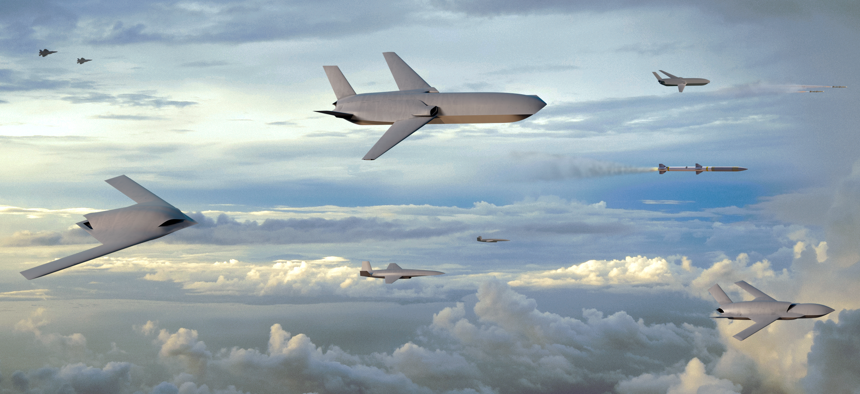
A rendering of the GAMBIT SERIES UAS in flight. Image courtesy of GA-ASI.



The next big wave of autonomous jets is rolling out around the globe
The U.S. Air Force is leading the way into the next era of air dominance — but the world isn’t far behind.
Presented by
General Atomics Aeronautical Systems, Inc.

Presented by
General Atomics Aeronautical Systems, Inc.
American allies and partners in Europe and Asia are just as interested as the U.S. in exploring what’s possible with uncrewed, semi-autonomous combat aircraft that can follow, accompany, or even lead conventional human-piloted fighters.
“International militaries understand this just as well as we do,” says Nicola Johnson, vice president of international strategic development with category leader General Atomics Aeronautical Systems, Inc. (GA-ASI). “Although Collaborative Combat Aircraft [CCA] may have begun in the United States, we expect them to be truly global.”
That’s why GA-ASI engages with so many international partners interested in its Gambit Series of CCAs.
The concept appeals because it’s so versatile. Gambit represents a common aircraft core that’s highly producible but also customizable, like an automotive chassis that can take one turn at the factory and become a family car or take another turn and become a luxury sedan.
One variant, Gambit 2, is an armed air-to-air dominance fighter that’s in production now for the U.S. Air Force and is known as its FQ-42 Vengeance CCA. But there are several others.
Gambit 5 is built to operate from U.S. or allied aircraft carriers and includes the modifications necessary to use a ship’s flight deck at sea and take on the maritime missions needed in a naval fighter.
Another example is Gambit 6, an armed platform built to handle a variety of air-to-ground missions, including strike, the suppression of enemy air defenses, electronic attack, and more. Although the United States program sought an air-to-air fighter, international customers also want air-to-ground, or what are often called multirole aircraft.
“We’ve delivered hundreds of aircraft for international customers, and each one was tailored to those specific requirements,” Johnson says. “Refining a platform in response to specific needs or missions is in our DNA, and we’re eager to get into the mode of doing that on CCAs too.”
In a marketplace becoming more crowded with novel offerings, GA-ASI has one of only a handful of platforms that actually flies regularly and is also one of a very small number of established builders with the manufacturing capacity to actually deliver on major orders quickly.
This explains the significant international response to GA-ASI’s showcase at the Farnborough International Airshow this past summer and the anticipation around the company’s upcoming display at the International Fighter Conference in Munich come November.
“The interest from around the world is intense,” says Johnson. “We’re looking forward to showing our customers all the possibilities we can offer that specifically address what they need.”
This content is made possible by our sponsor General Atomics Aeronautical Systems, Inc.; it is not written by and does not necessarily reflect the views of Defense One's editorial staff.
NEXT STORY: CCA points to more integrated, more capable uncrewed future