

sponsor content What's this?
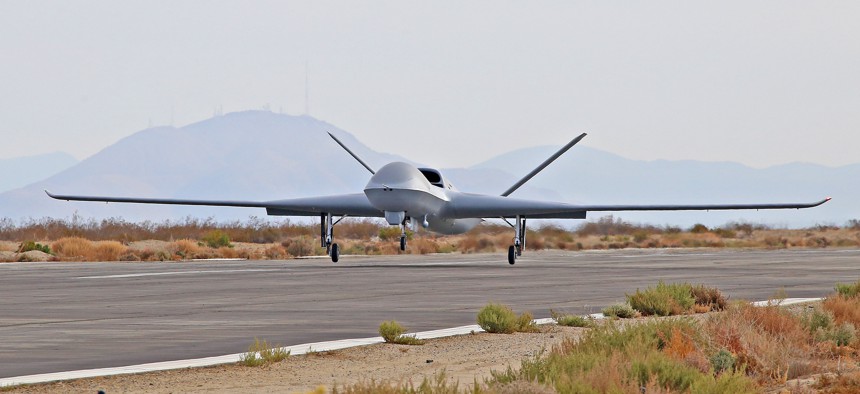
A photo of the the MQ-20 Avenger taking off from a runway. Image courtesy of GA-ASI.



Inside GA-ASI’s ‘flying laboratory’
GA-ASI’s FQ-42 brings real-world, combat-ready technology to the battlespace.
Presented by
General Atomics Aeronautical Systems, Inc.

Presented by
General Atomics Aeronautical Systems, Inc.
While aircraft like the FQ-42 Vengeance Collaborative Combat Aircraft (CCA) are redefining risk and altering the math behind Uncrewed Aerial Systems (UAS), one question remains: How to move from the abstract promise of autonomous wingmen to verified, combat-ready platforms engineered to perform amid the fog of war?
To meet the moment, General Atomics Aeronautical Systems, Inc. (GA-ASI) is leveraging the MQ-20 Avenger® as its flying laboratory. As the first large-jet uncrewed combat aircraft, the MQ-20 provides a unique high-fidelity environment that allows GA-ASI to stress-test complex autonomous behaviors integrated with real-life mission system components that cannot be fully replicated in simulated environments.
“Currently, there are no other fully autonomous flying combat aircraft that are able to do the type of Government Reference Architecture-compliant, integrated end-to-end autonomy and mission system testing that we do,” explained Dr. Stacy MacAllister, director of engineering for autonomy and artificial intelligence at GA-ASI. “Before we fly, we leverage a considerable amount of high-fidelity simulated and virtual tests to help develop and refine capabilities. That said, there will always be a simulation-to-real gap we have to consider. As a result, there is no substitute for seeing how a set of capabilities refined in simulation will execute on a real-life airplane, or how systems react when things in the real world complicate the scenario you planned for.”
Designing systems built for DDIL environments
The backbone of the MQ-20 Avenger® and FQ-42 is GA-ASI’s TacACE® software and the Optix platform. Both of these software systems work in tandem to ensure mission resilience in Denied, Degraded, Interrupted, and Limited (DDIL) environments — this is critical as planners assume ever-greater electromagnetic threats designed to sever the links between units.
The key, as MacAllister explained, is to assume an adversary will always attempt to disrupt an aircraft’s network connection. As a result, systems we develop must be able to operate in communications-degraded or -denied environments. Meaning the autonomy ecosystem on the aircraft needs to be robust enough so that it can continue to fly by itself and carry out its mission.
“The system we are building, testing, and maturing is enabling one-to-many control. As a pilot, if I have a couple of CCAs flying ahead, I don’t need to be on the controls for each CCA, looking through the screen at what comes up. The autonomous aircraft already knows what to do,” she said. “Maybe, while we’re flying, a few disruptions or contingencies occur, or maybe as a pilot we have some audibles to call for the Human-Machine Team, but the CCA’s mission doesn’t depend on the fighter having that always-on satellite link. The mission can continue, and that’s part of the value that autonomy brings to the USAF.”
Proofing TacACE® on the testing range
The value of the TacACE® autonomy ecosystem architecture was validated in several landmark exercises that merged live and virtual assets. During these scenarios, an MQ-20 Avenger® was paired with three to twelve virtual heterogeneous CCAs and tasked with executing find, fix, track, target, engage, and assess mission phases.
“The CCAs had to collaboratively patrol a search zone using the autonomy’s best judgment about the right aircraft loadout for the task — all while sharing cues and information from other sensors across the heterogeneous CCA team and while executing phases of the mission. In other words, the onboard autonomy during the mission had to dynamically collaborate based on real-world mission systems information and aircraft capabilities to detect and engage threats. This showcases autonomy’s ability to demonstrate dynamic judgment throughout the mission and operate using own ship or off-board information,” said MacAllister.
The result? The system successfully executed the missions, demonstrating the find, fix, track, target, engage, and assess mission phases — all without human intervention.
While these were virtual shootdowns in an exercise environment, the implications for the future force represent a massive step forward in semi-autonomous capabilities. For decades, GA-ASI has led the way with its commitment to an open, evolving architecture, built to meet the needs of today and tomorrow’s Air Force.
“We never stop assessing, training, and expanding,” said MacAllister. “These types of missions give us a great deal of confidence that we’re on the right track and that we’re providing the best possible aircraft, autonomy, and support systems to the USAF and our other customers around the globe.”
This content is made possible by our sponsor General Atomics Aeronautical Systems, Inc.; it is not written by and does not necessarily reflect the views of Defense One's editorial staff.
NEXT STORY: The Geospatial Imperative: The Strategic Necessity of GIS in Europe