

sponsor content What's this?

Autonomy Takes Center Stage at AUSA 2026
Presented by
ServiceNow

Presented by
ServiceNow
Today's battlefields are reshaping how the U.S. Army prepares for war. From the spread of unmanned and autonomous systems in Ukraine to the pervasive threat of Iranian drones and missiles, the Army is evolving to capitalize on new technologies that can be produced quickly and in large quantities, all without breaking the bank. The Association of the U.S. Army (AUSA) conference, held annually in Washington, D.C., reflects these shifting priorities each year. In 2026, vendors leaned heavily into the lessons of today's threat environment, showcasing a range of unmanned and autonomous platforms, counter-unmanned aerial system (C-UAS) capabilities, missile defense interceptors, and other hardware needed for future conflicts.
Autonomy and Unmanned Systems
The overarching theme of this year's show was autonomy and unmanned systems, which were on display at every turn. In the air, offerings ranged from small drones, loitering munitions, and launched effects from companies like AeroVironment (AV), Uvision, and Zone 5 Technologies, to advanced drone concepts like Shield AI's X-BAT. Similarly, unmanned and autonomous ground vehicle concepts included platforms like Overland AI's IBEX all the way up to an industry-funded autonomous Armored Multi-Purpose Vehicle (AMPV) prototype from BAE Systems.
A defining feature of this market is the separation of hardware and software. An open systems architecture approach lets industry and the Army run different autonomy software across a mix of air and ground platforms, depending on the platform and mission. For example, Forterra's AutoDrive system is utilized on BAE's AMPV prototype and Hypercraft's Razorback UGV. But costs are always a consideration. Autonomy isn't cheap, and vendors noted that full autonomy can significantly increase the unit price of unmanned systems. The Army must therefore balance cost and capability while keeping humans in the loop for critical decisions.
The systems showcased at AUSA tie directly into the Pentagon's effort to launch an Autonomous Warfare Command (AUTOWARCOM), as well as the Army's new Futures and Autonomous Systems Command (FASCOM), which will fall under AUTOWARCOM. The Army also recently activated its first Robotics Technicians (MOS 390A) warrant officers, who will help orchestrate the autonomous battlefields of the future.
“This goes beyond drones. FASCOM will pioneer operational concepts that harness autonomous capabilities across all warfighting functions.” - Gen. Christopher LaNeve, Vice Chief of Staff and Acting Chief of Staff of the Army
These commands represent a structural shift aimed at eliminating bureaucratic obstacles to fielding new technologies. In this sense, autonomy isn't just a new type of weapon system. Rather, it's a broad approach to acquisition and operations that will affect all domains.
C-UAS and Missile Defense Interceptors
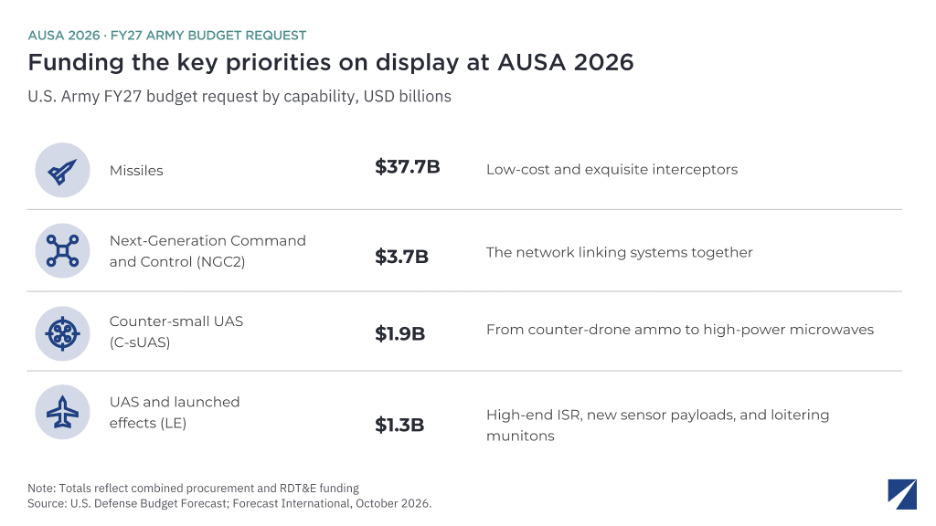
As the autonomy domain flourishes, so too does the need to defeat these types of systems fielded by potential adversaries. AUSA showcased this dynamic with displays of C-UAS capabilities and a range of affordable and exquisite interceptor missiles. The Army's immediate need to replenish depleted munitions stockpiles has only heightened the urgency of finding affordable interceptors that can be produced at scale.
The variety of C-UAS options at AUSA is telling: the Army will rely on many tools to counter drone threats. The Guardian-3 interceptor drone from Powerus is just one example from AUSA that incorporates autonomous flight systems and aims to lower the Army's cost of defeating drones. Directed energy is another critical component of the Army's C-UAS approach, and AUSA showcased everything from AV's LOCUST X3 laser to Epirus' Leonidas high-powered microwave system. At the lower end, vendors like Barrett and Beretta pitched small-arms ammunition and optics for use against small drone threats, making every soldier a potential C-UAS operator.
"We need to fight on a cost curve that's affordable." - Lt. Gen. Frank Lozano, Army Portfolio Acquisition Executive Fires
The push for affordability extended to interceptor missiles, with a range of low-cost options on display, such as Anduril's new Steelfin family of mass-producible missiles. However, this trend hasn't eliminated the need for exquisite solutions. Manufacturers also showcased high-end interceptors like Lockheed Martin's PAC-3 Edge, designed to defeat the most advanced threats.
Connecting these disparate components is the Next Generation Command and Control (NGC2) network, which will serve as the Army's digital backbone. The battlefield network is critical for linking sensors, shooters, drones, and crewed systems.
Ultimately, the Army's goal is to keep pace with technologies and threat environments that are changing faster than ever. "Whoever's behind now is going to fall even further behind," Defense Secretary Pete Hegseth told a crowd at AUSA on October 14. "And so investments now are going to matter, and they're going to ripple not just for years, but for decades across our joint force."
This content is made possible by our sponsor ServiceNow. It is written by Forecast International. It is not written by and does not necessarily reflect the views of Defense One's editorial staff
NEXT STORY: From episodic care to continuous readiness: Reshaping military healthcare