

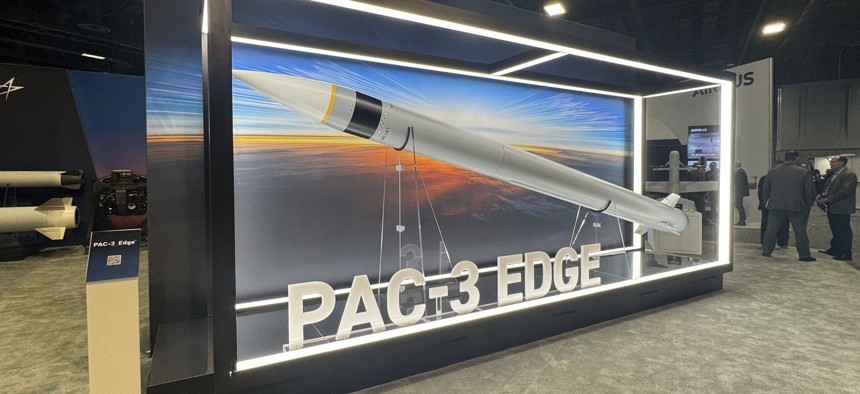
A mockup of a PAC-3 interceptor missile at Lockheed Martin's display at AUSA 2026. Bradley Peniston / Defense One



Army re-evaluating munitions procurement goals as Iran war continues
Buying more Patriot missiles is a top priority, the Army’s fires acquisition boss said.

The Army’s procurement goals for critical munitions could be shifting, officials said Tuesday in a break from the U.S. government’s typical reticence to talk about the enormous expenditure of weapons during the Trump administration's war on Iran.
Increasing annual production of Patriot air defense missiles, particularly the PAC-3 Missile Segment Enhancement, is high on the priority list, Gen. Frank Lozano, the Army’s fires portfolio acquisition executive, said during a panel at the AUSA annual meeting in Washington, D.C.
“Our goal has always been to get to 2,000, and we've had a lot of discussions about even more interceptors,” he said, “but when we start talking about overall missile output and we start looking at numbers—is it 4,000, is it 6,000, is it 8,000—we're looking at a diverse set of capabilities. Because we have to address the threat, and we need to address the threat in a complementary way, meaning we need to fight on a cost curve that's affordable for the U.S. Army to maintain and sustain that warfighting capability abroad.”
Lozano addressed reports of depleted stockpiles by repeating the government’s insistence that all is well.
“We have to win everywhere, and so when you have to win everywhere, you need to really make sure that from a foundational aspect of the joint force, you have enough depth within your magazine, from from a varying perspective of capabilities, that you're able to contribute to that joint fight in a meaningful way,” he said. “I will continue to double down and echo what our department leadership has stated: we have the capabilities we need to have to fight and win, but it's our job to ensure that victory is achievable in the future inside of any dynamic environment, scenario, fight we might find ourselves in.”
The Army is also “looking into” buying PAC-2 Guidance Enhanced Missile-Tactical, he said.
“Should we buy GEM-Ts? Because they're being produced,” Lozano said. “And so, if it's an effector that's available now, and GEM-Ts are a really good missile in the battle space [in which] they operate…so if we have the opportunity, it's probably something we should take advantage of, and we’re looking into doing that.”
The Army’s ability to scale some of these procurement programs will depend on funding from Congress, said Brent Ingraham, the Army’s civilian acquisition chief.
“We are looking every day, depending on where the budget lands, what a top line looks like, whether it's a reconciliation or not,” Ingraham said. “We have prioritized the missions that we truly need, we think about today and the near future…and so, depending on where the budget ends up, we will have to do some work to reprioritize our systems to focus on those key initiatives.”
Help us report on the future of national security. Contact Meghann Myers: mmyers@defenseone.com, meghannmyers.55 on Signal.
NEXT STORY: Cape Canaveral is building up its counter-drone defenses, Space Force says