

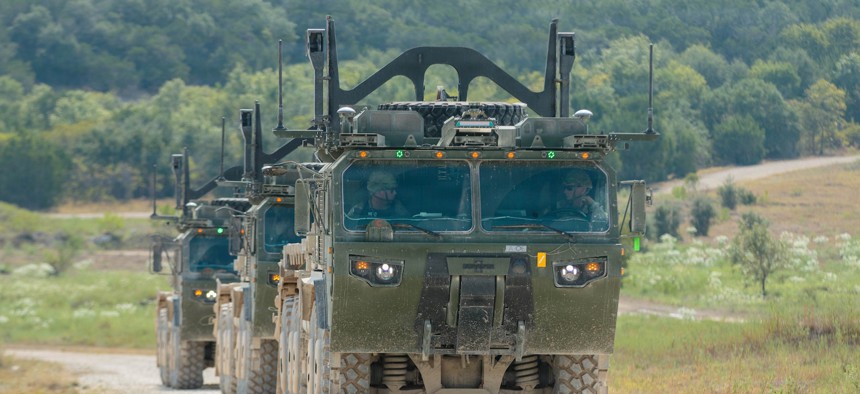
Soldiers demonstrate autonomous Palletized Load System vehicles at Fort Hood, Texas, Sept. 24, 2026. U.S. Army / 1st Lt. Tyler Williams

Army converts Futures and Concepts Command to Futures and Autonomy Command
Officials released more details about its component organization under the Defense Department’s new Autonomous Warfare Command.

When Lt. Gen. Mac McCurry woke up Tuesday morning, he was the commander of the Army’s Futures and Concepts Command. By the afternoon, the service had announced that his outfit will become the recently announced Futures and Autonomy Command.
FASCOM will be the Army’s component organization within the Defense Department’s planned Autonomous Warfare Command, it announced Oct. 1.
“You know, we did decide to keep the patch, because that's honestly one of the hardest things to do,” McCurry said of his command’s uniform insignia, at the AUSA annual meeting in Washington, D.C. “If we can get the patch, we can get autonomy. I haven't ruled out Optimus Prime 6 as my future callsign.”
FASCOM’s commander will also become the Army’s first Portfolio Acquisition Executive for autonomy, with authority over the full procurement effort for autonomous systems.
“We are incorporating autonomous and unmanned systems at every single echelon, across the formation, with the force structure to match, including introducing UAS and robotics military specialties to integrate these technologies at the point of need,” Gen. Christopher LaNeve, the acting Army chief of staff, said Tuesday during a speech at the AUSA annual meeting.
FASCOM will function much the way Army Cyber Command and Army Special Operations Command support U.S. Cyber Command and U.S. Special Operations Command, with an Army mission and force structure that also reports to the joint combatant command.
The point of the larger autonomy project is not to start fully automating existing warfighting functions, said Alex Miller, the Army’s chief technology officer.
Autonomous systems will compile information and help commanders make decision, but there will be “appropriate levels of human judgment” before weapons are fired.
“Things like counter-battery fire, things like air and missile defense, things that happen at a superhuman speed and scale—want to have humans on the loop for decisions, but then we cannot be limited by you know the 20 watts that have up here,” Miller said, pointing to his head. “If we are taking thousands of drones or hundreds of rounds, we can't put that on a human. We want to enable them to be a crew chief for superintelligence and autonomy.”
The service secretaries and Defense Secretary Pete Hegseth are slated to discuss more details about AUTOWARCOM on Wednesday during a panel at the final morning of AUSA’s annual meeting.
Help us report on the future of national security. Contact Meghann Myers: mmyers@defenseone.com, meghannmyers.55 on Signal.
NEXT STORY: Army plans ‘rodeo’ to round up supply-chain problems