

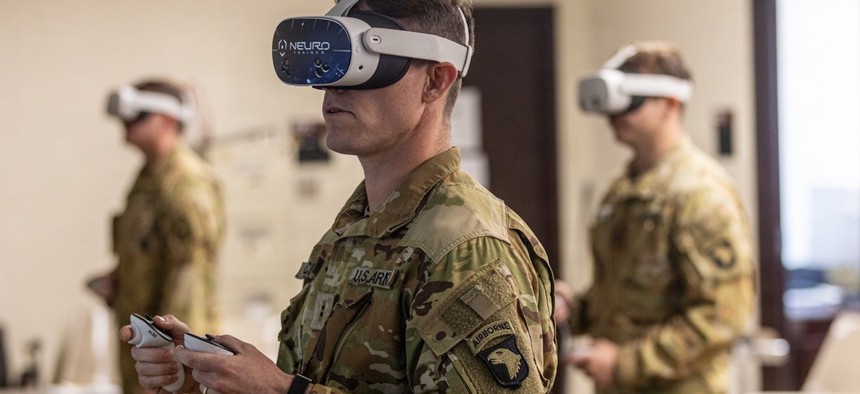
A U.S. soldier uses the NeuroTrainer virtual reality training system during the 101st Combat Aviation Brigade’s 32-week pilot test at Fort Campbell, Kentucky, on Oct. 20, 2026. U.S. Army / Capt. Andrew Lightsey IV

Army pilots are trying virtual reality to stay more alert in flight
The 101st Combat Aviation Brigade is testing the NeuroTrainer as a possible readiness tool for their aviators.

The 101st Combat Aviation Brigade is testing a virtual-reality headset to see if it can make helicopter pilots more alert.
For the next eight months, the unit will incorporate the Oculus-based NeuroTrainer into their flight-training regimen, to measure whether pilots’ reaction times improve.
“In the 101st Combat Aviation Brigade, our pilots operate in unpredictable environments where split-second decisions dictate mission success,” Col. Anthony Marston, the unit’s commander, told Defense One. “By putting our aviators through the targeted exercises using the NeuroTrainer, we want to see if it can measurably improve their processing abilities.”
Pilots will do three headset sessions a week, playing two games for at least six minutes. One game requires them to catch orange balls while dodging projectiles, and the other challenges them to identify a robot teammate outside of their immediate field of view, then swat a ball in that teammate’s direction.
“All the VR-based exercises are designed to challenge and improve reaction time, situational awareness, and quick-decision making,” said Capt. Drew Lightsey, a spokesman for the 101st CAB.
During the initial phase of the program, unit pilots will do a round on the NeuroTrainer and then get in a helicopter simulator to measure their cognition, a news release said.
“It had a little bit of a learning curve to start,” said Chief Warrant Officer 2 Eric Low, a CH-47 Chinook maintenance test pilot. “Once you start to get the hang of it, it felt like a video game. I like how it challenged different aspects of hand-eye coordination and the ability to track multiple objects at the same time.”
The second phase begins at week 15, when 70 pilots will be evaluated on their long-term results.
“Evaluators will consider the speed at which aircrews perform emergency procedures in the simulator and a qualitative assessment asking open-ended survey questions on how participants felt they improved after using the system over time,” Lightsey said.
Down the line, the NeuroTrainer could become a tool for pilots to use on days when they aren’t flying, or for staff pilots who don’t fly frequently but need to keep their skills sharp.
“I think this device could bring awareness to some of the underlying issues affecting our pilots,” said Victor Rodriguez, cognitive performance specialist for the 101st CAB’s Holistic Health and Fitness program. “The performance results could help us recognize when to discuss stress, oversaturation, or emotional regulation with them to help them improve.”
The press release said that similar headset tests are taking place at Navy Fighter Weapons School, Air Force Special Operations Command, and the 75th Ranger Regiment.
NEXT STORY: At last, Army seeing progress in Pacific network