

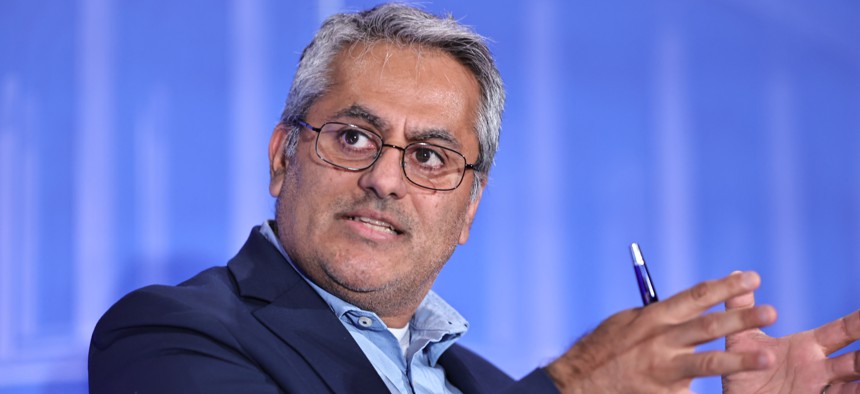
Transportation's senior advisor for AI, Neil Chaudhry, speaks Oct. 14 at the SAP Public Sector Summit in Washington, D.C. Zaid Hamid/Nextgov/FCW

Meet the agency using AI to screen grant applicants for links to potential adversaries
The Transportation Department is deepening its background checks on people and organizations that apply for research grants.

The Department of Transportation has been using artificial intelligence to determine whether grant recipients have ties to adversarial nations, an agency official said on Wednesday.
The federal government has taken a variety of steps in recent years to limit hostile foreign governments’ access to American research, including restricting access to individuals or entities connected with countries like Iran or Russia. As the U.S. seeks to maintain its dominance over China in the global tech race, the Trump administration and Congress in particular have also been tightening the rules on collaborating with organizations or scientists who could conceivably share sensitive technologies or information with Beijing.
It’s not easy, however, for officials or research institutions to unravel these threads, particularly when bad actors are surreptitiously working on behalf of nation states. But new capabilities could help to better chart these connections.
Neil Chaudhry, senior advisor for AI at Transportation, said his agency has worked with partners to create “some really robust AI tools” to analyze the recipients of its research grants.
“When we get to a down-select from grants that are some really promising research projects, we sort of do a deep dive on the [principal investigators] in the grant that says … do they have direct links to the [Chinese Communist Party] leadership, or do they have links to Russian oligarchs?” Chaudhry said during a panel at the SAP Public Sector Summit in Washington, D.C.
“What we don't want to do is go on a fishing expedition,” he said, adding that identifying these kinds of relationships is “not based on the color of their skin and their nationality or something,” but on factors such as whether an individual or entity may be receiving funding from questionable sources.
“If it's a company that's funded by a [venture capital firm] in Silicon Valley, that VC is probably funded by another VC in the Middle East or in Malaysia, and that VC is then wholly funded by the Chinese industrial bank,” Chaudhry said. “And then when that startup goes out of business, we don't know what just happened to that IP that the U.S. government spent money developing.”
Transportation did not respond to a request for comment by the time of publication.
Transportation’s latest AI use-case inventory, which was published earlier this year, does not include the research grant-focused capability. Although other agencies have been using automation or more in-depth analysis tools to identify potential connections to foreign adversaries, Transportation’s use of AI seems to be relatively unique.
A November 2024 report from the Government Accountability Office found that reviewed agencies had taken a variety of steps to comply with federal requirements mandating that they better identify foreign risks in the Small Business Innovation Research and Small Business Technology Transfer programs. GAO noted that the programs, which were created to allow U.S. small businesses to engage in federally funded R&D, “face risks of foreign actors seeking to illicitly acquire federally funded research and technologies.”
The watchdog noted at the time that some agencies — like the Air Force, National Science Foundation and NASA — were taking some steps “either to automate the processing of due diligence disclosure forms or support the vetting of applicants and identify associated risks.”