

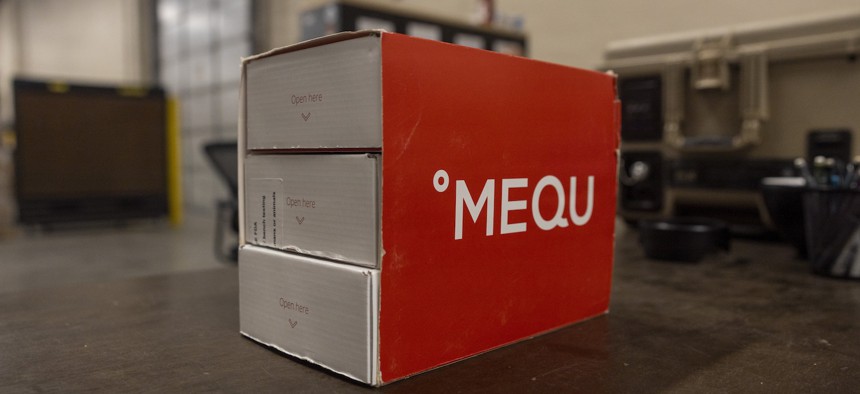
A blood warmer system at Marine Corps Base Camp Lejeune, North Carolina, Oct. 14, 2026. U.S. Marine Corps



Marines fielding new tech for prolonged medical care on the battlefield
Mobile blood refrigeration, ultrasounds, and power generation will keep troops alive beyond the “golden hour.”

The Marine Corps is preparing for a future battlefield on which the injuries are the same but the ability to quickly fly troops to a trauma hospital is very limited. To close that gap, the service is fielding new tech like mobile blood banks and ultrasounds, with a self-contained power source to keep them running.
The Expeditionary Medical Refrigeration Unit and Mobile and the MEQU mobile blood warmer were deployed to U.S. Central Command this year, where a unit set up a continuous mobile blood bank and sent their notes back to the Marine Corps on how to make it better, officials told reporters Friday during a media round table.
“We were told that the EMRU was instrumental to their ability to maintain a revolving blood bank to ensure that they had what they needed to be ready to care for injured service members,” said Navy Cmdr. Kyleigh Hupfl, clinic for Expeditionary Medical Systems.
The concept of the “golden hour,” the critical time period after a casualty that made all the difference in getting a wounded service member from the battlefield to hospital triage during the Global War on Terror, will be much more complicated in a near-peer fight.
While ground fighters could sometimes shoot down a medevac helicopter in Iraq or Afghanistan, an enemy with more sophisticated surveillance and missile technology will mean commanders have to wait to call in evacuations and work to stabilize casualties on site for much longer than in more recent conflicts.
“We're leaving the golden hour behind, and we're moving toward those longer patient-care hold times,” said Col. Paul Gillikin, program manager for Combat Support systems. “Again, fully recognizing the future fight against a peer competitor, over those great distances in the Pacific—we know that we're not going to have the developed [forward operating bases], the full mobility, the Iron Mountain.”
The No. 1 cause of battlefield death is severe bleeding, so being able to not only slow bleeding but give transfusions on site will be crucial.
“We need to be able to bring cold-chain distribution forward without relying on heavy generators, and we need to be able to do that in a sustainable way. We need to be able to warm that blood so that we don't get that patient in a worse-off situation,” Hupfl said. “We need to be able to see, after that, whether they have continued bleeding, so that the commander can make a risk decision on putting an evacuation asset at risk to get that patient out.”
That’s where the battery-powered EMRU and the associated blood warmer come in, as a mobile system that keeps blood products refrigerated, then heats them to body temp for quick transfusions. The Corps is also fielding the KOSMOS point-of-care ultrasound to assess internal bleeding, and the Marine Corps Squad Power Manager medical kit variant to keep them all running.
“We expect in the Marine Corps to be in distributed environments, where the evacuation will be delayed or contested,” said Brig. Gen. Tamara Campbell, deputy commander of Portfolio Acquisition Executive Marine Corps. “And so the equipment that we're looking at is to take that into account, regardless of the time it takes to apply that care. We need to do that at any time so that any of our soldiers, sailors, Marines—anybody that's within our operating environment needs that level of care.”