

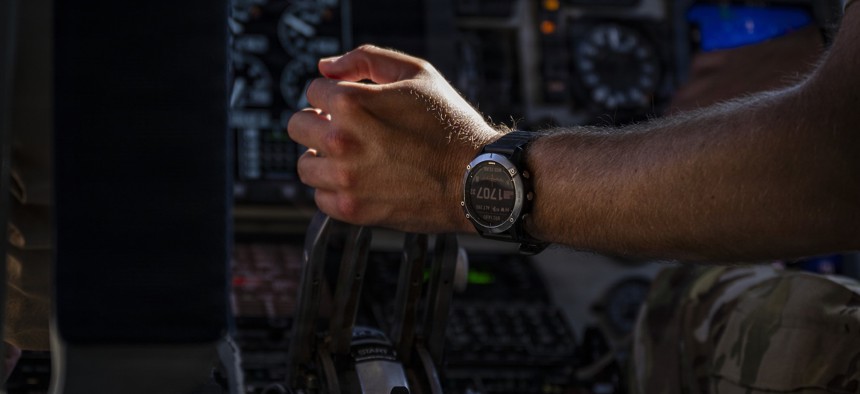
A pilot grips the throttle aboard a U.S. Air Force KC-135 Stratotanker aircraft in the U.S. Central Command area of responsibility July 22, 2026. U.S. Air Force / Senior Airman Adriana Jordan-Alcañiz)


Iran war ‘accelerated’ key tanker connectivity upgrades, top Air Force officials say
Service leaders said increasing battlespace awareness on the KC-135 was paramount.

DAYTON, Ohio—The ongoing war in Iran has pushed Air Force officials to prioritize battlespace awareness upgrades on the service’s tanker fleet, four months after two KC-135s were involved in a deadly crash during Operation Epic Fury.
Top acquisitions officials told reporters Tuesday during the Life Cycle Industry Days conference here that upgrading the KC-135, the newest of which was built more than 60 years ago, was a major priority for the service. In March, two of the tankers were involved in a mishap that did not involve “hostile fire or friendly fire,” according to U.S. Central Command. Six airmen died in the crash.
“We absolutely accelerated [Mobility Air Forces] connectivity because of Operation Epic Fury,” said Col. Paul Tinker, the deputy mobility program acquisition executive. “The MAF is more capable right now than it was, you know, in terms of connectivity, during the start of Epic Fury. We diverted personnel and funding resources to make that happen. It's AMC’s No. 1 priority, and it continues to be their No. 1 priority. We really focused on that for the last couple of months.”
Shortly following the crash, current and former Air Mobility leaders sounded alarms over the lack of battlespace awareness and connectivity onboard the KC-135. In March, Air Mobility Command said “almost half” of the service’s nearly 400 tankers were connected to Link 16, the military’s secure communications network, through a years-long effort known as real-time information in the cockpit, or RTIC. The service has made progress in just a few months.
While exact figures weren’t provided, “the majority of the KC-135 fleet is currently equipped with RTIC,” an Air Mobility Command spokesperson told Defense One in an emailed statement Wednesday.
After the deadly crash, former air mobility commanders told Defense One that KC-135s have standard radios that can provide some encrypted communications and a Traffic Alert and Collision Avoidance System, or TCAS, a transponder meant to prevent mid-air collisions. In chaotic combat zones, crews may decide to go without those systems and rely on visual separation instead.
The Air Force said increasing the amount of information KC-135 crews can have in the cockpit is a crucial safety upgrade, according to a January Congressional Research Service report.
“According to the Air Force, the tankers' ability to access tactical data links could increase mission success in contested environments by improving survivability, agility, and situational awareness for command-and-control elements and aircrews,” the report said. “The connectivity could provide aircrews with such information as potential threats, fuel availability, and safer landing sites. In addition, tanker aircraft could serve as a backup information conduit for other aircraft in a degraded communications environment.”
Col. Melvin Baylon, the Legacy Tankers Division’s senior materiel leader, told reporters the acquisitions arm has been working with Air Mobility Command on several upgrades, including increased access to Link 16.
“If you would’ve asked me just a few short years ago that we would’ve been integrating as much capability as we are onto the KC-135 platform, I would’ve said there would’ve been no chance,” Baylon said. “The end state is to make sure that we increase battlespace awareness.”