

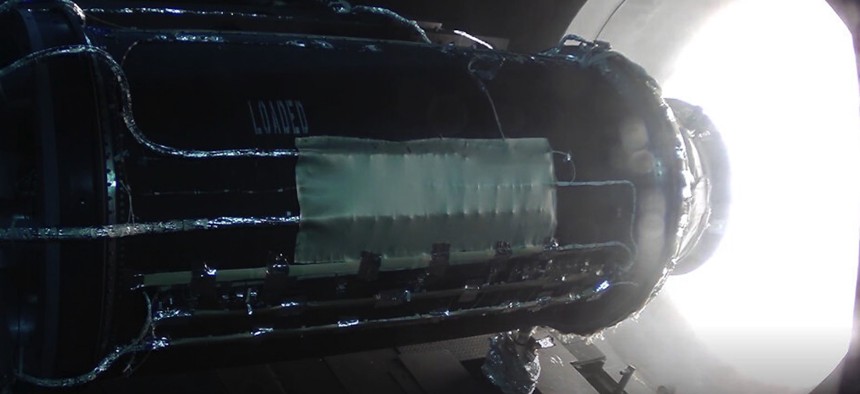
The rocket motor built by L3Harris Technologies for Lockheed Martin's Next Generation Interceptor undergoes a static test-firing. L3Harris Technologies



ICBM killer passes two key tests ahead of design review, Lockheed says
The company’s Next Generation Interceptor had an 18-month delay for motor problems.

HUNTSVILLE, Ala.— Lockheed Martin’s new ICBM killer, ordered two years ago to supersede the oft-troubled GMD interceptor, hit two major milestones this week and is expected to clear the design phase later this year, company officials said.
The company said last week that its L3Harris Technologies L3Harris Technologies, or NGI, had completed a critical burst test of its second-stage motor case. On Monday, ahead of the Space and Missile Defense Symposium here, Lockheed Martin announced that they had successfully fired its stage 2 rocket motor in a static test. Company officials said NGI, ordered under the Biden administration to replace the nation’s Ground-Based Midcourse Defense System, should clear the critical design review, or CDR, phase by the end of this year.
“These milestones are major steps toward our path to CDR, confirming our utmost confidence that NGI will meet the demanding performance envelope on track for fielding by 2030,” Christopher Jewell, Lockheed Martin’s NGI vice president, told reporters on Monday evening.
In 2024, the Missile Defense Agency awarded Lockheed Martin an $18 billion contract to design and build the Next Generation Interceptor. This April, MDA director Gen. Heath Collins told lawmakers the program fell behind schedule by 18 months due to several technical problems, but that it still remained on track to pass the design review in 2026.
“We are, as we transition into manufacturing, identifying and finding some issues with some of these new systems -- the solid rocket motor, the inertia measurement movement, as well as some in the sensors,” Collins said during an April 30 Senate Armed Services Committee hearing. “And we are working to buy down those risks and move forward as quickly as possible to make sure we pull the day as far to the left as possible.
The Government Accountability Office’s 2026 weapons system assessment did not include information on the Next Generation Interceptor “due to the lack of long-term cost and schedule baselines, which we could use to measure progress.”
NGI is slated to be part of the Trump administration's sprawling Golden Dome defense system.
This week’s Space and Missile Defense Symposium will likely see more discussion of Golden Dome than last year’s conference, when officials were ordered not to talk about it amid a general crackdown on public discussion by Defense Secretary Pete Hegseth. On Tuesday, Gen. Michael Guetlein, the Golden Dome director, is scheduled to update attendees on the program’s progress.
Collins told lawmakers in April that he, Guetlein, and U.S. Northern Command leader Gen. Gregory Guillot frequently discuss the role that NGI will play in the military’s defense strategy.
“Gen. Guillot, Gen. Guetlein, and I are regularly talking about Next-Gen Interceptor and the important part it plays in the layered defense of our homeland,” Collins told lawmakers.