

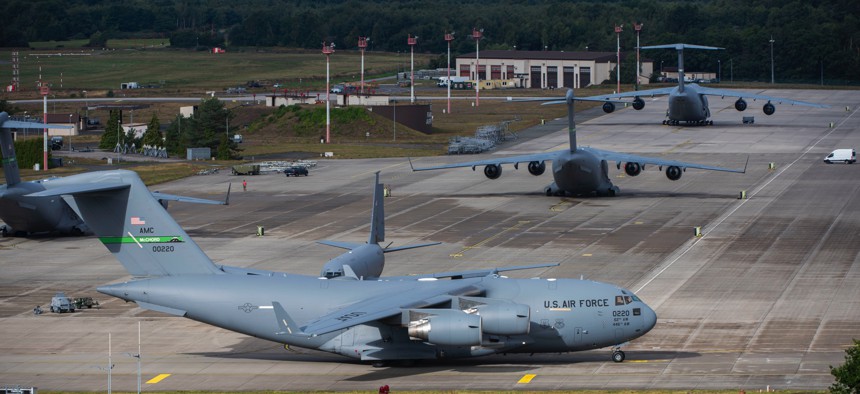
A C-17 Globemaster III aircraft taxis at Ramstein Air Base, Germany, on Sept. 3, 2025. U.S. Air Force / Senior Airman Sabrina Fuller-Judd

The wrong way to review US force posture in Europe
Loyalty tests don’t build loyalty. They erode it.
Bloomberg recently reported that the Trump administration will consider European countries’ ideological positions and support for U.S. policies as part of the European posture review that is currently underway. Whether a country has supported the 2026 Iran War, placed recent restrictions on U.S. forces based in their country, or “publicly opposed” regulations that constrain U.S. business in Europe will all be factors in determining where and how many forces remain stationed in Europe. These loyalty tests depart from decades of established practices of evaluating and adjusting U.S. force posture, are likely to backfire, and above all, could leave America less safe.
The U.S. military’s ability to find, fix, and finish practically any target around the world is built on its global military posture. No other country has ever had such varied and dispersed capabilities, all enabled by an unparalleled network of allies and partners. The importance of our overseas posture leads many new administrations to look at whether troop levels, capabilities, and locations match the most recent threat assessments.
So when Secretary Hegseth announced a European posture review in June, neither of the authors was particularly surprised. When we served in the Obama and Biden administrations, both of us were involved in these types of major posture decisions from different perches, including inside the Pentagon, the White House, and at the U.S. Mission to NATO. We consider such reviews to be wise—but only when their purpose and scope are clearly defined and when the results are based not on politics but on the advice of our top civilian and military leaders.
Unfortunately, that doesn’t appear to be where the Trump administration is starting. By making a list of pass/fail questions about a country’s overarching loyalty to the United States—which has never been a condition of NATO membership—the Pentagon is conflating ideological fealty with costly and consequential questions about the future of U.S. defense policy.
In our experience, useful posture reviews start by evaluating what the U.S. needs to meet the contingencies it may face now and in the future. Instead of measuring allies’ loyalty, the administration should answer four key questions.
First, how might the Russia-Ukraine war end and what will follow? Despite a campaign promise to end it within 24 hours, the war shows no signs of stopping. Even more concerning, over the last year, Russia has increasingly tested NATO unity with airspace violations, cyber attacks, and sabotage operations. If the U.S. makes drastic posture changes, Russia might conclude that Washington is signaling disinterest in European security. An emboldened Moscow might choose to act against NATO territory.
Second, what types of global dependencies will exist in the coming three to five years? U.S. forces in Europe are often deployed to the Middle East and Africa, so this review must consider contingencies outside the Euro-Atlantic area. Recall that U.S. forces in Europe helped enable last summer’s 12-day war and Operation Midnight Hammer against Iranian nuclear facilities, and that they have been crucial for generating forces in the current 2026 war against Iran. AFRICOM’s headquarters has been located in Europe since the combatant command was created nearly two decades ago. The tyranny of distance across the African continent, coupled with the smaller U.S. posture there since the 2023 Niger coup, only further highlights the operational relevance of European posture for Africa.
Third, how do we expect European capabilities to evolve? Europeans are spending substantially more on defense than they have in decades, a shift that was turbocharged by Russia’s full-scale invasion of Ukraine in 2022. However, it will be another five to ten years before they can provide for their own security. The United States must take Europe’s growing defense arsenal into consideration without leaving the continent exposed. At a minimum, and for the foreseeable future, the United States will likely need to leave in Europe strategic enablers such as lift, refueling, and long-range strike platforms; intelligence, surveillance, and reconnaissance capabilities; and command-and-control infrastructure. Nuclear forces will need to be part of that mix as well.
Finally, beyond geopolitics, the Pentagon will face a series of age-old questions about basing that influence recruitment, retention, and the overall readiness of the force. Chief among them: is rotational or permanent stationing a better fit for today’s security environment and the health of the force? Rotational forces are often more costly and can be harder on troops since these tours are traditionally unaccompanied.
Posture reviews are extraordinarily complicated because they require predicting future requirements and weighing those requirements against the competing needs of multiple regional commanders. Such reviews can also damage our important, and increasingly fragile, relationships with allies if not handled with deft and delicate diplomacy. It’s rare to get it just right.
The worst thing the United States could do right now is to base this important posture review on which allies have backed U.S. foreign policy—especially as being an ally of the United States has never required blind loyalty. Allies are already reacting to the leaked questionnaire and pushing back.
Loyalty tests don’t build loyalty. They erode it.
Mara Karlin served as Assistant Secretary of Defense for Strategy, Plans, and Capabilities and is a senior fellow at The Brookings Institution. Julianne Smith served as U.S. Permanent Representative to NATO from 2021 to 2024 and is a Distinguished Nonresident Fellow in Defense and Security at the Chicago Council for Global Affairs.
NEXT STORY: CMMC Works. Now let’s sharpen it.