

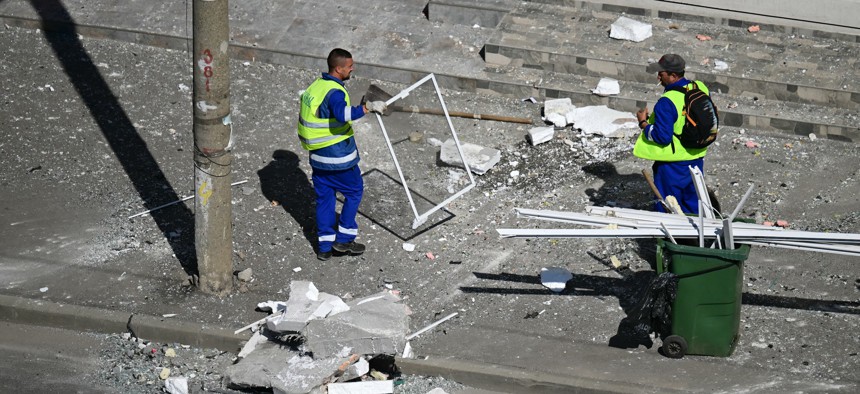
Municipal workers clear debris after a Russian drone struck an apartment building in Galati, Romania, a member of NATO, on May 29, 2026. Daniel MIHAILESCU / AFP via Getty Images


Russia has moved past ‘hybrid war.’ Why hasn’t Washington?
Europe is adapting to Moscow’s increasingly brazen and kinetic operations. The US should catch up.
On a recent September afternoon, David Petraeus, the former CIA director, was heading home by train from a security conference in Kyiv. What should have been a routine trip into Poland was upended when the state railway, Ukrzaliznytsia, ordered passengers off the train. Fifteen minutes later, Russian drones were heard overhead, and the train was struck shortly after the last passengers had been evacuated.
The attack is just one of the indications that Russia’s decades-long campaign against the West has outgrown the label of “hybrid war.” While Moscow’s efforts remain below the threshold of open war, they have grown more brazen and kinetic. And while European allies are moving quickly to counter Russia’s escalation, the United States lags behind.
The past few months have seen a striking number of Russian operations against Europe and a sharp change in tactics towards the United States. In August, a Russian drone carrying explosives struck the wing of a Ukrainian cargo plane at Germany’s Leipzig airport, a hub for NATO airlift to the eastern flank; the attack only failed due to a faulty detonator. That was just the most recent incursion into alliance airspace by Russian drones and even jets; IISS has tracked more than 100 confirmed or suspected incursions, including an explosive-laden drone shot down over Lithuania to a drone that struck an apartment building in Romania.
Of the train incident, Ukrzaliznytsia officials have said it was “entirely possible” that the drone had missed its intended target: a diplomatic train carrying two former prime ministers, Sweden’s Carl Bildt and the UK’s Boris Johnson, which had departed from Kyiv earlier than planned. Whether Petraeus was the intended target is irrelevant. The strike was a close call; injuring or killing a former U.S. official would have marked a sharp and reckless escalation in U.S.-Russian relations. This incident nevertheless reflects the Kremlin’s growing comfort with operations that put senior U.S. figures at risk.
Just days after that, the U.S. Justice Department announced a striking indictment that underscored how far the Kremlin’s escalation against the United States has gone. It charged five people connected to Russian intelligence with conspiracy to finance terrorism, and three of them with conspiracy to commit murder for hire. The network allegedly recruited people inside the United States to surveil and ultimately “eliminate” or “disappear” critics of Russia’s war in Ukraine. In one alleged plot, the network sought to have a Russian dissident killed on U.S. soil. Dozens of such plots have been uncovered in Europe but they have remained rare in the United States. This one places Russia alongside Iran, which has repeatedly plotted to kidnap or kill dissidents and former officials on American soil
Analysts have long believed that the Kremlin has sought to maintain deniability, plausible or implausible, when it moves against the West. Plausible deniability refers to a state’s ability to disclaim responsibility because the evidence is too ambiguous to act upon; implausible deniability refers to a state’s denial when attribution is obvious, often a way to signal with only a veneer of “escalation control” or aimed at its domestic audiences such as Russian-speaking communities rather than the targeted government. Yet the bold, sometimes sloppy character of the past year’s operations suggests the Kremlin is increasingly willing to forgo even that to continue to intimidate foreign governments and their citizens and to gather military intelligence. As the war in Ukraine has dragged on, economic pressure on the Kremlin has mounted, and Moscow appears to have entered a new phase in its conflict with the West. Raising the costs of Western support outweighs the value of deniability. At that point, these are no longer hybrid operations, but overt external operations.
European allies, for their part, have begun to escalate their own responses, even as diplomats and officials continue to describe the Russian threat as hybrid. Rather than simply announcing when a Russian drone or ship enters NATO territory, or summoning Russian diplomats, governments across Europe have begun shooting down drones and responding militarily. In late September, Poland’s Deputy Defense Minister Cezary Tomczyk announced that Polish fighter jets would no longer need visual confirmation from a pilot before downing a Russian drone; radar-based “positive identification” would now suffice.
The United States, by contrast, continues to treat the Russian threat as largely latent. To be fair, Russia’s tactics on the European continent remain more brazen and kinetic than those it employs against the United States. But Washington’s NATO commitments alone make Russia’s campaign against Europe an American concern, and Moscow is now escalating against the United States directly as well. If the pattern observed in Europe holds, its operations against the U.S. will grow only more brazen and openly hostile. While some U.S. agencies may recognize the rising threat, as the DOJ’s unsealing of charges against the Russian network and CIA Director John Ratcliffe’s August visit to Moscow could demonstrate, Washington still remains divided on how to classify it, and much of that division stems from the White House itself.
Messaging from the White House over the past month alone is mixed. On Sept. 15, Attorney General Todd Blanche stood in the White House Rose Garden to announce charges against a Russian intelligence network accused of plotting to murder a dissident in the Washington area. Eight days later, the administration invited Vladimir Putin to the G20 summit in Miami. The same month, President Trump signed the most significant Russia sanctions legislation since 2017, only for his administration to reportedly weigh sanctions relief days later.
The administration may view engagement with Russia as necessary to broker an end to the war in Ukraine, but these mixed signals leave agencies without a clear mandate and Russia without a clear message to de-escalate. Treating the Russian threat for what it is requires messaging from the top. A plot by Russian intelligence to commit murder on U.S. soil is a significant escalation, and it demands a clear response. Until Washington decides how it should view the threat from Russia, and respond accordingly, Moscow will continue to escalate until it finds a red line.
This commentary is published in coordination with the 2026 Global Security Forum, of which Defense One is a media partner.
Nikkie Lyubarsky is a Research Associate at The Soufan Center.