

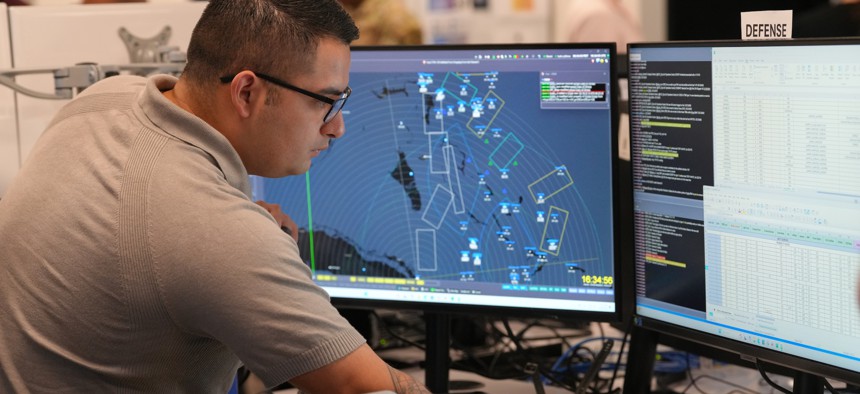
A U.S. Air Force air battle manager participates in an Air Force experiment at the 805th Combat Training Squadron’s unclassified location in downtown Las Vegas, Nev., on July 29, 2025. U.S. Air Force / Deb Henley
New bill aims to regulate military uses of AI
Sen. Kirsten Gillibrand also wants to establish a clear chain of human accountability for AI on the battlefield.

A new bill would restrict the Pentagon’s use of AI in operations and heavily regulate its use on fully-autonomous weapons, for domestic surveillance, and with nuclear weapons.
Sen. Kirsten Gillibrand, D-N.Y., announced “The Secure and Accountable Military AI Act” on Tuesday. Other lawmakers have not joined the legislation, and her office confirmed she plans to offer elements of the bill as amendments to the Senate’s version of the National Defense Authorization Act.
“Right now, the Pentagon is moving toward deploying incredibly powerful AI technology without commonsense guardrails in place, which could have catastrophic consequences that make all of us less safe,” Gillibrand said in an emailed statement. “We must act now – not to stifle technological progress, but to establish clear rules of the road that keep humans in charge and keep AI’s use in warfare smart and safe.”
NOTUS reported Tuesday that Sen. Elise Slotkin, D-Mich., plans to tuck a similar AI-guardrails bill, introduced earlier this year, into the NDAA. The Senate Armed Service Committee is slated to mark up the annual defense policy bill next week.
Americans' distrust in AI remains high compared to other countries, which experts have said could have national-security implications. The bill follows the Defense Department quarrels with Anthropic earlier this year centered around the company’s objections to the potential use of its technology.
The same day Gillibrand proposed the safeguards, President Donald Trump signed an executive order calling for AI to be “deployed rapidly to confront any and all threats” to the United States.
“The United States continues to lead the world in Artificial Intelligence (AI) because of the enormous talent and innovation of our AI industry, and because we refuse to stifle this innovation with overly burdensome regulation,” Trump’s executive order said.
Gillibrand is asking Defense Secretary Pete Hegseth to designate specific AI uses, such as nuclear missions, lethal targeting, domestic surveillance, and cyber as “high consequence,” which would require written approval from an undersecretary or the Joint Chiefs vice chairman, according to a summary of the bill. The senator is also requesting a 15-day notification to Congressional defense committees before using AI for those operations, or 48 hours after its deployment in certain circumstances.
The bill also asks the Pentagon to make it clear who the accountable human decision-maker is or what accountability chain exists for AI-guided technology use during high-consequence operations.
Gillibrand wants to hold frontier AI companies more accountable, too.
The bill asks for AI contractors to rapidly report certain incidents to the Pentagon “including theft of model weights or data poisoning,” according to a summary from the senator’s office. The Defense Department would need to be notified within three days for security breaches and seven days for concerning model behavior, if the provision becomes law.
Becca Wasser, the defense lead for Bloomberg Economics, said setting forth guidelines will help AI companies focus on the best use cases, and set clear standards for future operations.
“In some ways it's not novel, but it is codifying things in many respects that have been long-standing norms, and now, as technology is maturating, as some of these private AI companies are becoming more and more enmeshed with the Pentagon, it is putting down on paper some of the core use cases for AI, and putting some potential stop gap measures in place,” Wasser said. “I think it might be a check on the Pentagon's full embrace of AI and private companies to ensure that when AI is used in current military operations, it is used in a responsible and professional way.”