

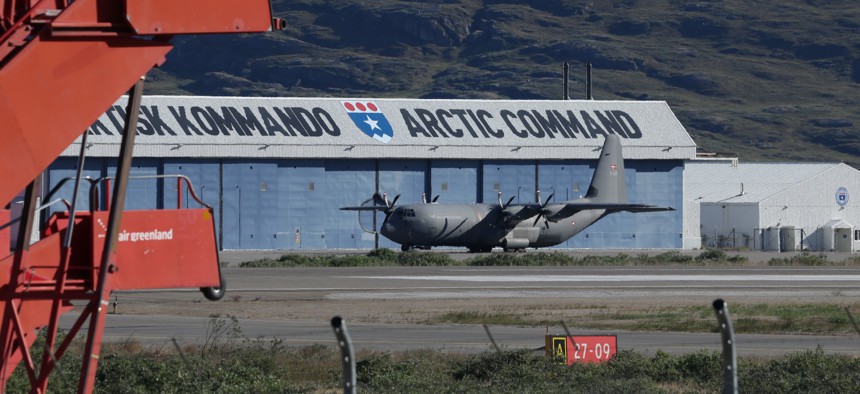
A Royal Danish Air Force transport plane stands on the tarmac next to a hangar of the Joint Arctic Command on July 14, 2026, in Kangerlussuaq, Greenland. Sean Gallup/Getty Images


Pentagon to start expanding Greenland bases next year: official
The U.S. is looking at upgrades to support cargo, fighter aircraft, and more troops.

The Pentagon is spending the winter evaluating options for expanding U.S. basing in Greenland, according to a senior defense official, with an eye toward breaking ground on new facilities next year.
The Trump administration announced in September that military outposts at Mestersvig and Narsarsuaq would become U.S. bases, while expanding the existing U.S. footprint at Pituffik Space Base.
“Right now we're in a planning cycle because we're going to run out of execution window, from a weather perspective, to do anything almost immediately,” a senior defense official told reporters at a Tuesday event hosted by the Project on Media and National Security. The official spoke on background because they were not authorized to speak publicly about the plans.
The moves come nearly two years after President Donald Trump, who had sought to purchase the independently-governed Danish territory in his first term, began suggesting that the United States might seize Greenland by force. In January, Trump sought to force a sale with threats to invade the island and impose punitive tariffs on Denmark and other NATO allies. Instead, he settled for expanding a 1951 treaty that allows the U.S. to base forces in Greenland.
Mestersvig, to start, has a 6,000-foot gravel runway, the official said, and has primarily hosted special operations forces.
“And so, as we talk with the teams…what are the options that you need on the northeastern side or on the eastern side of Greenland? What kind of capabilities? What do you want that to do? So we're having that conversation back and forth there,” the official said.
For Narsarsuag in the south, they’re looking at what kinds of upgrades the runway needs to support modern U.S. aircraft.
“So if it's capable of putting in C-130s, great. If I needed to put fighter aircraft in there for some reason…what would that take? How would I expand it?” the official said.
At this point, the official added, the Pentagon is looking less at housing specific capabilities and looking first at what’s even possible, both for equipment and for people.
“If I needed to create a capability and I needed to put people into a location for a period of time, what do I need to think about? I need to think about lodging, I need to think about food. I need to think about energy,” the official said. “So it's all of those types of things, not necessarily a, ‘Hey, I want to station this there right now.’ That's not where we're at in that conversation. We're more in the, ‘that location has this,’ and to the degree that I can do that by making strategic investments, that's smart.”