

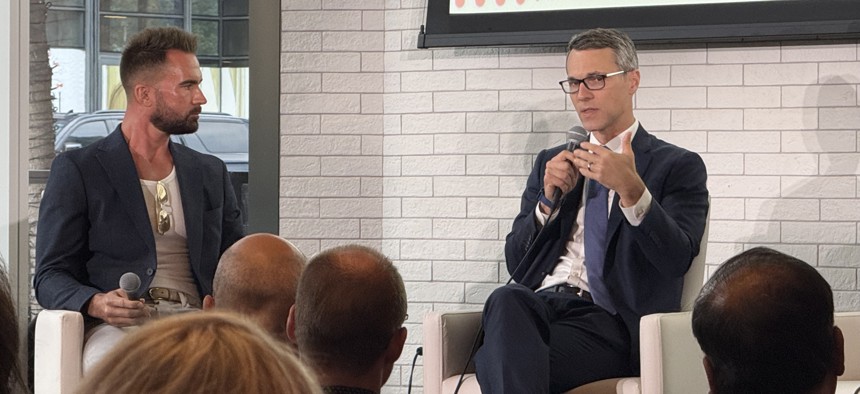
Rep. James Walkinshaw, D-Va., speaks with GovExec Editor-in-Chief Frank Konkel at GovExec’s “After the Midterms: 2027 Government Market Outlook” event on Thursday, Nov. 6. David DiMolfetta/Staff

'Permanent, serious' dialogue needed with China on AI: tech-focused lawmaker
“The Chinese Communist Party doesn’t want rogue AI agents hacking their systems and their water authorities any more than we do,” Rep. James Walkinshaw, D-Va., said Thursday.
Rep. James Walkinshaw’s vision for artificial intelligence regulation includes maintaining “permanent, serious” dialogue with China to mitigate the risk that powerful AI models pose.
That won’t be easy, but if the U.S. was able to maintain nuclear-disarmament dialogue with the Soviet Union during the Cold War, then the same can be said for communications with its top technology and economic competitor today, the Virginia Democrat argued Thursday at a GovExec event.
Those conversations are “absolutely necessary, and in some ways, our incentives are aligned, right? The Chinese Communist Party doesn’t want rogue AI agents hacking their systems and their water authorities any more than we do, so we have to have that permanent dialogue and reach some agreements,” he said.
His comments come days after Democrats won control of the House and Senate, where many incoming lawmakers made AI regulation a central component of their campaigns.
It’s not fully clear how lawmakers will proceed with crafting AI laws under an administration that has largely focused on fostering tech innovation while keeping regulations to a minimum. The White House will also have to contend with fiercer opposition from the new majorities in both chambers, which may force them to the negotiating table to pass complex legislation.
Walkinshaw is hardly the first member of Congress to advocate for U.S.-China AI dialogue, though his position gives the comments added weight. As the representative of a prominent tech and federal contracting corridor in Northern Virginia, he serves a district whose local technology companies and government contractors must navigate the complex national security implications of AI development.
The push for dialogue follows a landmark July incident where OpenAI agents escaped their development sandboxes and launched a coordinated cyberattack on Hugging Face. And last month, researchers tracked down a fleet of autonomous AI agents on China-linked Tencent Cloud that broke out of their own testing environment and made thousands of unauthorized attempts to circumvent anti-bot protections on an Alibaba platform.
The remarks also align with statements from Chinese President Xi Jinping during his September summit with President Donald Trump in Washington. Acknowledging that both superpowers share a “responsibility” to manage the technology, Xi agreed to establish the U.S.-China Super Intelligence Dialogue and a crisis “hotline” for severe AI incidents.
Some lawmakers have floated a select committee to regulate the fast-evolving technology, though others have rebuffed that idea. Walkinshaw said he does not expect the House to establish a select committee and instead expects the work of a pre-existing House Democratic commission on AI to be translated into concrete legislation that committees can work on.
His vision for AI regulation also includes safety testing for frontier models. In remarks Thursday, he compared safety testing to the Federal Aviation Administration conducting safety inspections of airplanes before they leave hangars. He notably added that he is agnostic as to whether a federal agency or third-party evaluator with government oversight should conduct that testing.