

sponsor content What's this?




From Data to Dominance: Building the Architecture of Decision Superiority
The technologies transforming global logistics are rapidly accelerating how the Department of War must think about and achieve speed, scale, and decision superiority in contested logistics.
Presented by
D&G Solutions

Presented by
D&G Solutions
Author: Leah Sanders, D&G Solutions CEO
Contributing Author: Mark Bennett, Senior Advisor to D&G Solutions
The New Infrastructure of Power
Across global supply chains, the systems that track trucks, ships, and pallets have become the new infrastructure of power, an invisible network that now underpins economic and strategic strength. What once signaled industrial might — steel, fuel, and factories — has shifted toward data, algorithms, and the ability to act on information before anyone else.
This transformation is no longer theoretical; in global logistics, it’s already here. The brains of modern supply chains—enterprise resource planning (ERP) platforms such as SAP and Oracle—integrate forecasting, procurement, compliance, and inventory management into a single decision fabric. Beneath them, real-time visibility platforms like Project44 and FourKites serve as the eyes of supply chains, transforming fragmented shipment data into a unified, live picture of global movement.
Just as the human body depends on coordination between its brain and eyes, global logistics has built a digital nervous system that links sensing, thinking, and acting across its enterprise.
The Department of War must now build its own, and confront the greatest obstacle of all: us.
Tackling the Greatest Obstacle: Us
By the late 2010s, predictive algorithms were already flagging disruptions and forecasting delivery times faster than any human could respond; but every alert still paused for a human judgement. The 2020 pandemic exposed the bottleneck at scale, forcing companies to automate decisions amid uncertainty and pushing AI from limited applications to full-scale deployment. In response, advances in compute power, driven by Nvidia’s GPUs and new AI frameworks, enabled systems to process and act on data in real time. Then, in 2022, OpenAI’s ChatGPT accelerated the shift from AI as a tool to an agent, ushering in a new era defined by autonomous decision-making.
“We are at the iPhone moment of AI,” said Jensen Huang, CEO of NVIDIA. Artificial intelligence is collapsing the distance between sensing and acting, and for the first time, logistics systems are beginning to anticipate and respond on their own. Companies like Project44 and FourKites are training AI engines to forecast delivery times, detect anomalies, and recommend corrective actions before disruptions cascade through the network. ERP giants are also infusing AI into their core architectures. For example, SAP’s Joule integrates conversational and generative-AI capabilities directly into its S/4HANA cloud applications. Across these systems, the distance between data and decision (once measured in days) is collapsing to seconds. This is more than a commercial milestone; it’s an operational blueprint.
The Defense Parallel
The Department of War is already moving in this direction, but largely in isolated pockets. Today, it’s purchasing piecemeal platforms and building solutions that deliver localized success. As Secretary Pete Hegseth emphasized in his November address on acquisition reform: “Starting today, we will now manage our defense sales enterprise with a single integrated vision, from initial planning to contract execution to delivery.” Hegseth’s critique underscores a deeper truth; the Department lacks connective tissue.
Fragmentation breeds delay. Each program becomes a self-contained island of progress, optimized for compliance rather than mission speed.
Beyond Piecemeal Progress
The blueprint for decision superiority already exists. Commercial systems have proven that integrating sensing, data, and decision-making architectures yields exponential speed and resilience. But for the Department of War, success depends on building an architecture that mirrors how it fights and decides.
Portions of the Department are already showing what’s possible. Federated data fabrics built on platforms such as Palantir and IBM watsonx.ai are beginning to connect disparate command, control, and logistics systems — enabling real-time coordination while maintaining data security. What’s missing is scale, consistency, and a unified framework to make these successes repeatable across the enterprise.
The Architecture: A System Built to Think
This architecture below forms the operational backbone of how next-generation defense logistics must function. In this model, humans define intent and authority, while AI manages scale and tempo. Data moves securely, decisions propagate instantly, and the enterprise synchronizes itself around mission outcomes. This is not science fiction; it’s how the most advanced commercial logistics systems already operate.
Think of the architecture as a living water system. A Federated Fabric builds pipes that connect and carry information. Large Language Model (LLM) Orchestration filters, secures, and purifies what flows through them. Virtual Tables act as faucets, delivering precisely what decision-makers need. Verification governs the entire network as the water authority, ensuring trust and control. This architecture isn’t just technical plumbing; it’s the doctrine of decision dominance.
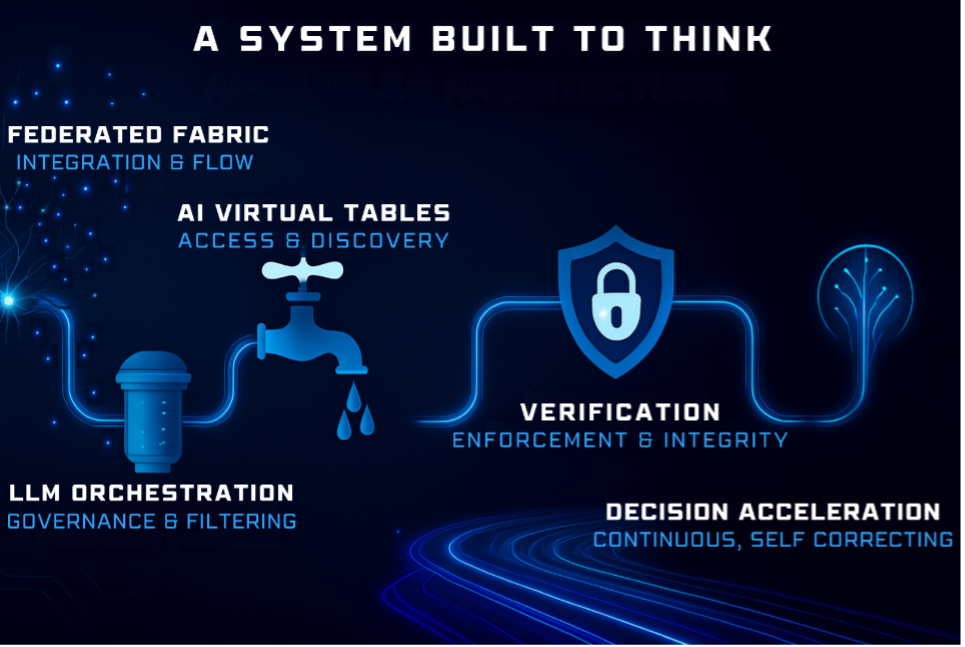
Together, these layers create a system that can think, adapt, and act in motion. Each exists today in partial form, but until they are connected, modernization will remain a patchwork of pilots and isolated victories.
Federated Fabric:
The Department of War’s data spans hundreds of systems and classification levels, making centralization impractical. Too much time is lost reconciling versions, permissions, and write-back requirements across domains. A federated fabric connects these silos through policy-controlled exchanges and event streams. Each node retains custody of its data but exposes standardized feeds through platforms such as Apache Kafka or AWS Kinesis. Linked together, these streams create live operational awareness and enable collaboration across domains — the connective tissue the Department currently lacks.
LLM Orchestration:
Before AI can think, it needs order. Within Impact Level–cleared environments (IL4–IL6), governance tools enforce attribute-based access controls, tagging, and automated classification while detecting schema drift and validating data quality at the source. Once this foundation is in place, LLM agents can sustain data integrity, enforce policy compliance, and preserve interoperability in real time. Without this orchestration, the Department will struggle with stale, inconsistent data quality. And AI will always be limited by the quality of what it consumes.
AI Virtual Tables:
AI-generated virtual tables create a unified, logical view across distributed systems without moving the data itself. Using semantic mapping and federated query translation, LLMs can interpret user intent and route queries across live sources. Versions of this capability already exist in platforms like the Palantir Platform (e.g., Foundry), providing secure, real-time access to authoritative data under local control.
Verification:
Role- and Attribute-Based Access Controls protect data while maintaining secure interoperability. Every transaction is logged, ensuring full visibility into data origin and state. With that foundation in place, the next step is scale and autonomy. To move beyond pilots, the Department must enable bidirectional writebacks, allowing validated AI outputs to update core systems automatically. This eliminates manual corrections, ensures insights are reflected instantly, and creates a self-synchronizing environment where security and speed reinforce each other.
Decision Acceleration:
The final challenge is turning insight into action. This layer connects the data fabric to operations, where AI simulates outcomes and recommends next steps. Humans lead, AI executes within guardrails, and together they move at the speed of mission.
The Call to Action: Data to Dominance
The Department of War doesn’t need to invent this architecture from scratch. The blueprint exists; the challenge is scale. To seize decision superiority, the Department must link proven systems, mandate interoperability, and modernize policy at the same pace as technology itself.
Without that integration, modernization will remain a patchwork of pilots and isolated victories. With it, the Department can move from reactive coordination to predictive and prescriptive decision-making.
In this new era, power belongs not to those who hold the most data, but to those whose systems can think, decide, and act before anyone else moves.
About the Authors: Leah is the CEO of D&G Solutions. She focuses on the nexus of defense supply chains, data architecture, and decision automation. Leah was joined in this work by Mark Bennett, Senior Advisor to D&G Solutions, specializing in defense data integration and applied AI for logistics and operational decision-making.
leah.sanders@dngsolutions.com
This content is made possible by our sponsor D&G Solutions; it is not written by and does not necessarily reflect the views of Defense One’s editorial staff.
NEXT STORY: GovExec TV: Five Questions with Maximus' Duncan McCaskill