

sponsor content What's this?
Autonomy at the Tactical Edge: A Booz Allen + Shield AI Interview
Presented by
Booz Allen
Presented by
Booz Allen
Defense tech partnerships—like the one between Booz Allen and Shield AI—are a key focus amid a change in customer priorities. “The whole world is under pivot,” Andrea Inserra, president of Booz Allen’s global defense business, said in a recent interview with Defense One. “[E]verything is changing…and I think there's goodness to that.”
Below, we dive deeper into how one Booz Allen partnership is deploying technology for real-world defense missions. This interview was originally published in Velocity, Booz Allen’s premier publication for insights and thought leadership on technology and innovation.
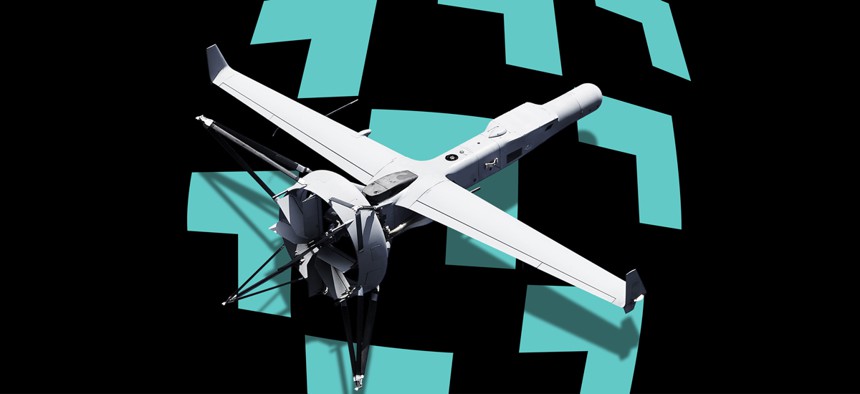
In 2015, Brandon Tseng founded Shield AI with a singular mission: protect service members and civilians with AI-powered autonomy. Shield AI is building the world’s best AI pilot: one that enables unmanned systems to operate without GPS, communications, or a remote pilot.
Partnering with Booz Allen, Shield AI helps the U.S. field the intelligent mass needed to compete with peer adversaries. Read on for an excerpt of a conversation in which Randy Yamada, Ph.D., Booz Allen’s vice president for autonomy, interviews Brandon Tseng, Shield AI co-founder and president.
You co-founded Shield AI to protect service members and civilians with artificially intelligent systems. Tell us more about what problem these systems solve for the warfighter.
Since our founding in 2015, that has been our mission, and it comes from my time in the U.S. Navy SEAL teams. On deployments from Afghanistan to the Pacific to the Persian Gulf, I saw firsthand the need for this capability. At Shield AI, we are building the world's best AI pilot. The easiest way to think about an AI pilot is self-driving technology. In a military context, it enables unmanned systems to operate without GPS, without communications, and without a remote pilot. It also unlocks the concept of “teaming” or “swarming,” which, with mass being a fundamental concept of warfare, introduces the warfighting concept of unlimited mass.
Speed is also everything in today’s environment, whether we’re talking about technology competition or mission outcomes. I’d like to talk about your vision for an “autonomy factory.” When you look at the market, there hasn’t really been a professional-grade autonomy stack—it’s been mostly open source and community-driven. What pushed you to invest in Hivemind as a product?
Strategically, we believed we had built the world’s best AI pilot. Shield AI was the first company to put an AI pilot on an unmanned system and deploy it on the battlefield—starting with a quadcopter in Afghanistan in 2018. We were also the first to execute denied-environment operations with V-BAT and to demonstrate long-endurance ISR and targeting in Ukraine. More recently, we were finalists for the Collier Trophy after flying an F-16 autonomously.
So, the question became: How do we proliferate this capability? How do we put a million AI pilots in the hands of customers in the next 10 years, and 100 million in the next 20? We realized Shield AI couldn’t do that alone. To scale, we had to enable the broader defense industrial base with the same developer tools, infrastructure, and pipelines we use internally to build autonomy. That’s what led to Hivemind Enterprise.
I want to pivot for a moment to something we’re hearing a lot about at the Pentagon: “commercial first.” As a former SEAL, what does that concept mean to you?
To me, it reflects a recognition that more R&D is happening in the commercial sector than in the defense sector. The idea is to lean on commercial solutions that already exist or can be built rapidly, rather than standing up major development programs that take years to deliver. That’s not to say large strategic systems like fighter jets or submarines won’t require government investment. But for the vast majority of capabilities, commercial products are available—or can be quickly adapted—and we should bias toward those.
Before we wrap up, I want to touch on Shield AI’s partnership with Booz Allen. From your perspective, how has that collaboration accelerated the mission?
One of the biggest realities we face is scale. Ukraine has openly talked about building a million-drone army. China will do the same. Inevitably, the U.S. will have to field its own force of millions of autonomous systems. But you can’t train enough human pilots to operate them. Even with today’s limited fleet, there’s already a pilot shortage. To unlock the power of intelligent mass, autonomy is the critical enabling technology.
That’s where the partnership with Booz Allen matters. You bring deep engineering expertise, a clear-eyed view of the technical challenges, and an ability to connect solutions across the defense enterprise. Together, we’re building the pathways to scale it across the Department of War. That’s the journey ahead, and Booz Allen has been a fantastic partner in making it real.
Learn more by reading the full interview at BoozAllen.com/VelocityShieldAI.
This content is made possible by our sponsor, Booz Allen; it is not written by and does not necessarily reflect the views of Defense One's editorial staff.
NEXT STORY: Readiness and Care: Accelerating Defense Health Platforms