

sponsor content What's this?
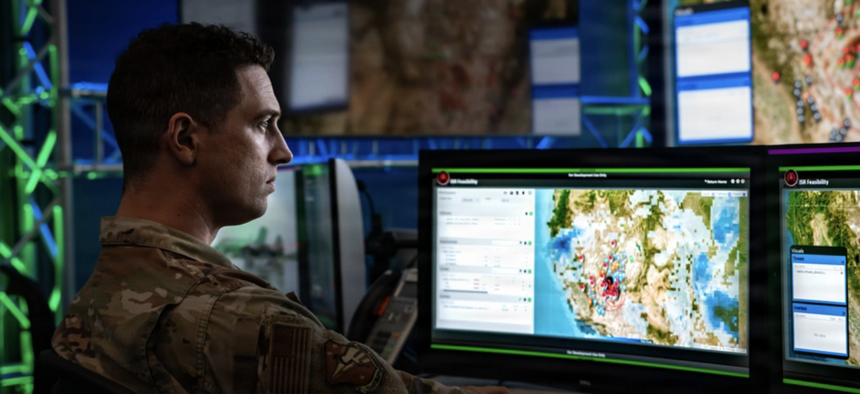
DVIDS | Richard A Eldridge

AI and Influence: The New ‘Arms Race’
U.S. adversaries heavily employ information operations; new technology and old-fashioned marketing acumen could help America recover the advantage
Presented by
Leidos

Presented by
Leidos
The mysterious field of information operations (IO) has long been part of war, conflict, and competition. From Cold War book distribution programs to the Eastern Bloc to Russian-affiliated websites pushing false information about the U.S. military in the aftermath of the capture of Venezuelan President Nicolas Maduro, so called “operations in the information environment” have influenced, persuaded, coerced, and subverted in the name of national security.
“The role of information operations, for decades really, has been about battling for ideas and narratives,” Leidos’ Andrew Hallman, a 33-year veteran of the Central Intelligence Agency, said in a recent interview. Following a lull after the Cold War, the urgency for IO returned in the aftermath of 9/11, as the U.S. sought to draw a sharp contrast between American values and those of Islamist terror groups. Much as before, these operations remained time intensive, involving planning, market research, tactics, and strategy.
Today, the “ubiquity of advanced technology” has changed the operating space significantly, Hallman notes. Modern digital communications tools like social media apps and smartphones, and advanced telecommunications networks have thoroughly proliferated across the global economy, and democratized the average consumer’s ability to access and disseminate information. In short, the nation that can harness artificial intelligence (AI) to operate in the information environment faster and more effectively than its adversaries will come out on top.
To meet and counter these challenges, Leidos has developed an AI-powered IO platform called Imperium™ that delivers near-instant command and control, planning, assessment, and analysis with vetted, accurate data points.
The power of influence
For retired U.S. Army Maj. Gen. Patrick Roberson, an experienced Special Forces leader who retired in 2024 after more than 34 years of service, the savage violence of the 2014 to 2019 counter-ISIS campaign in Iraq and Syria was a milestone moment for modern influence operations. ISIS terrorists rapidly deployed an aggressive propaganda campaign and the group’s imagery of trucks adorned with black flags, triumphant well-equipped fighters, and forces being well-received by local residents spread around the globe.
ISIS’ modern propaganda efforts were fine tuned to a digital-savvy world. Grisly execution videos went viral on Twitter threads, and were often covered by mainstream news, while sympathizers directly appealed to recruits online to join the so-called caliphate. “I remember seeing the sophistication of their propaganda improve, and how cleverly they were messaging and disseminating it over time,” recalled Roberson, who served as both the deputy commander and commander of Special Operations Joint Task Force – Operation Inherent Resolve over the course of the campaign. “They were able to tie it all together with their audience in a way that was very hard to counter.”
The messaging was key to the group’s ability to hold territory and subvert dissent. “As a government, if ISIS controls your life the consequences of opposing them were repeatedly portrayed as being very dangerous,” Roberson said. “Someone’s receptiveness to counter messaging is going to be limited since most people in that environment are just trying to survive.”
The U.S. and their allies pursued several responses to these tactics. Special operations forces ramped up training and exercising in IO during the leadup to the 2016-2017 Battle of Mosul. But, Roberson added, where influence could not succeed, kinetic power was called on. “Their propaganda and media leaders were high level targets,” he said. “We viewed them as very serious threats to be taken off the battlefield.” In hindsight, however, the need became more pronounced for non-kinetic tools that could blunt ISIS messaging – and do so at the speed of real-world operations.
The future gray zone fight
China and Russia have poured resources into influence and disinformation as their tools of choice in the “gray zone” between peace and conflict from fishing and territory disputes in the South China Sea to drone incursions over Western Europe. “The threshold changes constantly in these environments,” Roberson said. “Maybe someone will push the limits in the ocean where the laws are more muddied or fly into airspace where restrictions are disputed. If you do enough of it, and pair it with scaled messages, it desensitizes people over time. Eventually, you can arrive at the outcome you desire without receiving a more forceful response.”
Influence campaigns have become more “hybrid” in some cases, Hallman said, as the Russians have become very aggressive in using a combination of internet “bot farms,” synthetic personas, cloned Western media outlets, and paid media influencers to flood websites and social media channels with pro-Kremlin narratives. These automated messages are presented in tandem with deepfakes, spokespersons, or state media messages, resulting in “multi modal information operations.” China, for its part, has also evolved its traditionally subtle information operations with campaigns of greater scale and attempts to influence U.S. politics.
Along with AI’s advances, “these messages can be generated at speed and scale and resonate far better than just five or ten years ago,” Hallman says. “It puts a premium on the United States and our allies to detect our adversaries, characterize them, and generate counter messaging quickly at scale.”
Old mission, new tools
So how has the U.S. responded? The conventional wisdom of national security practitioners is: Not well, but improving. The urgency of the moment, though, is spurring change.
Technology holds the key to breaking through and Leidos’ Imperium can now close the gap that has opened between the U.S. and its adversaries. Instead of spending weeks planning, executing, delivering, and measuring effectiveness of information campaigns, Imperium can optimize campaigns “in flight” and adjust accordingly, depending on cost and access. “That is a very powerful tool,” Hallman said.
Today, Hallman serves as Leidos’ Intelligence Community executive where he focuses on getting transformational tools like Imperium into the hands of practitioners. “Speed and scale are key – you have to do all this faster to have relevance in this mission, and this technology allows us to do it.” Additionally, Roberson noted that reach and scale are key to any success in the IO space. “If you measure the performance of an adversary, and it’s only, say, 10 percent of what they are doing, you don’t have the right volume, and you can’t respond effectively. [Imperium] is a tool that quantifies the threat rapidly and accurately changes things, instead of making it a subjective judgment every time,” he noted.
Key to this new technology is what drives it: vetted, accurate data points. To this end, Leidos teamed with global communications firm VML, to combine unique insights and expertise with AI-enhanced outcomes. With trillions of data points from marketing, customer surveys, and demographics informing the platform, the scale and reach that has eluded IO practitioners can finally be captured. The scale of insight coupled with improved trend prediction, better identification of disinformation, and shifting conditions means more rapid response.
AI is often presented in an influence context as a tool used against the U.S., but could easily be turned the other way. “One of the great advantages we have is our technology base, our AI work here in the U.S.,” Roberson said. Paired with our edge in marketing, branding, and advertising, national security practitioners now have a potent tool to wield in the gray zone to better understand an environment or what an adversary is messaging in it. “With AI tools and the data that a firm like a VML or other agency brings, you get accuracy, speed, quality, and volume all at once. You can hardly afford not to do it.”
Hallman echoes Roberson’s assessment, adding that despite the organizational and policy challenges that persist, there is great opportunity to leap ahead in the IO space. While it is hard to rally around narrative as opposed to responding to a more tangible kinetic terrorist attack, for example, Hallman said our adversaries have compelled us to become combatants on this digital battlefield, and perception shaping is tied to big picture outcomes for the U.S. and its allies.
“If we don’t embrace this technology and leverage it for the IO mission, we are going to allow adversaries to shape narratives that corrupt our discourse and deny us the right to choose our own political destiny and outcomes,” Hallman said. “We should not cede that control to them.”
This content is made possible by our sponsor Leidos; it is not written by and does not necessarily reflect the views of Defense One’s editorial staff.
NEXT STORY: The future is here: Sixth-gen air dominance