

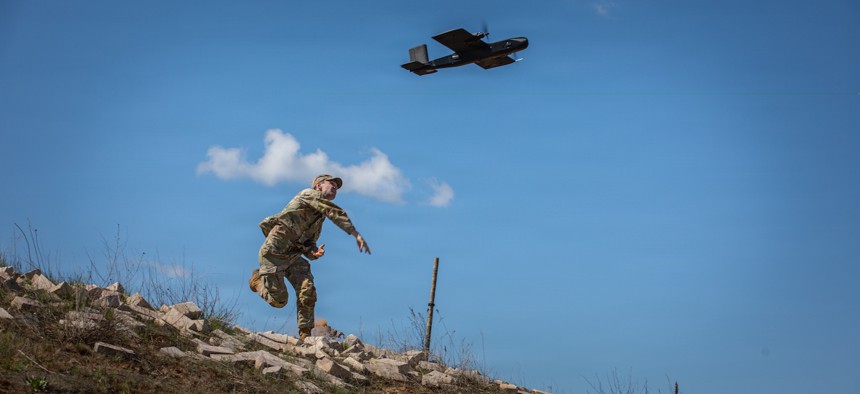
Sgt. Todd Kelly hand-launches a Peregrine one-way attack unmanned aerial system during Project Flytrap at Pabradė Training Area, Lithuania, May 15, 2026. U.S. Army / Sgt. Max Elliott


The Army wants its units to use more data, but many aren’t built to do so
AI might help move intelligence more quickly up and down the echelons, Army and industry speakers said.

Recent Army field exercises keep revealing a missing key to the data-driven future envisioned by service leaders: the ability to move information quickly and effectively between echelons. Some put it this way: “The Army doesn’t have a data issue, it has a data-management issue.”
A major takeaway from Project Flytrap, a Poland-based exercise, is that the way combat units, communications units, and headquarters share information and make decisions can’t keep up, according to a junior signal officer who helped manage data for the exercise earlier this year.
“The battlefield is so massively complex, and there's such a vast amount of things you have to account for,” Capt. Gabriel Glazer, a graduate student at Carnegie Mellon University who most recently served in the 2nd Cavalry Regiment, said Thursday at an Armed Forces Communications and Electronics Association event near Washington, D.C. “It is, frankly, almost impossible for any unit, the way it is structured now, to account for them, and it's almost impossible for any leader to make the best decision at a speed at which it's going to be relevant for their success or failure in whatever operation they're in.”
It’s a gap artificial intelligence could potentially fill, Glazer said, to shorten the time it takes to get intelligence from individual units on the ground up to division and corps headquarters, then disperse it throughout the entire formation.
“Getting the data down to the lower level is absolutely critical, because we obviously can't do that, especially in every situation, especially if we're going to be in a denied or degraded environment,” he said.
While the Army has been testing its next-generation command-and-control platform by linking up ever-larger formations, Glazer argued there needs to be a lower-level fix to help junior officers make decisions, while also sending their data up to higher echelons.
“I think that a platoon leader on the ground is going to want the information coming from a division or a corps, but they are going to need a system that enables them to react and make the best decision to the drone swarm that is going to be approaching them, if they are in that type of environment,” he said.
Even the most advanced networks are still only transmitting data and making decisions at human speed, said James Craven, Anduril’s NGC2 program manager.
“Imagine that we have indications and warning of an anti-radiation missile, or an aircraft capable of launching anti-radiation missiles at the division HQ, as it is now,” Craven said.
That information has to get from the intelligence shop to the operations shop, who will set the division’s electromagnetic posture, then to the signals battalion to physically change the configuration of the radios to protect them from interference.
“There's a seam and gap there, but it occurs at people speed,” he said. “It's not going to be fast.”
There are opportunities for AI to ease some of that friction, said Melissa Daminski of L3 Harris.
“AI is going to be native, and so there is that dual-sided AI aspect of cellular communications, where we will need to be sensing the spectrum and maneuvering within a 5G, 6G signal as our adversaries are doing the same,” she said. “And similarly, we'll need AI and other smarts to say, okay, it's time to get off of this channel and move to another one.”
For now, Glazer said, the Army Data Operations Center is troubleshooting individual data-flow issues as they pop up.
“As those barriers are broken down, we're going to see lower-level, tactical-level units finding solutions to problems that propagate throughout the entire course, and I'm really excited for that,” he said.
Help us report on the future of national security. Contact Meghann Myers: mmyers@defenseone.com, meghannmyers.55 on Signal.
NEXT STORY: OpenAI gives NATO access to most advanced cybersecurity AI