

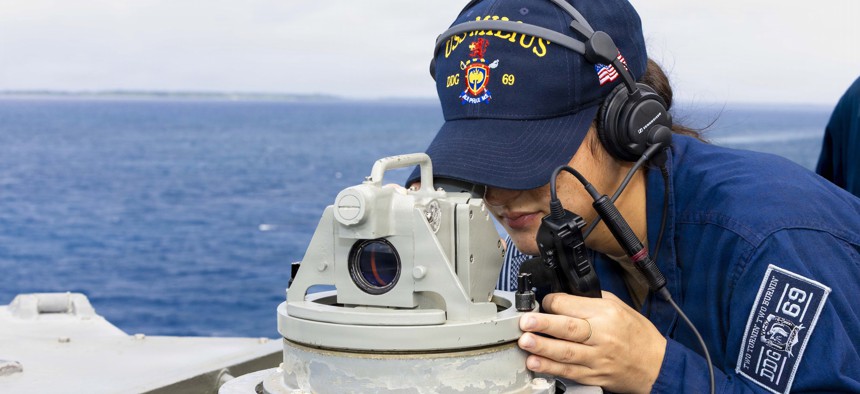
A sailor looks through an alidade as the guided-missile destroyer Milius leaves Diego Garcia on Sept. 20, 2026. U.S. Navy



The port-call situation is wearing out Navy warships
Diego Garcia is the only safe place for ships fighting Iran, but the remote atoll can’t provide the maintenance they need.

A few years ago, a port call in the Middle East might mean bottomless-mojito brunches in Bahrain, hitting the indoor ski slopes in a Dubai megamall, or a desert safari in Qatar. But since Operation Epic Fury began eight months ago, U.S. warships in the theater have basically had just one option: Diego Garcia, some 2,500 miles away.
It’s not great for morale, but the consequences go beyond disgruntled sailors who tire of fishing off the British island in the Indian Ocean. The remote coral atoll lacks the pierside infrastructure that many Gulf, Mediterranean, and Pacific ports can offer. As the Navy stretches its fleet with longer deployments and fewer port calls, warships are losing the ability to do crucial mid-cruise maintenance.
“When a ship is deployed overseas for longer than the nominal seven-month deployment period, that increases the amount of time for equipment on the ship to break, get worn down, or worn out. As a result, when the ship finally does make it back to the United States, it might need more maintenance and repair work than it would have needed if the deployment had not exceeded seven months,” said Ron O’Rourke, who retired this year after more than 40 years as a naval analyst for the Congressional Research Service.
“That can increase the time and cost to do the maintenance and repair work, and an increased time needed to do the work could prevent other ships from entering maintenance and overhaul as scheduled. This can lead to a cascading effect in delaying maintenance on other ships.”
A Navy officer with expertise in maritime security agreed, noting that “even deployed ships need time alongside”—that is, moored directly to a pier or tender vessel for what’s called voyage repair availability—“to fix broken things, remediate rust, paint, etc. If these ships are kept out for 10 to 12 months, they’ll be missing other scheduled maintenance events and be much more broken than they should be when they get home.”
The Navy itself nodded to the problem in a recent press release about the aircraft carrier Abraham Lincoln, which is changing homeports to receive overdue depot-level maintenance after a nearly 11-month deployment.
“Regularly scheduled depot-level maintenance maximizes the lifespan of our Navy vessels and keeps our fleets lethal, modern, and ready to defend the nation.”
The Lincoln’s 321-day deployment—and the carrier Gerald R. Ford’s 326-day deployment before it—set records for consecutive days at sea and length of deployment, respectively. But a few Arleigh Burke-class guided missile destroyers are on track to far surpass those numbers. And Navy officials recently told families in Yokosuka, Japan, that for the foreseeable future they should expect all ships to deploy for 10 to 12 months.
A Navy spokesperson said they would “not discuss specific readiness rates, operational requirements, force-allocation deliberations, or future force movements. However, we remain committed to regular maintenance to maximize the lifespan of our Navy vessels and keep our fleets lethal and ready to defend our nation.”
‘It’s empty’
Instead of the luxury hotels and hundreds of restaurants sailors can visit in ports like Dubai and Bahrain, Diego Garcia has a military supply base and a small town with a handful of restaurants. And since virtually every ship deployed in the region is using the island for port calls and resupply, store shelves don’t always stay stocked.
The guided-missile destroyer John Finn, which left Japan in January, pulled into Diego Garcia after months at sea.
“Everybody’s going to the ship store and it’s empty,” a sailor’s spouse told Defense One. “You can find ice cream, but you’re not going to find your necessities that you need to function.”
The ship had pulled in because it was “empty,” the spouse said, after having spent all of its weapons in the campaign against Iran. “So they had to spend that week resupplying.”
The spouse of a sailor on the Mustin, another guided-missile destroyer, said her husband was able to get socks but not shoe polish at the exchange on base during the only port call the ship has made since leaving Japan in April.
“He got off like, preparing to be able to get the stuff that he needed right now, and he goes, ‘They don’t have shit,’” she said. “They didn’t have anything.”
For the Mustin crew, the port call seemed like a welcome respite from their months at sea, until they were told just before getting off the ship that they would not return in August as originally planned, but stay deployed until April 2027, the spouse told Defense One.
“The sad part is, they were actually in good spirits,” she said. “And then I know things went really rowdy in Diego Garcia because they were given the bad news literally the day before they pulled in. … There was one of the nights in Diego Garcia that two sailors ended up in the ER with alcohol poisoning. And so then they lost their last night of liberty because of it.”
O’Rourke said the British island “can provide an opportunity to be on land for a while, and to engage in certain R&R activities. But the options for doing R&R things at Diego Garcia are a lot more limited than they are at other ports, such as Singapore or somewhere in the Mediterranean.”
Ralph Cossa, chairman of the Pacific Forum, was less diplomatic.
“Please shoot me if that’s the only R&R I’m going to get in 10 months,” he said.
Mail delays
Sailors have asked their families and friends to send them supplies, but mail is taking three to six months to reach the destroyers, the spouses said.
The Mustin spouse sent her husband six boxes at the end of June; he received one in September and the rest in October. The John Finn spouse said it took four months for a few packages to reach her sailor, and some that “took even longer than six months to get out there.”
“I think I’ve sent my husband the same thing three different times now, and I’m like, well, hopefully one of these gets to you in the next two or three months, and whenever the other ones show up, you’re just gonna have an abundance. Share it with somebody else.”
Both spouses expressed concern about the sailors’ ability to vote in the upcoming elections, given the mail delays. The John Finn spouse said her husband, who has done multiple deployments in the past, said, “There has been no conversation about voting because we don’t have time for it. We don’t have time to even have conversations because we are busy doing all of this other crap that nobody wants to be doing to begin with.”
By contrast, sailors aboard the George Washington aircraft carrier generally “can expect to receive mail shipped from the states within weeks,” Lt. Cmdr. Bobby Dixon, a ship spokesperson, told Defense One. “However, this can take longer when deployed overseas. We work with our U.S. military logistics teammates to minimize mail delays and we are committed to ensuring all service members can exercise their right to vote.”
Maintenance
Navy ships, like any other vehicles, require a certain amount of maintenance to continue working. There are three levels of repairs: basic, intermediate, and depot-level maintenance.
Deployed ships are under stress from the salt water and sea air, and more things are likely to wear down or break when they’re being used frequently for long periods of time. And the forward-deployed destroyers based in Yokosuka—including the John Finn and the Mustin—are usually in a cycle in which they spend just a few months at sea before heading back home for a few months of maintenance.
Now those two destroyers are slated to be at sea for a year or more, which will mean they will miss the beginning of their planned five-month shipyard maintenance periods. And the Mustin spouse said there were already some maintenance problems on that ship when it shifted homeports from San Diego, Calif., to Yokosuka, just before it left for deployment.
“Their maintenance log was 100 percent not empty,” and there were a lot of things “that they should have been turned around for,” she said. The ship was told to head to Japan anyway.
And though the sailors were told their lone port call was planned so they could perform maintenance, “they never got anything fixed when they went to Diego Garcia. … They didn’t actually go up pierside.”
O’Rourke said there are consequences for delays to the intermediate and depot levels of maintenance.
“If you have a period where the total fraction of the Navy being on deployment overseas is elevated above what the notional model calls for, there will be a period downstream where you have to pay the piper, where the fraction of the Navy that will be available for deployment will be less than what the notional model called for because you're making up for that earlier period,” he said.
It’s not a new problem.
“Years ago, the Navy got itself into a hole on conventional surface ship maintenance due in part to what turned out to be underestimates in planning, scheduling, and funding that work. Since then, the Navy has been working for years to dig itself out of that conventional surface ship maintenance hole. Perturbations in ship maintenance and repair schedules caused by ships being used for extended deployments can add to the Navy’s challenge of digging itself out of that hole,” O’Rourke said.
So the service needs to give its ships the maintenance they need. But that’s unlikely to happen while the Navy is keeping so many ships in theater, a second Navy expert said.
“The end result is that deferred maintenance becomes more and more problematic, causing knock-on effects like parts and equipment wearing out or breaking before they should. In the end, these ships will reach their end of service life well before their scheduled date.”