



Air Force bets on hybrid-electric aircraft for transport
Electra Defense’s nine-seat aircraft builds on existing development and aims to take on special operations missions.

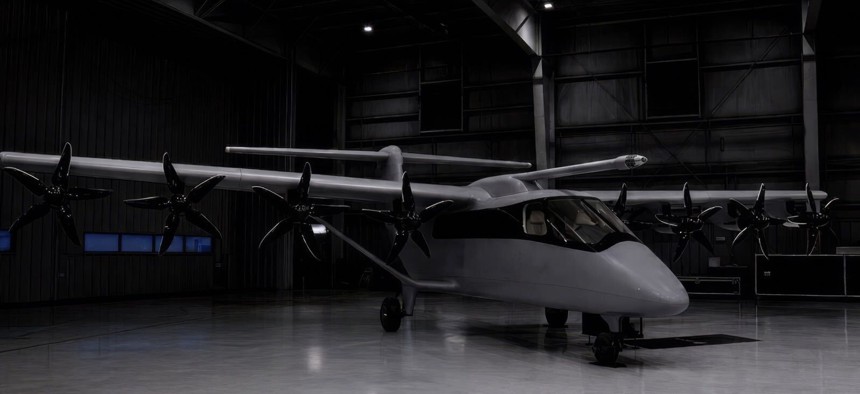
The Air Force is pitching in nearly $5 million to help a Virginia-based aerospace company bring a 9-seat hybrid-electric airplane to flight—and to evaluate its potential use in combat.
A $4.7 million other transaction agreement contract from AFWERX will help Electra develop its EL9 prototype aircraft, building on the company’s existing EL2 two-seat prototype.
The EL9 is a small aircraft, comparable to a Cessna Caravan or Pilatus PC-12. Its size, combined with the ability to take off and land in just 150 feet, could make it good to use for special operations.
“The USAF has always been interested in what new technology can bring to the battlefield, and the new contract will let it test what an ultra-[short take off and landing] aircraft can do in service,” said Douglas Royce, senior aerospace and power systems analyst for Forecast International. “The contract isn’t a signal that the USAF is ready to acquire this type of aircraft, but the vulnerability of traditional air bases to missile attack may encourage the use of distributed operations in combat zones. Operating an ultra-STOL platform from short or improvised runways may be a part of that concept.”
“The special forces use would make sense because having a nine-passenger aircraft that can fly in and fly out of very short runways or roads would be useful for the way they operate. The more traditional transport missions would be handled by larger aircraft. But these tests may also spur other ideas once they have one in hand,” Royce said.
The Air Force’s interest in electric aircraft garnered Congressional support in the 2025 National Defense Authorization Act, which formalized the Air Force’s Agility Prime efforts to develop hybrid and electric vertical-takeoff-and-landing aircraft with commercial industry. AFWERX received $4.96 million for the “electrification of fixed wing aircraft” that year. Last week, the Air Force raised the funding ceiling of its operational testing contract with Joby Aviation, which makes autonomous eVTOL aircraft.
Under the AFWERX contract, Electra would need to verify its hybrid-electric propulsion, and conduct ground testing and acoustic flight testing of the EL9 prototype. The latter would show whether the aircraft could do “battery-only low-signature ingress and egress for special operations missions,” the company wrote in the release.
“We're starting to move into the design and development of the EL9. A lot of the work up to this point has been the development of the technology in general. So blown lift, hybrid electric propulsion, etc.,” Donn Yates, Electra Defense’s vice president and general manager, told Defense One. “Then there's what we call the operational analysis, specifically targeted at how an aircraft like the EL9 would do agile combat employment operations in contested theaters for contested logistics...We've never been asked to do that before, ever. So they're funding us to go do operational analysis.”
To do that, Electra has teamed with Lockheed Martin Skunk Works to analyze how the EL9 aircraft “would help enable contested logistics operations in the Pacific,” Yates said.
The plan is to fly the EL9 by early 2029, which then “begins the certification process” and brings the aircraft closer to flying in military exercises.
Yates also said the plane is being designed for possible uncrewed operation.
“Because we're marketing to commercial customers first, our plane is piloted. Now, the cool thing about our plane, and our company, is that it has DNA and roots in Aurora Flight Sciences, [which] was doing autonomy when autonomy wasn't cool–-and nobody wanted to talk about it—20 years ago,” Yates said.
Compared to the more traditional build of a Cessna Caravan, which uses mechanical flight controls, EL9’s design is “all digital flight controls, so you can do autonomous behaviors and fly an aircraft without a pilot much easier,” Yates said. “And so, even though we're not in an autonomy play up front, I think you'll hear some announcements in the coming months about work that we're doing…with specific customers towards making the aircraft, what we call, optionally piloted.”
Electra has completed multiple demonstrations of its two-seater aircraft to show off its blown-lift, a mechanism that allows the aircraft to generate lift at slower speeds by using electric motors to blow air over the wings, and hybrid electric propulsion technologies. The most recent one was landing the aircraft at the Downtown Skyport in New York City.
“That New York City event was massive because people started to go, ‘Oh, you could take off from barges in the Pacific or various locations.’ And they're starting to really grasp the future of what the technology could do,” Yates said.
As the company preps the EL9 for flight, it’s also writing code to “plug into simulations in war games, which I would argue is actually even more compelling than actually doing an exercise. Because that's where you're plugging into the entire contested logistics apparatus.”
That could help commanders and troops know how to use a technology, even before seeing it perform in a military exercise.
“Another reason why this contract allows us in that operational analysis piece that I talked about, the validation of using our model into these things will be significant,” Yates said.
In 2023, the company received a potentially $85 million strategic funding increase award from AFWERX, which combines government and private money, for development of a full-scale preproduction aircraft, including test flights and demonstrations of “the potential of Ultra-STOL aircraft and hybrid-electric propulsion to support runway-independent distributed military operations and mobile power generation.”