

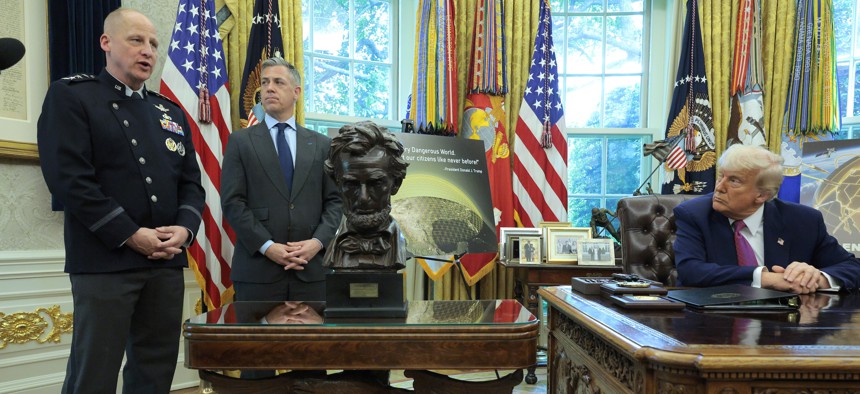
WASHINGTON, DC - MAY 20: Space Force General Michael Guetlein, speaks alongside Rep. Jim Banks (R-IN) and U.S. President Donald Trump in the Oval Office at the White House on May 20, 2025. Chip Somodevilla/Getty Images


Golden Dome’s projected cost just jumped $10 billion. Experts fear that’s just for starters.
Three prime contractors have been named to build the project's command and control layer.

Golden Dome’s official projected price tag just jumped $10 billion to $185 billion. Experts say the real cost is likely to be far, far more.
Gen. Michael Guetlein, the Space Force officer in charge of the sprawling missile defense project, said Tuesday that it was no longer expected to cost $175 billion, the number given by President Trump when he announced the project last May.
“We were asked to procure some additional space capabilities,” Guetlein told attendees at the McAleese Defense Programs Conference. “So, we are at $185 billion for the objective architecture, which delivers way out into the 2035 timeframe.”
Experts told Defense One it’s most likely going to exceed that figure. Soon after the project was announced, the Congressional Budget Office predicted anywhere from $542 billion to $831 billion over 20 years. In September, an American Enterprise Institute report said the highest-end architecture could mount to $3.6 trillion.
But Guetlein said he was confident in the new figure.
“There's been numerous cost estimates out there in excess of a trillion dollars. I would say the difference between what they are estimating and what we are building is they're not estimating what I'm building,” he said. “We are changing that equation for Golden Dome, simplifying it, if you will, just aggregating it, if you will, to bring down that cost equation and not exceed that $185 billion that the President has committed.”
Todd Harrison, a senior fellow at AEI who has researched Golden Dome’s likely costs, said Guetlein’s $185 billion figure would likely only include a basic capability for space-based interceptors—which has been seen as the most expensive and ambitious part of the project. It’s also, he said, just the beginning of the expenses.
“My understanding is that is just the near-term cost to acquire an initial level of capability. It's not the total acquisition cost, and it does not include long-term operation and replenishment costs,” Harrison said. “It also is a good indicator that space-based interceptors will be a relatively minor part of the architecture, if they even move out of the demonstration phase.”
Last year, the Space Force awarded small contracts to companies to develop orbital interceptors and were soliciting proposals for space-based midcourse interceptors, too. Physicists have questioned the project’s use of boost-phase and mid-course space interceptors, claiming it’s impractical against modern missile threats.
Given Guetlein’s budget estimate, it’s not clear how much space-based interceptors will play a role in the final architecture, said Victoria Samson, the Secure World Foundation’s chief director of space security and stability.
“Really and truly, it's not going to be cheap, but the long pole in the tent in terms of cost is going to be the space-based interceptor layer,” Samson said. “That's going to be the one that's going to drive it up, depending how much they decide to go ahead with it.”
Guetlein admitted that the space-based interceptors are a challenge for the program.
“We have not had anything fail yet, we’ve had numerous successful tests that I can only go into in this environment,” Guetlein said. “If I was to predict where the biggest amount of risk is the space-based interceptor. And it's not the technology, it's the scalability and the affordability.”
The Pentagon is casting a wide net when it comes to Golden Dome-related work. Early this year, the Missile Defense Agency made several announcements that a total of 2,440 applicants have been approved to compete for work totaling up to $151 billion out of an original pool of 2,463, leaving just 23 applicants out of the running.
Guetlein said that Lockheed Martin, RTX, and Northrop Grumman are three prime contractors working with six other companies to build command and control capabilities, or C2, layer for Golden Dome.
“Now, we have a team of nine building our command and control capability, which is really a glue layer that sits upon all these other services and agencies, C2 systems,” Guetlein said.
While Trump’s January 2025 executive order establishing Golden Dome does not establish a due date for the project, a subsequent December 2025 executive order calls for “developing and demonstrating prototype next-generation missile defense technologies by 2028” leaving Guetlein a little more than two years to meet the president’s goals.
“I do not have a 2028 mandate inside the executive order. However, the President did ask us to rapidly change the defensive equation of the nation as fast as we possibly can, and put a marker on there for the summer of 2028,” Guetlein said. “By the summer of 2028 I have to demonstrate the ability with operational capability deployed in the field to defend ourselves against those threats as identified in the executive order. That's what they have asked us to do.”