

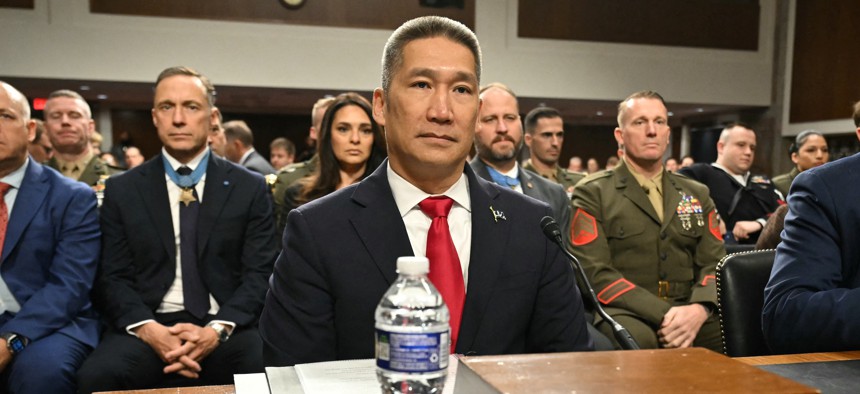
Acting Navy Secretary Hung Cao arrives to testify at a Senate Armed Services Committee hearing on his nomination to lead the Navy on Capitol Hill in Washington, D.C., on November 17, 2026. SAUL LOEB / AFP via Getty Images


Senate grills acting Navy secretary on Iran war costs, extended deployments
Democrats in particular bristled at Hung Cao’s characterization of unsuccessful suicide attempts as “mitigations.”

The White House’s pick to lead the Navy didn’t have clear answers Tuesday when lawmakers pressed him about ballooning Iran war costs, the resulting toll on troops deployed to the region, and the service’s overall readiness during a Senate confirmation hearing.
Hung Cao, a retired Navy captain who has been the service’s acting secretary since April, said the Iran war was a “strain” on resources, but failed to provide the detailed answers sought by Sen. Elizabeth Warren, D-Mass.
“I do not know the daily cost, ma'am…I know the rough costs, how much it's costing us so far,” he told the Senate Armed Services Committee, later adding that it was around $30 billion after Warren quoted estimates of about $32.5 million a day.
Cao also didn’t have an answer when asked how much damage Iranian strikes had caused to the U.S. Naval Base in Bahrain. “We're still making all the assessments because it's a non-permissive area for us to go.” U.S. troops are still in Bahrain; some came under fire yesterday during Iran’s latest strike on radar facilities there.
Warren pointed to a Wall Street Journal report estimating $400 million to “construct buildings of the same types as those damaged at NSA Bahrain.”
Similar testy back-and-forth scenarios repeated throughout the nearly three-hour hearing. Senators on both sides of the aisle prodded Cao over the Trump administration’s exclusion of Democrats from meetings pertaining to national security and the Iran war.
Sen. Mike Rounds, R-S.D., said such partisan behavior puts defense funding in jeopardy because “it limits us to basically using Republican votes only,” Rounds said. “Pretty tough to ask all of my colleagues to support that if they're not even invited in to hear the information in the first place.”
And Sen. Elissa Slotkin, D-Mich., suggested the Iran war's added costs were “holding up” naval modernization efforts and “the important improvements that we all want to make long term for our military.”
Cao, who was confirmed as the Navy’s undersecretary before being named acting secretary, promised not to have partisan briefings and to communicate with Congress.
As have other Pentagon leaders, Cao urged lawmakers to pass the administration’s proposed $350 billion reconciliation bill atop the regular, if still historically large, trillion-dollar defense appropriations bill for the fiscal year that started more than two months ago. He said that many Navy programs, including buying up to 35 landing ship mediums, depend on the reconciliation bill.
“That is also predicated on us having a $1.45 trillion dollar budget…because a lot of the LSMs, the extra LSMs, are in the reconciliation,” he said.
Cao’s reluctance to take stances that challenge or contradict public statements from the White House or Pentagon chief Pete Hegseth also drew ire from some Democrats.
When Sen. Tammy Duckworth, D-Ill., asked if he “urged” Defense Secretary Pete Hegseth to end the Iran war, Cao said it is “not within my purview to do that,” adding that his “stance on our readiness and the strain it takes on our sailors” is known.
Duckworth said she would not vote for him.
The hearing ended after a fiery exchange with Sen. Kristen Gillibrand, D-N.Y., over Cao’s attempt to frame to sailor suicide attempts as “mitigations.”
Gillibrand said Cao was “minimizing” sailors’ mental health “strain” amid extended deployments and poor living conditions aboard the Abraham Lincoln aircraft carrier. Cao denied the accusation, and brought up his own experience in uniform. The exchange took a turn when Cao refused to back down from his assertion that the Navy has sufficient processes to address sailors’ mental health challenges when deployed.
“You see it as eight suicide attempts. I see it as eight suicides mitigations because of the the chaplains we have on board, the deployment resiliency counselors, as well as mental health specialists. Normally, most carrier strike groups, when they deploy, have about one or two suicides. This is well before Epic Fury,” Cao said earlier in the hearing, when Sen. Richard Blumenthal, D-Conn., first asked about sailors’ welfare on the USS Abraham Lincoln. “Unfortunately, this is the fight we're dealing with right now. We had zero actual suicides on board the Abraham Lincoln.”
Cao previously called news reports of substandard living conditions aboard the Lincoln “dishonest.”
“I think you are minimizing what mental health strain is on these service members,” Gillibrand said, mentioning one incident when a sailor jumped overboard and was subsequently punished for it.
Cao disagreed: “I have done many deployments—Iraq, Afghanistan, Somalia. I have been in places [where] we get two MREs a day and five bottles of water. That's what I got. And, you know, talk about no showers or anything else. I understand what our sailors and Marines are going through, and I put mental health as a top of my concern.”
And then he doubled down on the service preventing suicides by putting “mental health resiliency providers as well as chaplains on board.”
Gillibrand retorted: “It's inadequate.”
Then Cao quipped: “Then that’s why we need the $1.45 trillion.”