
Anticipating the Adversary
StartAs British novelist and former intelligence officer John Le Carré once said, “it’s easy to forget what intelligence consists of: luck and speculation. Here and there a windfall, here and there a scoop.” Where Le Carré and his colleagues commonly operated under the constraints of limited information, today’s intelligence analysts face just the opposite: an avalanche of data that strains human capacity to distinguish the ‘noteworthy’ from the ‘noise’. As our adversaries rush to exploit this information deluge, what can the Intelligence Community (IC) do to respond? The answer may lie in 'anticipatory intelligence' -- a powerful hybrid of human ingenuity and cutting-edge cognitive tools that's pushing the limit for what's possible.
2/7
#2: Demand for Sustainable Data Architecture
The data deluge has forced the IC to act. In 2012, the Office of the Director of National Intelligence (DNI) took the first step when it created the Intelligence Community Information Technology Enterprise (IC ITE), a framework dedicated to opening data channels between IC members through a common enterprise platform.
While DNI credits the program for achieving an operable Desktop Environment and Apps Mall, its architects say much remains to be done: “IC agencies will need to transition to IC ITE services, capitalize on the opportunities they present, and begin to reduce their own legacy IT infrastructure.”
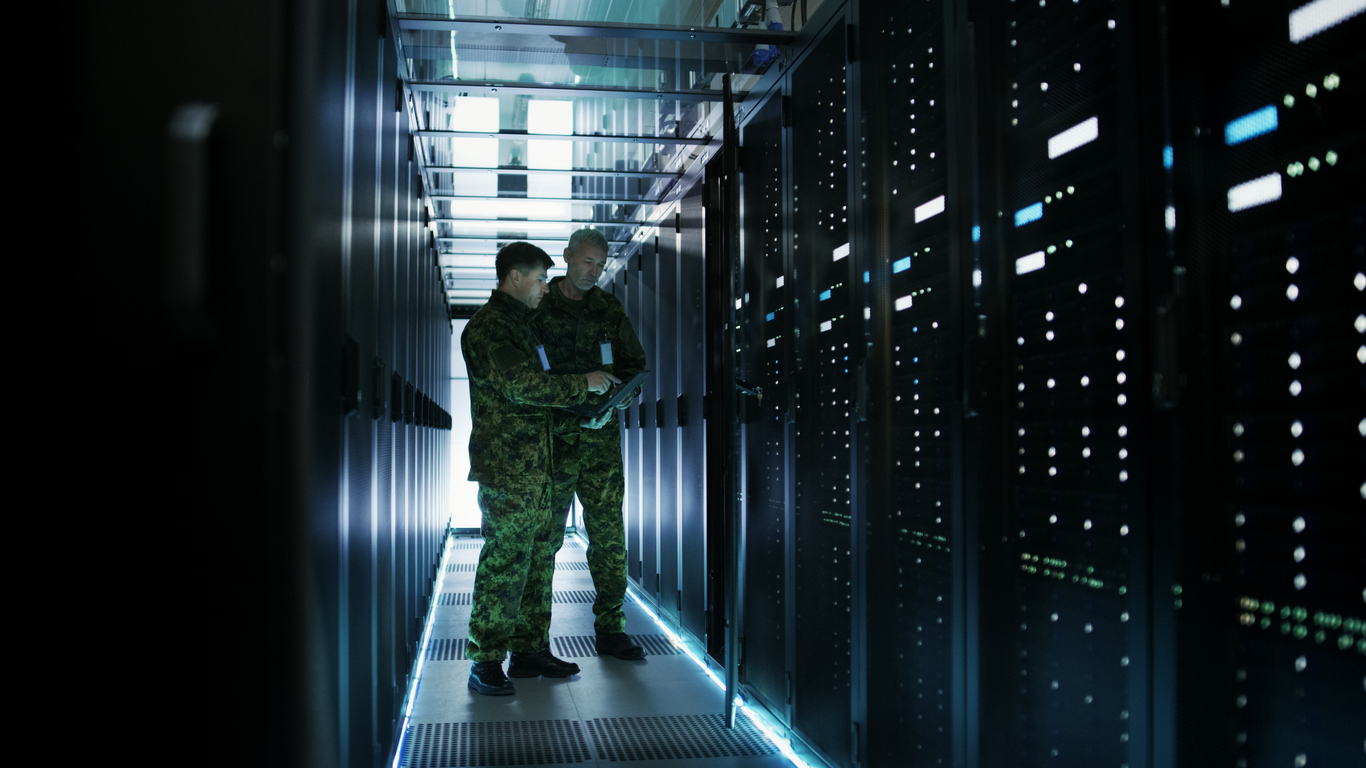
Soldiers examine a military data center / Photo: gorodenkoff (iStock) As data continues to grow in volume and variety, agencies need a platform that scales to meet their collection and dissemination needs. Such an architecture should:
- Store and standardize data for mission-readiness
- Support state-of-the-art tools and applications
- Enable analysts to focus more on mission, and less on integration/curation of data
Fortunately, the technology needed to sustain an architecture like this already exists. Developments in the last year show the IC is preparing its data foundation and investing in scalable cloud solutions, artificial intelligence (AI), and analytics for improved insights into human behavior.
The recent creation of the Intelligence Community Security Coordination Center (IC SCC) is another positive development that will enable automation of IC data flow to improve coordination and efficiency between mission partners. While this facilitates greater data sharing, it also underscores the fact that human analysts cannot process such vast amounts of data on their own. What’s equally vital are a set of tools that can tap into cognitive insights.
Read on to see what those tools look like.
Contents
3/7
#3: Leveraging Cognitive Tools
In 1997, a supercomputer unseated the world’s greatest human chess player. In 2015, artificial intelligence handily defeated the reigning Go champion, also human. But where these cases showcased the incredible processing power and calculation of cognitive machines to a global audience, the next leap in cognitive technologies will be far less glamorous, taking place beyond the spotlight on a theater very few have the clearance to see.

1997: IBM's Deep Blue defeats world chess champion Garry Kasparov in a 6-game series (3½–2½) / Forbes.com That’s right: our nation’s spooks are currently looking to unleash the full range of cognitive technologies. Recent advancements in machine learning, pattern recognition software, visualization, automation, and natural language processing now make it possible for agencies to aggregate colossal amounts of data and detect patterns and habits previously undetectable to the sharpest human eye. For agencies with solid data foundations in place, cognitive tools build on those platforms by improving accuracy, validity, and delivery of intelligence.
A few agencies already anticipate the impact such changes will have on their broader organization, having developed strategic frameworks for the Internet of Things, open-source data analytics, and enterprise data governance in the last year.
As we will explore in the next card, these cognitive tools can ingest terabytes of unstructured data in record time, providing analysts and field operatives with up-to-the-second data and risk assessments in real-time. If you’re in the business of protecting American lives, that kind of capability is critical. But is anyone leveraging it so far? Read on to find out.
5/7
#4: Augmenting the Warfighter
The IC and Defense community are aggressively expanding their analytical toolkit to augment warfighter capabilities. In April 2017, a Pentagon memorandum disclosed Project Maven and the creation of an Algorithmic Warfare Cross-Functional Team (AWCFT) designed to “accelerate DoD’s integration of big data and machine learning.” Deploying the latest in automation, computer vision algorithms, and deep learning, Maven’s stated objectives will be to:
- Organize a data-labeling effort, and develop, acquire, and/or modify algorithms to accomplish key tasks
- Identify required computational resources and identify a path to fielding that infrastructure
- Integrate algorithmic-based technology with Programs of Record in 90-day sprints
Air Force Lt. Gen. John N.T. “Jack” Shanahan, Director for Defense Intelligence (Warfighter Support), says AWCFT looks to leverage cognitive tools deliberately in the fight against ISIS. Speaking to Defense One in May, Shanahan said “we have to tackle the problem a different way. We’re not going to solve it by throwing more people at the problem,” adding “there are a thousand things we want to do with artificial intelligence, machine learning, deep learning, computer vision.”

The Intelligence, Surveillance and Reconnaissance Division at the Combined Air Operations Center at Al Udeid Air Base, Qatar / Defense.gov The Department of Defense (DoD) isn’t alone in this focus. Dawn Meyerriecks, the CIA’s deputy director for science and technology, has confirmed that the Agency already has 137 AI-related pilot programs in progress. These range from automatic object tagging in videos that flag suspicious behavior for analysts, to the deployment of cognitive engines that can predict probable outcomes based on big data and correlational evidence.
What such tools can deliver to warfighters abroad is difficult to overstate. What they enable the IC to do going forward is even more amazing.
6/7
#5: Connecting the Dots
The next step in the IC’s expansion of cognitive tools is the stuff of science fiction: the capacity to predict and preempt adversarial actions against American citizens. This is the realm of anticipatory intelligence.
As computing power, data storage capacities, and data standards evolve, intelligence and defense analysts are reshaping the route from input to insight. While a skilled analyst ten years ago could have gotten her hands on a few datasets and employed statistical models to draw inferences assessing likelihood of threats, these estimates were subject to manual calculation and technical limitations that prevented the model from recalibrating in real-time based on incoming data.
Now, however, the unique alignment between today’s geopolitical dynamics and the need for tools that go past prediction have made an anticipatory framework not just possible, but vital to the IC’s evolution. Collin Agee, U.S. Army senior adviser for IC engagement, posits that “predictive intelligence is deterministic [while] anticipatory is more cognitiveand more sophisticated.” Kevin O’Connell, who teaches at Georgetown University’s Center for Security Studies, explains further: “Historically, thinking about the future meant experts picked a small number of future scenarios. The current combination of human judgment and computational power allows the rapid consideration of thousands, maybe millions of scenarios.”

Former CIA Director John Brennan credits cognitive tools with providing anticipatory forecasts of social unrest across the world While emerging technology certainly promises to increase agencies’ capacity to foresee existential threats, it also elevates the need for rigorous human validation of machine-based conclusions. The author of a recent report on anticipatory intelligence said it best: “Because loosely coupled data could produce inaccurate predictions, confident analysis depends upon keeping humans in the loop.” Thus, maintaining accuracy across findings should remain a top priority for the IC going forward.
So what do these innovations look like on the ground?
- Start Over
7/7
#6: Anticipatory Intelligence
The power to accurately predict, isolate, and eliminate threats in their nascent stages is already changing the nature of America’s intelligence operations.
The Intelligence Advanced Research Projects Activity (IARPA), an organization within DNI, has at least seven ongoing research projects under the anticipatory intelligence umbrella. This includes Cyber-attack Automated Unconventional Sensor Environment (CAUSE), a program aimed at “cyber-kinetic event detection” and “threat modeling”, as well as Project Mercury, which seeks to “develop methods for continuous, automated analysis of SIGINT in order to anticipate and/or detect political crises, disease outbreaks, terrorist activity, and military actions.” To that end, Mercury will enable:
- empirically driven sociological models for population-level behavior change in anticipation of, and in response to, these events
- processing and analysis of streaming data that represent those population behavior changes
- data extraction techniques that focus on volume, rather than depth, by identifying shallow features of streaming SIGINT data that correlate with events
- models to generate probabilistic forecasts of future events
Expectations are high, especially after a pilot competition — the Aggregative Contingent Estimation (ACE) — showed that human-machine teams were capable of producing forecasts 30 percent more accurate than human-only groups in traditional intelligence tests. According to IARPA Program Manager Steven Rieber, one team demonstrated “the largest improvement in judgmental forecasting in the literature.”
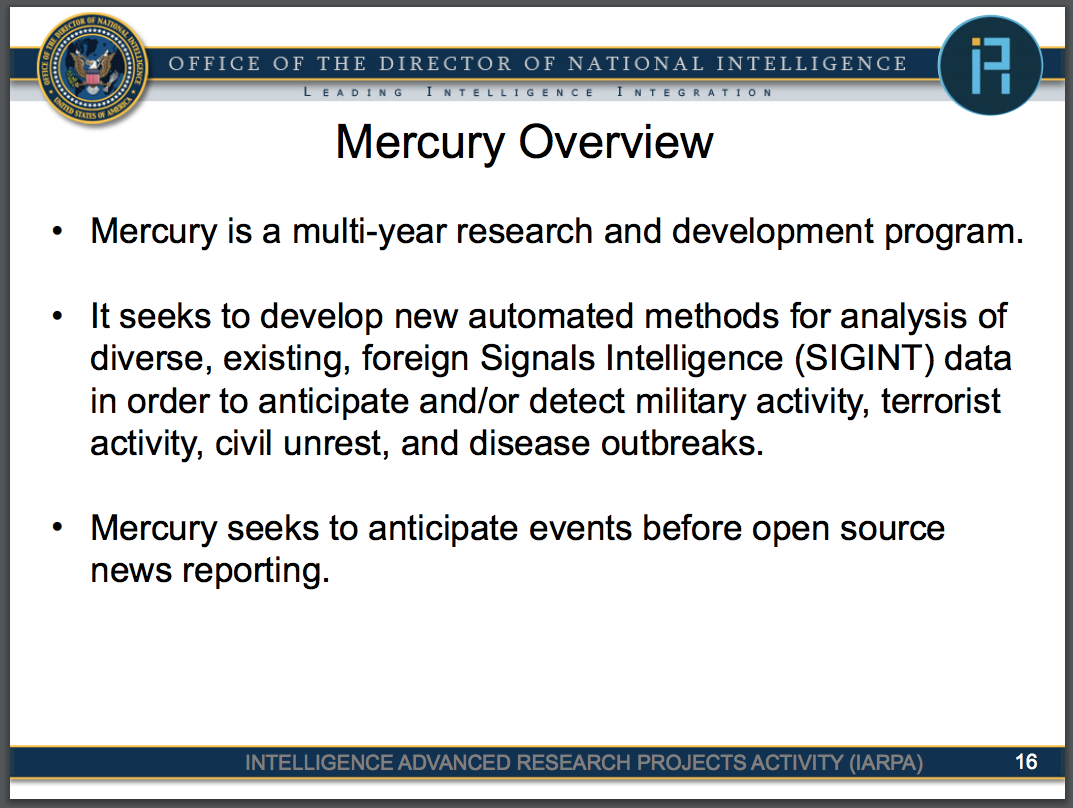
Slide from an unclassified preview of Project Mercury, one of seven IARPA programs looking to leverage anticipatory intelligence / IARPA.gov Now two other agencies have made public their plans for anticipatory intelligence. In an interview with The Cipher Brief, NGA Director for Source Mission Integration, Duncan Scot Currie, says his agency is channeling considerable resources toward these technologies: “Our desire in the future is to replace 75 percent of the routine functions that imagery analysts do with machines, and move those people to focus on doing more anticipatory analysis.”
CIA is also preparing its workforce for the anticipatory future. Using machine learning and other cutting-edge techniques, analysts are now integrating insights from “disparate data sets” to “better predict the flow of everything from illicit cash to extremist [movements] around the globe.” Former CIA Director John Brennan says these advancements in some cases have enabled the agency to “anticipate the development of social unrest and societal instability…as near as three to five days out.”
With the IC’s recent record of decisively launching new technology and analytical methods, there is plenty of reason to believe anticipatory intelligence will become the robust IC tool of the future.