

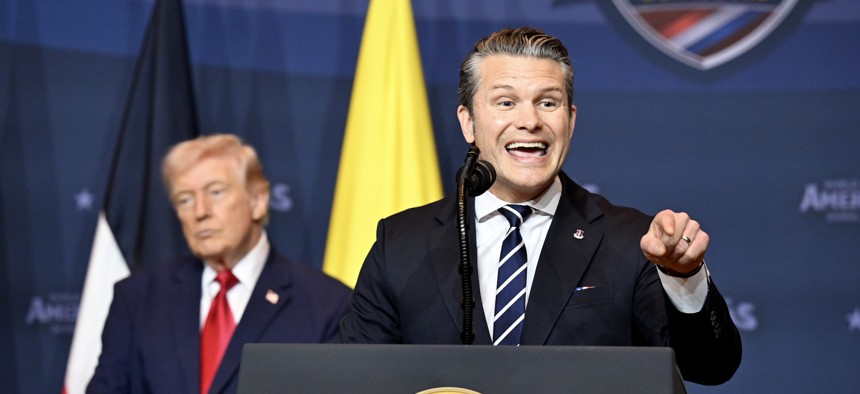
Defense Secretary Pete Hegseth speaks as President Donald Trump listens during the “The Shield of the Americas Summit,“ at the Trump National Doral Golf Club in Doral, Florida, on March 7, 2026. Roberto Schmidt/Getty Images


Defense workers' morale has plunged under Trump, survey finds
Only 9% of Army civilians found Defense Secretary Pete Hegseth’s leadership motivating.

The Defense Department’s civilian workforce is reporting a precipitous drop in job satisfaction, according to a survey released Thursday, following a year of cuts and a hiring freeze that has left many offices understaffed and employees in fear of further reductions in force.
Conducted by the nonprofit, nonpartisan Partnership for Public Service, the survey shows that civilian workers with the Navy and Marine Corps have seen the biggest plunge in satisfaction, from a score of 68.1 out of 100 in 2024 to 36.4 in 2025. The scores for Air Force workers dropped from 67 to 38.5; Army, from 70.3 to 48.1; and the defense secretary’s office, the Joint Staff and other fourth-estate organizations, from 63.6 to 40.6.
Just 9.1 percent of Army employees agreed that “Secretary of War Pete Hegseth’s political leadership team generates high levels of motivation in the workforce,” the survey report said, and they were the most satisfied of any of the large agencies surveyed.
The military departments did not respond to a request for comment from Defense One on Friday.
Asked whether representatives were aware of the survey results and had any initiatives underway to address low morale, Pentagon spokesman Jacob Bliss accused Defense One of “cherry-picking” parts of the survey and accused the Partnership for Public Service of being anti-Trump.
Bliss did not respond to a follow-up request to describe which parts of the survey would give a more fulsome understanding of the results.
The Partnership for Public Service conducted the survey on its own for the first time this year. Historically, they have based their “Best Places to Work in Federal Government” report on data from the annual Federal Employees Viewpoint Survey, which the Office of Personnel Management is legally required to conduct.
But last year, OPM leaders announced that they wouldn’t conduct the survey because they needed to change the questions to comply with the Trump administration’s new anti-diversity policies.
“This workforce has been fundamentally traumatized in the way that this leadership team said that they intended to do at the outset,” Max Stier, Partnership for Public Service’s CEO, told Government Executive. “That’s not good for anyone. It’s bad for the workforce, it’s fundamentally bad for the American people, and it will lead to us to be less safe, healthy and prosperous as a society. The things that we want and need from government are not what we’ll get.”
The survey of some 11,000 federal workers produced results in line with personal stories from Defense civilians about low morale, drops in productivity and fear of involuntary cuts that have hung over the civilian workforce for the past year.
Some 14 percent of DOD’s formerly 795,000-strong civilian workforce left in 2025, either by voluntary or involuntary means, with about 30,000 hired in jobs exempt from the ongoing hiring freeze.
Stier stressed that the survey data comes from those who remained after the bulk of the cuts took place during the 2025 fiscal year, not from potentially disgruntled employees who left voluntarily or were fired for dubious performance issues.
“The truth of the matter is that we know from focus groups and other things we’ve done that this is consistent with all of the anecdotal information we have gotten,” he said. “We have talked to thousands of employees through various programming, and the message consistently has been that they are fearful, that they are being mistreated, and all of the facts on the ground suggest that they have been traumatized.”
Erich Wagner contributed to this report.
Help us report on the future of national security. Contact Meghann Myers: mmyers@defenseone.com, meghannmyers.55 on Signal.
NEXT STORY: DNI's threat assessment omits foreign election interference