

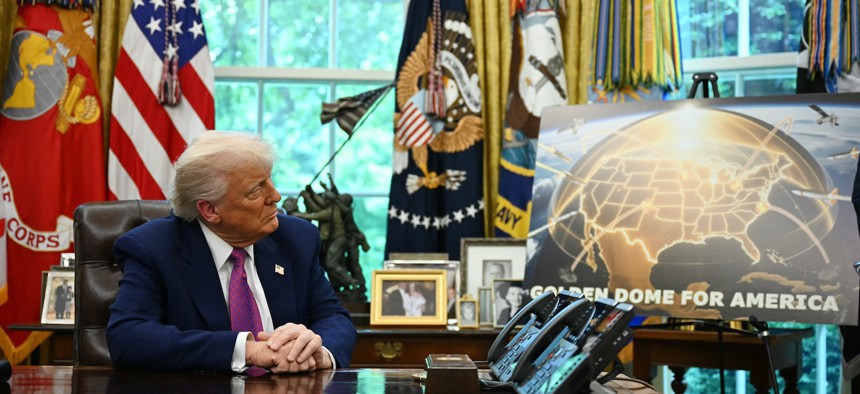
President Donald Trump listens during an announcement about the Golden Dome missile defense shield, on May 20, 2025. JIM WATSON / AFP via Getty Images


Appropriators slash Trump’s $17B Golden Dome request in draft bill
GOP-led committee says reliance on reconciliation “threatens” the missile defense program’s success.

Senate appropriators reined in President Donald Trump's $17 billion-plus Golden Dome ask this week, pushing roughly half the administration’s request into a draft defense bill that budget experts said is unlikely to pass, signaling that long-term funding for the missile-defense system can’t rely on a one-time measure facing uncertainty in the lame-duck Congress.
The nearly $1.1 trillion proposal released by the GOP-led Senate Appropriations Committee on Monday contains tens of billions in funding for priority defense programs—including Golden Dome—that the administration has been zealously campaigning for via a $350 billion reconciliation measure, one dogged by backlash over Iran war spending.
Nearly all of the $17.5 billion Golden Dome request is tied up in reconciliation, making it particularly vulnerable to funding uncertainty, as the program’s Space Force lead acknowledged as far back as August. Only about $398 million of the administration’s base budget request was allocated for the program.
As GOP lawmakers scramble to push the administration’s defense priorities through before a Democratic majority takes Congress in January, appropriators tagged nearly $9.4 billion for Golden Dome in their fiscal 2027 defense draft—a steadier funding vehicle—saying the administration’s reliance on reconciliation measures “threatens the success” of the program
“The chances of Golden Dome getting the full $17 billion requested are now almost zero,” Todd Harrison, a defense budget analyst with AEI, told Defense One on Wednesday. “The best they’re gonna get is probably $9 billion, and in all likelihood, it’ll be less than that.”
Defense budget experts described the proposal in its current form as legislatively toothless, given the ticking clock and the need for Democratic support. Aside from signalling scrutiny about Golden Dome funding beyond Trump’s second term, they said the bill could also help set stakes for negotiations with a Democratic-led Congress next year.
“It's Republicans, in their own kind of way, indicating that they are open to negotiations, productive negotiations with the new Democratic majority come January,” said Carlton Haelig, a defense expert with the Center for a New American Security. “I don't think that this is a DOA legislative effort. Obviously, it's not going to pass, but it's more than just about passing the legislation.”
The draft does not specify which “select” Golden Dome initiatives would be covered by the $9 billion figure. Even so, Harrison said the program will likely “have to rethink the scope of its architecture, what pieces were included, and how fast they can actually go.”
Republican Sen. Mitch McConnell, who chairs the defense appropriations subcommittee, in a press release seemed to mirror the sentiment that reconciliation is unviable, calling the draft a “roadmap to sustainably and responsibly” deliver defense priorities, adding that deterring a growing cast of threats is “bigger than one-time surges of cash.”
Following GOP conferences and a meeting with Deputy Defense Secretary Steve Feinberg on Wednesday, several news outlets reported that Republicans didn’t reach a consensus over defense spending, though some kept the door open to reconciliation or striking a deal with the current Democratic minority through regular appropriations. Adding to the pressure is a continuing resolution set to expire next month.
Meanwhile, the administration is still pushing for maximum funding, including for Golden Dome and other priorities, via reconciliation. Officials are also touting progress on the missile defense program, which got more than $24 billion through the One Big Beautiful Bill Act last year.
The secretive initiative aims to build an interconnected suite of interceptors, sensors, and defenses to protect the U.S. from missile and aerial threats, which the administration considers “the most catastrophic threat facing” the country.
Golden Dome Deputy Director Marcia Holmes told an audience Tuesday at the Golden Age of Space conference, hosted by the Washington Times, that a key component of the missile-defense system—a command and control platform meant to connect disparate threat-tracking technology—has recently been successful in testing, having drawn lessons from the Iran war.
“The multi-domain coordinated defense operations executed recently in the Middle East, repelling massive synchronized silos of ballistic missiles, land attack cruise missiles, and drones, have been a goldmine of real-world operational data for our C2 development,” Holmes said. “That fight proved that when you seamlessly share tracks, allocate engagements, and deconflict fires across multinational and multi-service assets, mass attacks fail.”
She also acknowledged to the Washington Times that the administration is still seeking a total $185 billion from lawmakers for the program’s long-term sustainment—up from the Trump administration’s initial request, but still a far cry from the $1.2 trillion, 20-year bill the Congressional Budget Office recently estimated.
The day prior, Republican appropriators requested an independent estimate from the Cost Assessment and Program Evaluation office within 90 days should their bill pass. They likely did so “because they don't necessarily believe the president's estimate for how much it's going to cost,” Haelig said.
“To me, it sounds like it's also the Republicans, perhaps given the political wind of the last few weeks, are starting to shift and be more oppositional toward the White House in what they're willing to go along with,” he said, noting that GOP appropriators still acknowledge how important it is to fund Golden Dome, but want to do so through budget vehicles they can oversee.
Holmes affirmed that the administration will work with Congress to fund Golden Dome construction, with the goal of reaching initial operating capacity in 2028.
“What I’m getting is that the administration is only looking through 2028, and they don’t really seem to care what happens after that,” Harrison said. “They’re only trying to get to a point where they can declare some sort of victory, some sort of initial operational capability before the president leaves office. What happens after that doesn’t appear to be a priority.”
NEXT STORY: The secret terms of Trump’s Venezuelan oil deal