

sponsor content What's this?


AI at the edge: Making mission-critical intelligence practical
Presented by
Crystal Group

Presented by
Crystal Group
Artificial intelligence is transforming how defense organizations, critical infrastructure operators, and industrial teams collect data, interpret threats, and make decisions. As AI capabilities advance, organizations are moving beyond centralized cloud environments and bringing intelligence closer to where operations occur. The result is a growing shift toward AI at the edge, deploying advanced computing alongside sensors, platforms, and operational systems.

This shift is becoming a strategic requirement for environments where speed, resilience, and autonomy determine mission success.
However, deploying AI at the edge involves more than moving algorithms closer to the data source. Real-world environments introduce operational challenges that conventional computing platforms were never designed to handle. Delivering reliable AI performance outside controlled data centers requires rugged, cyber-secure computing infrastructure built for extreme conditions.
Edge environments demand a different approach
Edge AI systems operate in environments far removed from traditional data centers. Platforms may include aircraft, ships, autonomous vehicles, forward operating bases, or remote infrastructure sites. In these locations, hardware is routinely exposed to vibration, shock, extreme temperatures, dust, moisture, and unstable power.
Commercial servers often struggle under these conditions.
For defense and critical infrastructure operators, reliability is essential for mission success. A system failure, unexpected shutdown, or thermal throttling event can interrupt workflows, delay decisions, and compromise safety.
Purpose-built rugged computing addresses these challenges. Crystal Group designs edge platforms engineered to withstand operational extremes while delivering predictable performance across long deployment lifecycles. These systems help ensure AI workloads continue operating even when environmental stressors disable conventional hardware.
Delivering AI performance within SWaP constraints
Many edge deployments operate within strict size, weight, and power (SWaP) limits. Autonomous platforms, tactical vehicles, and remote installations cannot support the power draw or cooling requirements of traditional servers.
At the same time, AI workloads continue to grow in complexity. Applications such as sensor fusion, predictive analytics, and real-time inferencing require powerful processors and accelerators.
Balancing performance with SWaP constraints is a persistent challenge.
Crystal Group addresses this by integrating advanced processors and accelerators into compact, rugged architectures optimized for edge deployment. These systems deliver the compute density required for real-time AI processing while maintaining efficiency within demanding SWaP envelopes.
The result is computing infrastructure that supports both durability and performance.
Enabling faster decisions at the source
Latency remains one of the biggest barriers to effective AI deployment. In many mission environments, decisions must occur instantly. Sending sensor data to distant data centers for processing introduces delays that reduce the value of AI insights.
Edge architectures solve this challenge by placing compute directly at the source of data.
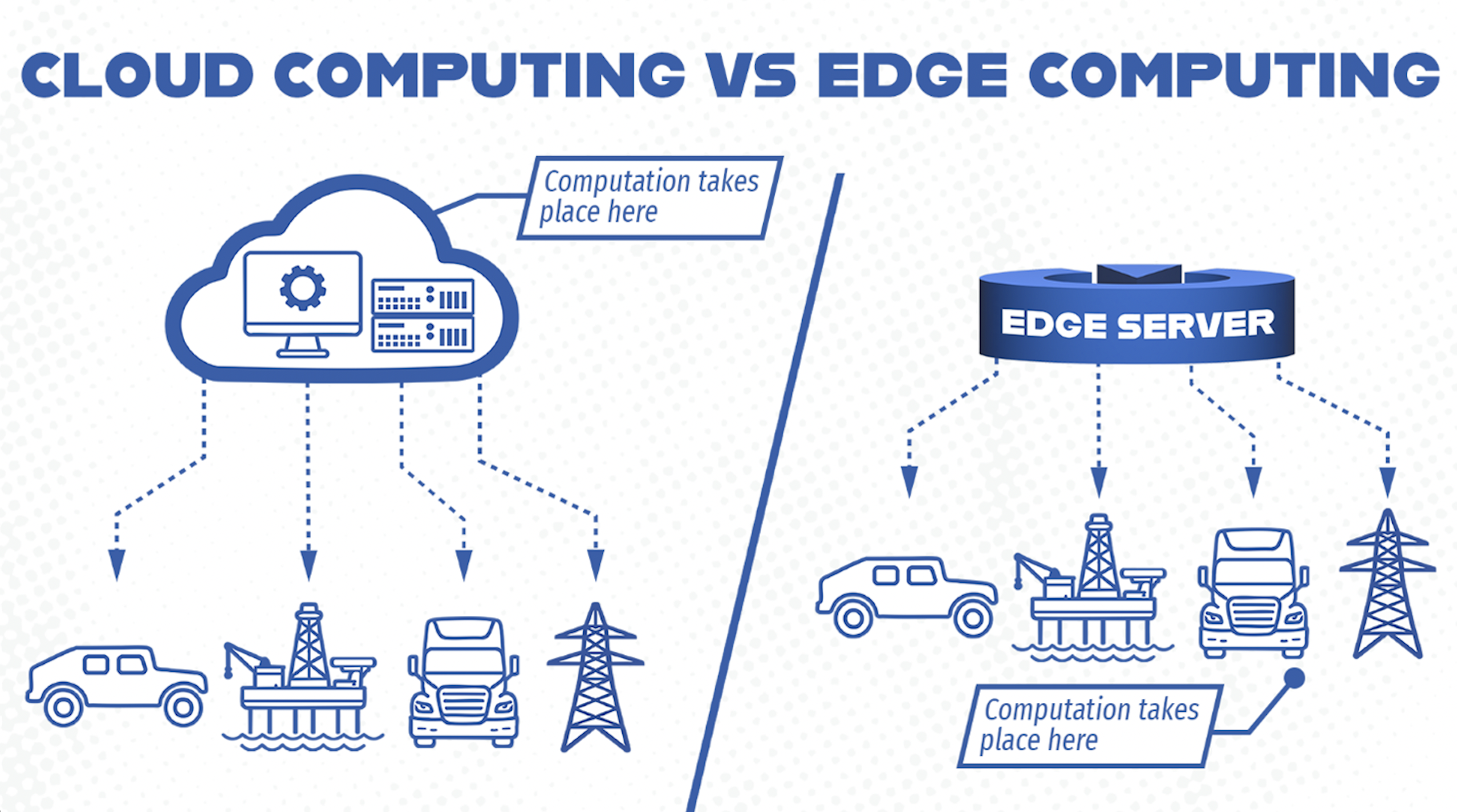
Edge architectures place compute at the source of data, reducing latency and dependence on continuous connectivity.
Local processing reduces latency and minimizes dependence on continuous network connectivity. This capability is critical in contested environments, remote locations, and mobile operations where communications infrastructure may be limited or unreliable.
By enabling AI workloads to run where data is generated, rugged edge platforms support faster analysis, improved situational awareness, and greater operational autonomy.
The foundation for mission-ready AI
AI at the edge is rapidly becoming essential for organizations that require real-time intelligence and resilient decision-making.
These capabilities depend on infrastructure designed for the environments where operations take place.
By addressing challenges related to environmental durability, SWaP constraints, latency, and reliability, Crystal Group enables AI systems that perform consistently under pressure. Rugged hardware makes mission-critical intelligence practical, dependable, and ready to deploy wherever operations demand it.
This content is made possible by our sponsor Crystal Group; it is not written by and does not necessarily reflect the views of Defense One’s editorial staff.
NEXT STORY: A production powerhouse for US Navy radars