

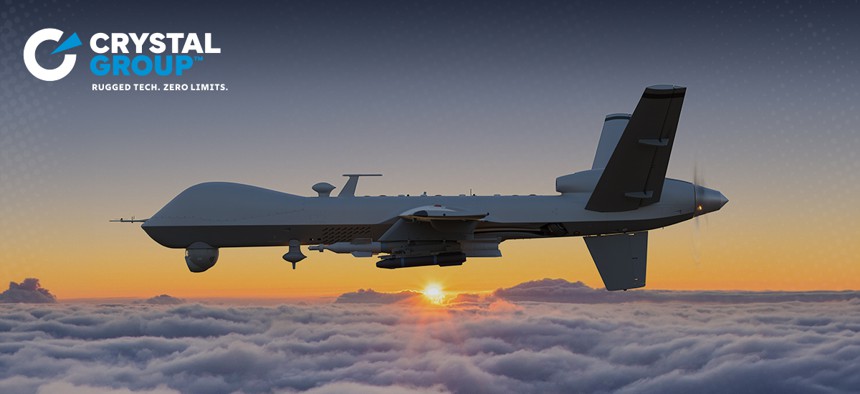

Commercial autonomy is accelerating military capability
Presented by
Crystal Group

Presented by
Crystal Group
Innovation in autonomous and unmanned systems is no longer driven exclusively by defense programs. Today, many of the most significant advances in perception, artificial intelligence, sensor fusion, and autonomous navigation are happening in the commercial sector, where development cycles move at startup speed. For defense organizations worldwide, this shift presents a powerful opportunity to accelerate capability by adapting proven commercial technologies for military operations.
Commercial autonomy companies are solving complex navigation challenges across industries such as warehousing, construction, agriculture, mining, and logistics. Their software enables vehicles and robotic systems to understand terrain, avoid obstacles, plan routes, and operate with minimal human intervention. These capabilities are being refined at scale, benefiting from continuous iteration, large data sets, and rapid innovation cycles.
The relevance to defense applications is clear. Autonomous technologies developed for commercial use can support a wide range of military missions, including resupply operations, reconnaissance, route clearance, engineering support, and contested logistics. In environments where reducing risk to personnel is critical, autonomy offers a force multiplier that enhances both operational effectiveness and survivability.
However, commercial innovation alone does not create a military-ready solution.
The transition from commercial prototype to deployed defense capability requires more than advanced software. It demands hardware and system architectures that can withstand the realities of operational environments. Military platforms must perform reliably in extreme temperatures, persistent vibration, dust, moisture, electromagnetic interference, and unpredictable power conditions. These are not edge cases. They are the baseline conditions under which defense systems must operate.
Compute systems, in particular, play a central role in enabling autonomy. Modern autonomous platforms rely on high-performance processing to support real-time sensor fusion, machine learning inference, communications, cybersecurity, and mission management. These workloads must be executed simultaneously, often in constrained environments where size, weight, and power are limited. Maintaining consistent performance under these conditions is essential to mission success.
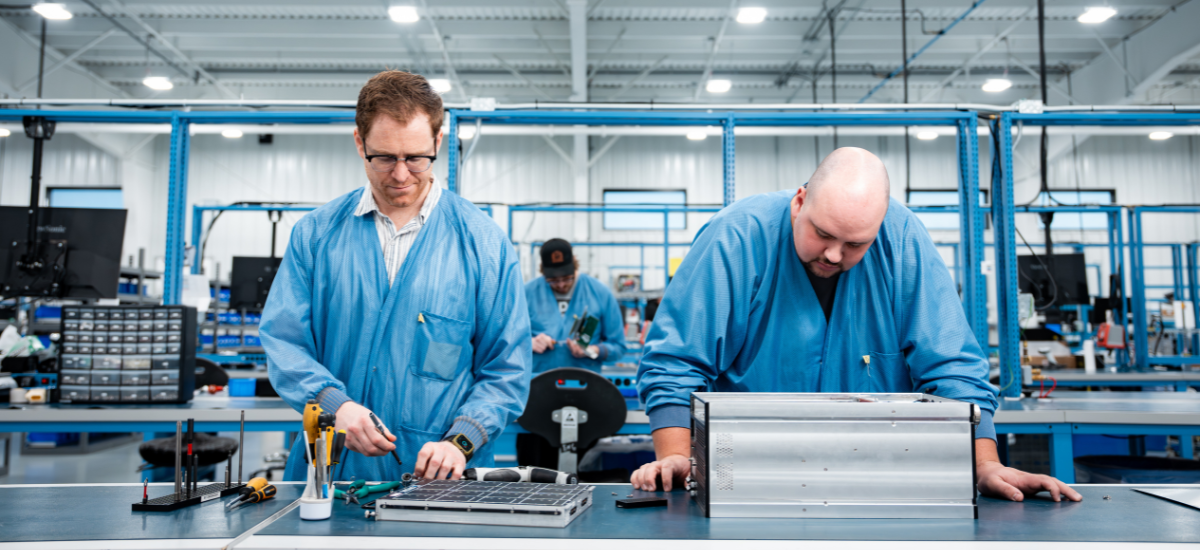
This is where ruggedization becomes an enabler rather than an afterthought.
Rugged compute platforms are designed from the ground up to deliver reliable performance in harsh environments. They incorporate thermal management strategies that allow processors and GPUs to operate at full capacity without throttling, even in extreme heat or limited airflow. They are engineered to withstand shock and vibration, ensuring continued operation on mobile platforms such as ground vehicles, aircraft, and maritime systems. They also address electromagnetic compatibility requirements, allowing multiple electronic systems to operate in close proximity without interference.
As autonomous systems become more capable, onboard computing requirements will continue to grow. The ability to process data at the edge, close to where it is generated, reduces latency, enhances decision-making speed, and minimizes reliance on vulnerable communication links. Rugged compute platforms make it possible to bring advanced AI capabilities out of controlled testing environments and into real-world operations without sacrificing reliability.
Equally important is the ability to rapidly integrate evolving commercial technologies. The pace of innovation in sensors, processors, and AI models shows no signs of slowing. Defense organizations must be able to incorporate these advancements without undergoing lengthy and costly redesigns. Modular hardware and scalable compute platforms enable this flexibility, allowing systems to evolve over time while preserving existing investments.
This approach also supports interoperability across platforms and domains. As defense operations become increasingly joint and multi-domain, systems must be able to share data and operate cohesively across land, air, sea, space, and cyber environments. Standardized interfaces and adaptable computing infrastructure help ensure that autonomous capabilities can be deployed wherever they are needed.
The future of defense autonomy will not be built by choosing between commercial innovation and military engineering. Instead, it will come from combining the speed and creativity of commercial development with infrastructure designed specifically for defense missions. This integration allows organizations to leverage the best of both worlds, rapid technological advancement and proven operational resilience.
As autonomous systems continue to evolve, success will depend on more than intelligent algorithms. It will require resilient computing platforms that enable commercial innovation to operate where the mission demands it most, at the tactical edge, under the harshest conditions, and with unwavering reliability.
This content is made possible by our sponsor Crystal Group; it is not written by and does not necessarily reflect the views of Defense One’s editorial staff.
NEXT STORY: Cyber Defense at Machine Speed