

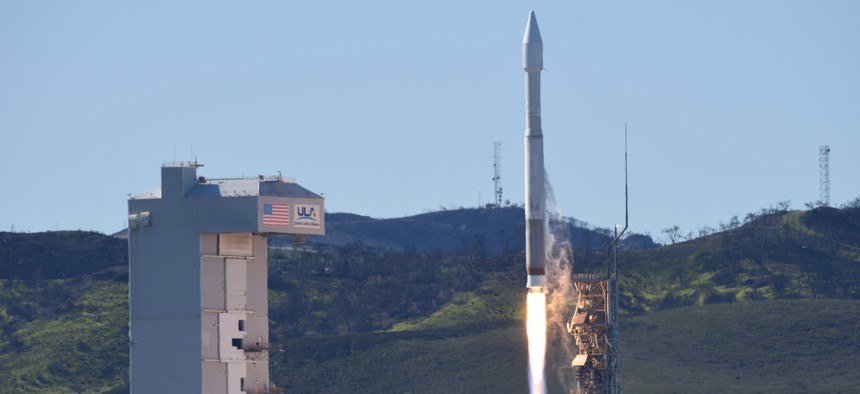
A National Reconnaissance Office payload on a United Launch Alliance Atlas V rocket launches March 1, 2017, at Vandenberg Air Force Base, Calif. U.S. Air Force / Senior Airman Ian Dudley



US military bought commercial satellite images of alleged narco airstrips, Chinese naval fleet
The Space Force can improve how it embraces commercial intel, a new GAO report says.

The U.S. military purchased satellite images that identified Chinese aircraft carrier positions and Ecuadorian airstrips allegedly used for drug trafficking, a new report from the Government Accountability Office revealed. But despite those and other examples of prior use, the Space Force still hasn’t fully embraced commercial intelligence, the watchdog said.
“Some Space Force officials told GAO about challenges they have faced related to purchasing and using commercial space data such as licensing costs, perceived use restrictions, and concerns over long-term access to the data,” the report said. “These challenges led to hesitation to purchase and use commercial data among these potential users.”
The Space Force’s Joint Commercial Operations Cell, the group that buys the majority of the service’s data, spent nearly $77 million between 2023 and 2025 on commercial space services through the Global Data Marketplace, an e-commerce site used by the military for unclassified images. The JCO has a working group to discuss purchases being made by the U.S. government, but Space Force officials aren’t included in that group, according to the report. That’s led to the hesitations and confusion about purchasing intelligence on the platform, the GAO said.
“This working group meets monthly and coordinates purchases. GAO found that many of the challenges reported by Space Force officials could have been addressed with discussions at the working group, but the Space Force officials were not part of the working group and information about the working group is not widely available,” the watchdog report said.
The GAO recommended that Air Force Secretary Troy Meink, who formerly served as principal deputy director of the National Reconnaissance Office, increase communication and awareness of the working group. The Defense Department concurred with the watchdog’s findings in a June 18 response.
“Increased communication about the working group could lead to additional Space Force and other officials engaging in discussions that could address perceived issues and improve the use of commercial space data and services for national security purposes,” the GAO report said.
The Space Force will need to rely on those commercial assets for future fights, according to the GAO. As adversary counterspace capabilities grow, the Defense Department needs private satellite imagery to fill in blind spots and decrease risk to its own space assets.
“Threats to DoD’s space assets from strategic competitors have grown substantially in number and intensity,” the GAO report said. “DoD is working to integrate commercial space solutions, such as data and services, to mitigate these threats as well as enhance its capabilities.”
Jon Ludwigson, GAO’s contracting and national security acquisitions director, said in a phone interview on Thursday afternoon that there are positives to using those commercial systems in tandem with the military’s highly-classified spy satellites.
“We're not going to use commercial data for everything, but if we can use it for some things, it reduces the pressure on the exquisite systems to do things,” Ludwigson said. “It also gives us the opportunity to cue others that we're watching in ways that don't require us to disclose that we're using exquisite systems.”
The National Reconnaissance Office, an intelligence agency which builds and launches spy satellites, purchased commercial electro-optical imagery from Vantor, Planet Labs, and BlackSky through its $4 billion Electro-Optical Commercial Layer contract awarded in 2022, according to GAO.
Images purchased by NRO in 2024 showed “changes in Chinese aircraft carriers and other ships’ locations over time, and identify the types of ships” at Sanya Naval Base in Hainan province.
That same year, JCO purchased images that “helped the U.S. Southern Command identify possible clandestine airstrips in Ecuador.” The U.S. government shared the intelligence, which led the Ecuadorian government “to further investigate and disable the airstrips that were likely used by narcotraffickers,” GAO reported.
Identifying those sites and sharing their locations with Ecuador is an example of how governments can benefit from the unclassified imagery, Ludwigson said. It also protects and frees up use of the military’s most crucial spy satellites.
“When we go to share stuff that's coming off an exquisite system, that image is, itself, classified,” he said. “So, if we can use commercial imagery for those conversations with the Ecuadorian government or other governments to say, ‘Hey, look at this. This is what we think it is, and this is what we are concerned about,’ it’'s a commercial asset, then we haven't given up anything about our exquisite assets.”