

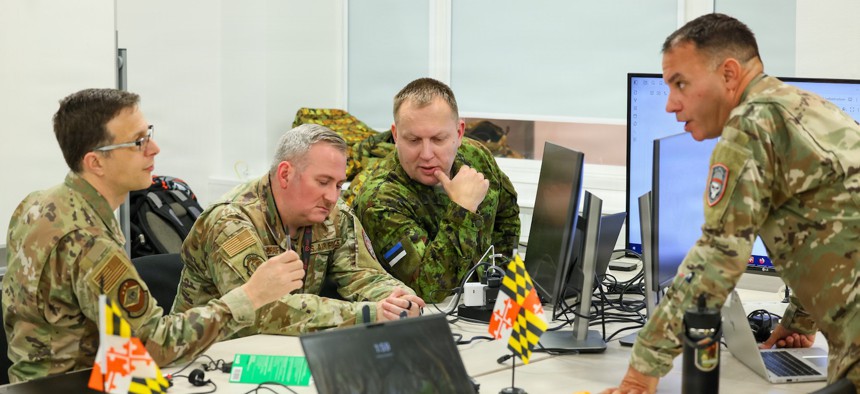
Maryland Air National Guard troops and Estonian troops participate in Crossed Swords 25 in Tallinn, Estonia, November 3, 2025. Courtesy / Air National Guard


OpenAI gives NATO access to most advanced cybersecurity AI
NATO operators this month built and deployed AI agents in an exercise, with help from OpenAI.

IZMIR, Turkey—NATO governments will now have access to OpenAI’s most powerful AI models to find and patch cyber vulnerabilities, company executives said Tuesday at an alliance conference here.
The announcement follows new NATO efforts to allow operators to work with new cyber tools, including AI agents, in key exercises such as Crossed Swords, a cyber wargame that took place in Tallinn, Estonia, earlier this month. Participants designed and deployed AI agents to achieve missions, “working alongside them as operators. The technical environment also uses on-premises AI and, for the first time in the exercise, OpenAI Daybreak,” according to a NATO announcement.
The move marks an international expansion of the company’s Daybreak effort, launched in May, which gives accredited institutions and the U.S. government access to the company’s most advanced models to find vulnerabilities in key pieces of software. Anthropic’s Project Glasswing, launched in April, is similar.
OpenAI made the announcement during NATO Edge, the alliance's largest annual technology business event. This year, more than 3,500 attendees and more than 270 exhibitors came to discuss security, tech, and business opportunities resulting from NATO’s growing defense commitments. A NATO official said the NATO Communications and Information Agency, orNCIA, will award more than $3 billion in contracts to industry by the end of 2027, with a heavy focus on cloud computing, space services, and artificial intelligence. That $3 billion is on top of whatever NATO allies each spend on AI. Not surprisingly, many of the exhibitors offered AI tools or AI-powered products.
This event also comes as Russia increases its cyber attacks on NATO allies. Cybersecurity experts and officials have warned for years that AI would enable actors like Russian criminal groups to multiply their efforts, exposing more vulnerabilities in software and helping attackers write more effective malware. That could fuel Russian efforts to cause havoc and disruption in Western populations and drive public frustration with their governments. A growing number of cybersecurity experts, along with executives from AI giants OpenAI and Anthropic, have said that the best defense is to use AI in new ways to find and fix vulnerabilities first.
That philosophy drove the emphasis on agentic AI cyber defense at this year’s Crossed Swords.
In Izmir, OpenAI national security and policy head Sasha Baker said what tech companies and NATO need to focus on is “collapsing that time window from when a vulnerability is discovered to when it is patched…from months to weeks to hours to minutes? That's the outcome that we want to achieve. And so I encourage you all to hold us accountable for that.”
NEXT STORY: 'Robot Wars': Defense One Futures, Ep. 1