

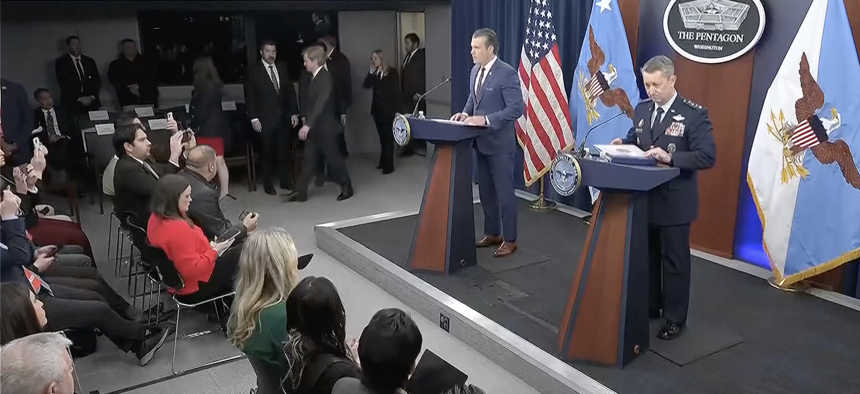
Defense Secretary Pete Hegseth and Joint Chiefs Chairman Gen. Dan Caine brief reporters on March 2, 2026. Defense Department



Hegseth: second operation against Iran won’t lead to another ‘forever war’
Casualties include four U.S. service member deaths, three F-15s downed by friendly fire.

The Pentagon is adamant that the new U.S. bombing campaign in Iran will not lead to another decades-long war, but Defense Secretary Pete Hegseth refused Monday to repeat any of the possible timelines offered by his boss over the past 24 hours, nor to take the deployment of U.S. troops into Iran off the table.
In his first press conference since the last time the U.S. struck Iran, in June, Hegseth said the U.S. chose to strike conventional Iranian military assets because they were part of Tehran’s plan to build nuclear weapons.
“Iran was building powerful missiles and drones to create a conventional shield for their nuclear blackmail ambitions,” he said. “Our bases, our people, our allies—Iran had a conventional gun to our head as they tried to lie their way to a nuclear bomb.”
The administration’s claims that Iran had restarted its nuclear program, had enough material to build a bomb, and that it is developing long-range ballistic missiles with the ability to strike the United States are “false or unproven,” the New York Times reported last week. Last year, the Defense Intelligence Agency assessed that Iran has no such missiles, and that it would take a decade to amass 60 of them.
As has been Hegseth’s custom, but a stark departure from his predecessors, the secretary used the press conference to deliver a political speech that praised President Trump for his leadership and castigated former president Biden.
But Hegseth spared operational details, including a way ahead. He also made no mention of the casualties the U.S. has taken thus far, including four confirmed deaths as of Monday morning.
At the press conference, streamed from the Pentagon’s briefing room, Joint Chiefs Chairman Gen. Dan Caine confirmed that the overnight downing of three F-15E fighters was not the result of enemy fire, though he would not elaborate.
An hour before the press conference began, U.S. Central Command officials confirmed the jets were accidentally shot down by Kuwaiti forces.
In his remarks detailing the planning and execution of the operation, Caine started off by offering condolences to the family and friends of the fallen.
“As the secretary said, they are heroes and represent the best our nation has to offer,” Caine said as he read his prepared remarks, apparently having assumed that he would be echoing a sentiment that Hegseth never offered.
Instead, the secretary gloated over the operation’s success and called on Iranians to “take advantage” of the country’s power vacuum.
“Turns out the regime who chanted 'death to America' and 'death to Israel' was gifted death from America and death from Israel,” Hegseth said. “This is not a so-called regime-change war, but regime sure did change."
Later, in a direct appeal to U.S. troops, Hegseth encouraged them to ignore “the noise” and “stay focused.”
In his prepared remarks, Caine acknowledged the U.S. personnel abroad still in harm’s way, including at a U.S. Navy base in Bahrain that took fire over the weekend, later prompting an evacuation of its personnel still in the city.
“I am proud of all of you as you take the fight to the enemy,” he said.
The way forward
After the June strikes, Hegseth and other administration officials repeatedly said Iran’s nuclear capabilities were “obliterated.” On Monday, Hegseth said that Iran’s refusal to negotiate a deal that would end its nuclear ambitions required further strikes.
“The former regime had every chance to make a peaceful and sensible deal,” he said. “Tehran was not negotiating. They were stalling, buying time to reload their missile stockpiles and restart their nuclear ambitions.”
He did not mention the 2015 nuclear deal that Trump scuttled during his first term in office.
Trump has offered several possible timelines for the operation, including telling the Daily Mail on Sunday that it could take “four weeks or less.”
When a reporter asked Hegseth about the timeline, the secretary called it a “typical NBC, sort of gotcha-type question.”
“So you can play games about four weeks, five weeks—he has all the latitude, and I'm glad he does, because there's no better communicator than our president at expressing those things,” he said.
After calling the U.S. goals “realistic” and “not utopian” in his prepared remarks, Hegseth responded to a reporter’s question about the administration’s objectives with a short list of capabilities the administration doesn’t want Iran to have, including long-range ballistic missiles and attack drones.
“So that's a discrete reason of what is being addressed here, to ensure that they can’t use that conventional umbrella to continue a pursuit of nuclear ambitions,” he said.
And asked whether there were any U.S. troops in Iran at the moment, Hegseth scoffed.
“No, but we're not going to go into the exercise of what we will not do,” he said, calling it a “fallacy” that past administrations would preemptively draw lines in the sand about how far they would go.
“Why in the world would we tell you, the enemy, anybody, what we will or will not do in pursuit of an objective?” he said. “We fight to win. We fight to achieve objectives the president of the United States has laid out, and we will do so unapologetically.”
Caine said that more tactical aviation assets are heading into the Middle East, adding to the largest U.S. buildup in the region since the Global War on Terror.
“We’re just about where we want to be in terms of total combat capacity,” he added.
Help us report on the future of national security. Contact Meghann Myers: mmyers@defenseone.com, meghannmyers.55 on Signal.
NEXT STORY: ‘It sounded relentless’: American in Bahrain describes days of drone and missile attacks