

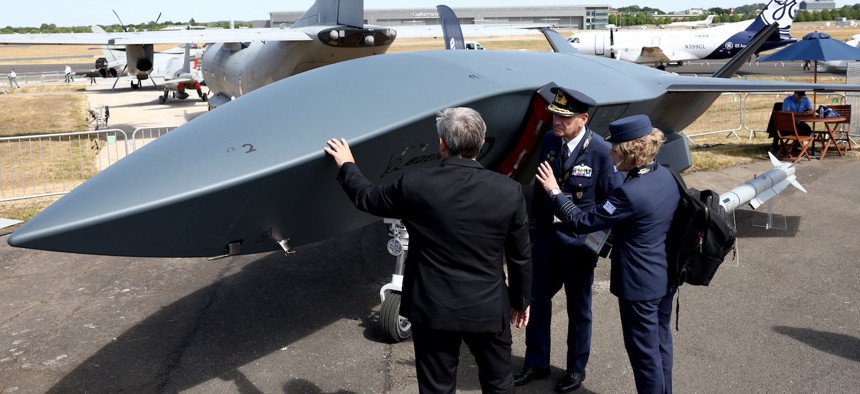
Members of the Greek air force look at the Boeing MQ-28 Ghost Bat on the opening day of the Farnborough International Airshow, July 20, 2026. Toby Shepheard / AFP via Getty Images



Boeing adjusts approach to court more European business
Growing international workforce, manufacturing and assembly come into focus as the aerospace giant pitches platforms abroad.

LONDON—Keeping some things local will be key for U.S. weapons makers that want to expand their business in Europe, a top Boeing executive said.
That can mean not being a prime on certain contracts, teaming with European defense companies, employing locals, and designing future platforms—like the MQ-28 Ghost Bat—with open architecture that can be tailored to fit international militaries’ needs.
“I would say that we've been listening a little bit [differently] for the past couple of years, as there has been some kind of shift in Europe,” Steve Parker, Boeing’s president and CEO for its defense business, told reporters Sunday ahead of the Farnborough International Airshow.
For example, as part of an upcoming bid competition, Boeing is pitching its T-7A fighter jet training platform—built with Saab for the U.S. Air Force—to be the Royal Air Force’s next trainer.
“We're going to bring what I believe is the world's most advanced training system to the UK, and we'll compete there very differently with a UK focus and a final assembly checkout line here,” Parker said, “We are teamed with BAE Systems, and…they will prime an opportunity for us, and this is all about British jobs.”
BAE Systems announced the solidification of the multivendor bid for T-7 on Tuesday.
Having BAE, Saab, and Boeing bid together “aligns with the ambition of the Defence Investment Plan, while strengthening the UK’s sovereign industrial capability,” Charles Woodburn, BAE Systems’ CEO, said in a news release announcing the decision.
And for Boeing, it’s a way to emphasize their commitment to keeping European business.
“Boeing Defense UK, we started with five employees. We're up to over 2,100—those are 2,100 jobs here in the UK. I don't care whose name is on the door,” Chris Raymond, Boeing’s president and CEO of global services told reporters. “And you’ve got to create those partnerships between a piece of kit they want and an industrial participation plan that works and gets the local capability starting to grow.”
Raymond said the company has employed that strategy in the UK, Australia, India, Japan, and Canada.
The comments come as the UK and other European countries boost their defense spending and increasingly look internally at domestic defense companies.
From a tech perspective, collaborative design using modular open systems architecture can give foreign governments more flexibility and “provides the country sovereignty,” Parker said of Boeing’s MQ-28 Ghost Bat, a collaborative combat aircraft that will be on display for the first time this week at Farnborough.
The St. Louis-based company is working with Rheinmettall and others to put their technology on the German version of the Ghost Bat aircraft.
“We've teamed with Rheinmetall and a number of other German companies to offer that up to the [German armed forces] and the [German air force], and they will have similar control of what systems they want to put on,” he said. “We're changing the way we bring these capabilities to bear, and sort of the value proposition of the offering. And I think there's more to come there as well. So, it's playing out. We've been looking at it for a couple of years, and I think there's a lot of opportunity for us if we think differently, which is what we're doing.”