

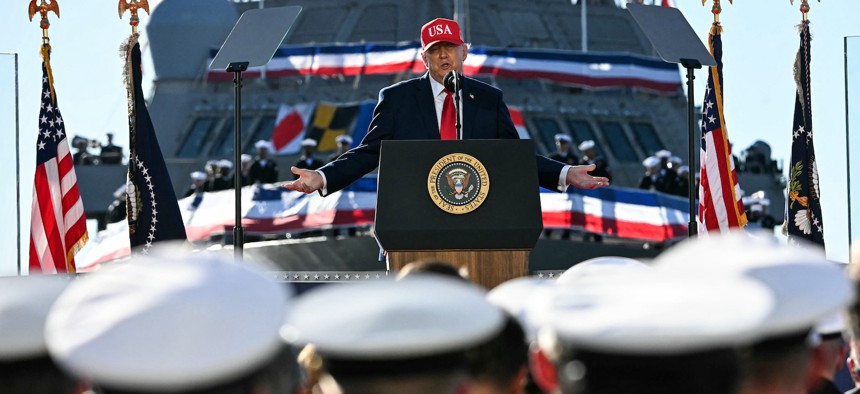
President Trump speaks in Sparrows Point, Maryland, standing in front of the USS Billings, a Freedom-variant littoral combat ship, on October 6, 2026. Jim WATSON / AFP via Getty Images



Anduril wades into traditional shipbuilding arena with major submarine play
The defense tech company plans to build submarine components at a shipyard outside of Baltimore in which the government will have an approximate 40 percent stake, President Donald Trump said Tuesday.
SPARROWS POINT, Md.—Defense tech company Anduril aims to speed up Virginia-class submarine production by building components, such as torpedo tubes, at a future site outside the nation’s capital by 2030.
The new facility, to be called Arsenal-2, will be the company’s second manufacturing plant and is part of a $6.6 billion effort funded by Anduril, at $3.7 billion, and the U.S. Navy through a $2.9 billion contract award. That contract tasks Anduril with building “critical components and large scale assemblies of the Virginia-class” to be delivered to General Dynamics Electric Boat in Connecticut, and HII Newport News Shipbuilding in Virginia, which are the prime contractors on the Navy’s submarine programs, according to the company’s announcement.
Flanked by two of Anduril’s Dive-XL vessels, President Donald Trump spoke to a mostly Navy audience Tuesday on a range of topics, from Venezuela to tariffs, and even gave a quick endorsement of subsea autonomous vessels before he announced the U.S. government’s stake in the new shipyard.
“The ultimate proof of our commitment to ensuring the shipyard's enduring success: American taxpayers will receive a 40 percent stake in the new shipyard. We get 40 percent,” Trump said, without providing more details.
That stake is in a new Anduril subsidiary created to operate the future shipyard. The government is not taking an equity stake in Anduril, the company said.
Additional specifics on the deal were not immediately available.
Submarines are “our oceans' apex predators” that are needed “now more than ever” for deterrence, Vice Adm. Robert Gaucher, who oversees the Navy’s submarine construction, said during the event at Tradepoint Atlantic near Baltimore. But he also acknowledged the nation’s lack of shipbuilding capacity.
“As other nations challenge the rules-based order that keeps our oceans free and open, we need the deterrence and denial of our submarines now more than ever,” he said. “At the same time, we must reckon with the fact that we have lost industrial capacity. Today, we start to rebuild it.”
The shipyard is being designed with reconfigurable production lines and will be underpinned by Anduril’s ArsenalOS industrial software platform.
“What we're really focused on here is being able to build an entire shipyard with a software and digital foundation. So that covers everything from how the factory is laid out, how work moves through the factory in a logical way, how all of that work is managed,” Chris Brose, Anduril’s president and chief strategy officer, told reporters.
That means “automating things that you can automate, keeping digital records of things like precision welding, so that you have traceability back to all the work that was done and an ability to understand, in very precise detail, for the purposes of certification and other types of kind of safety critical measures, what was done at what point all along the way, and having that traceability throughout the entire yard.”
The idea, he said, is for software to make it easier for new or inexperienced shipbuilders to perform tasks because they “can come in with a modicum of training enabled by technology—with digital designs, technical augmentation—and really understand how they can [be] contributing much, much faster.”
The company plans to break ground by early 2027 on Arsenal-2, which will span approximately 40 football fields on nearly 200 acres just outside of Baltimore. Initial operations are slated to begin by 2030.
The Navy contract also ties payments to “demonstrated production outcomes,” Anduril said in its news release.
Having a non-traditional defense company like Anduril building submarine components is an example of the Navy’s strategy to increase shipbuilding throughput by distributing the workload across multiple suppliers in the industrial base.
“Today, roughly 10 percent of shipbuilding work is performed at distributed sites. Our goal is 50 percent. New hulls will prioritize modular, digital designs that enable distributed shipbuilding across multiple yards and suppliers,” the Navy wrote in its 2026 shipbuilding plan earlier this year.
The move also deepens the Pentagon’s relationship with the company, which has several contracts across the military, and its leaders. Last week, Defense Secretary Pete Hegseth named Anduril’s founder, Palmer Luckey, as part of an advising committee for Project Meridian, which will analyze future warfare needs.
Once operational, Anduril’s Baltimore plant is expected to increase overall Navy submarine production by 15 percent or about 9 million production hours per year. That should then translate into more ships produced through the Newport News and Electric Boat shipyards, Gaucher said: “Situated geographically between these two prime shipyards and connected to them by a network of sea, rail, and road, Arsenal-2 will take on the heavy component manufacturing.”
The facility will also build “components our prime shipyards need today, like precision torpedo tubes and impulse tanks,” he said, eventually “moving on to complex rafted module assemblies.”
The company also plans to eventually build sections of the ship’s hull.
Tuesday’s audience included about 100 sailors, and 200 midshipmen bused an hour from the U.S. Naval Academy in Annapolis. Acting Navy Secretary Hung Cao and Hegseth also spoke at the event.
The USS Billings, which was recently deployed in the Caribbean, served as a prominent backdrop to the stage. Sailors aboard the Freedom-class littoral combat ship could be seen standing at attention during the president’s address.
But many high-level Maryland officials, including Democratic Gov. Wes Moore, were absent from the hourslong event. Moore apparently skipped the event after being denied a speaking slot. Four Baltimore Ravens football players attended and did not speak, but were asked to stand as part of a special shoutout during the president’s remarks.