

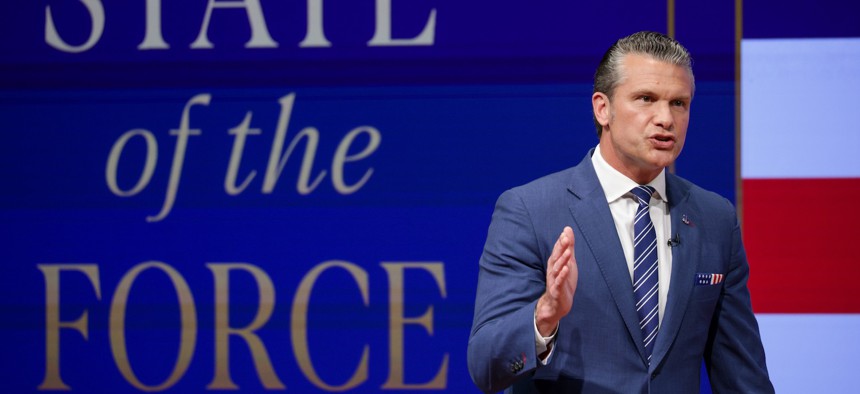
Defense Secretary Pete Hegseth gives a State of the Force address at Marine Corps Base Quantico, Virginia, on September 30, 2026. Alex Wong / Getty Images



Hegseth plans ‘Autonomous Warfare Command’
The military’s 12th combatant command was among a slew of announcements in a Quantico speech Wednesday.
The Pentagon will create a combatant command to lead its efforts to develop and deploy robotic weapons, Defense Secretary Pete Hegseth said Wednesday in a speech peppered with Bible verses and insults to the press.
The new Autonomous Warfare Command, or AUTOWARCOM, will be “a new four-star combatant command with service-like authorities built to scale autonomous and robotic capabilities across the joint force,” Hegseth said. It is to stand up by Oct. 1, 2027, according to a memo released after his speech.
The secretary seemed to say that planning for the new command would flow from the three-month-old direct reporting portfolio manager for unmanned offensive and defensive systems, whose “culminating mission” will “take place over the course of months, clearing the path for Autonomous Warfare Command.” In the meantime, the office is being given a new task: to “prototype a new construct called warfighting acquisition” that “fuses operators with entrepreneurs in rapid adaptation cycles while distributing decisions and dollars closer to frontline units, to combatant commands.” He said the office would henceforth be led by Owen West, who currently runs the Defense Innovation Unit, and a Navy senior chief petty officer who is both a SEAL and a test pilot. It will also be renamed “Project Agincourt,” the secretary said, miming a bow and arrow.
To further speed the adoption of unmanned technologies, Hegseth said, the Army, Navy, and Air Force Departments will create “new MOS frameworks”—a reference to the job classifications of the Army and Marine Corps—”to support our shift to autonomy. We need institutional knowledge and career paths for a new generation of autonomous warfighters.”
The secretary also announced a committee with a four-month deadline “to creatively look to the future and identify the domains that we must conquer and capabilities we must master.” The committee, dubbed Project Meridian, will be led by defense contractors Elon Musk and Palmer Luckey and Newt Gingrich, the 83-year-old former Speaker of the House whose mixed scientific legacy includes dissolving Congress’ non-partisan scientific advisory office.
‘FORTRESS America’
Hegseth said that the U.S. military has become “Dependent on foreign mines for rare earths, on overseas factories for microchips, on foreign supply chains for weapons, and on a civilian power grid to keep the lights on at our bases.” So, he said, he is launching an effort to ensure that every U.S. military base will eventually generate its own electrical power; he gave no timeline or cost estimate. He also said the military will increase its stockpiles of munitions and critical supply-chain materials. It will also stockpile medicine and blood, part of what Hegseth called “a national insurance policy for the American homeland.”
As part of this “FORTRESS America” effort, Hegseth said, the U.S. military will build a new base in the state that makes the best pitch for it. A DOD statement said the base will “serve as a foundational hub for integrated defense operations, distributed command-and-control, and resilient cyber and technological capabilities.” The secretary said the base will cover “hundreds of thousands of acres,” house 15,000 to 25,000 troops, and have structures of “timeless classical architecture” to comply with an August executive order.
Other new initiatives include a planned Office of Religious Affairs that will report to Hegseth personally. “ORA will ensure religious affairs are no longer dispersed across distant bureaucratic layers, giving senior leaders a dedicated capability to protect free exercise, remove policy barriers, identify unmet requirements, and secure the support needed for the Service chaplaincies to succeed,” a DOD statement said.
Hegseth continued a pattern of espousing conservative evangelical religious beliefs in official speeches. He quoted the Bible several times, called children “precious souls made in the image and likeness of God,” and said that “America's military must understand the difference” between God and evil.
The defense secretary also took pains, beginning with the second sentence of his speech and continuing at intervals until his closing thoughts, to lambaste what he called the “hyperventilating” and “delusional” media for, among other things, reporting on the swift depletion of key munitions in the war on Iran. He said that “partisan activism that intentionally smears the troops” amounts to “treason, actually.” He cited no evidence of smears or activism, nor any basis for telling the assembled troops that “it's your movements and bases that they reveal to the enemy.”
Hegseth prompted and drew light applause on a few occasions, a change from the resolute silence at his high-profile speech a year ago; the video feed did not reveal whether the clapping came from the carefully selected junior officers and senior enlisted leaders, or from others in the audience. “This is decidedly not a trifling matter of decorum or politeness," Peter Feaver, a noted expert on civil-military affairs, wrote a day before the speech. "The safety of the American republic and the constitutional order depend on elected political leaders trusting that the military they have inherited from previous administrations will serve in a nonpartisan fashion.”