

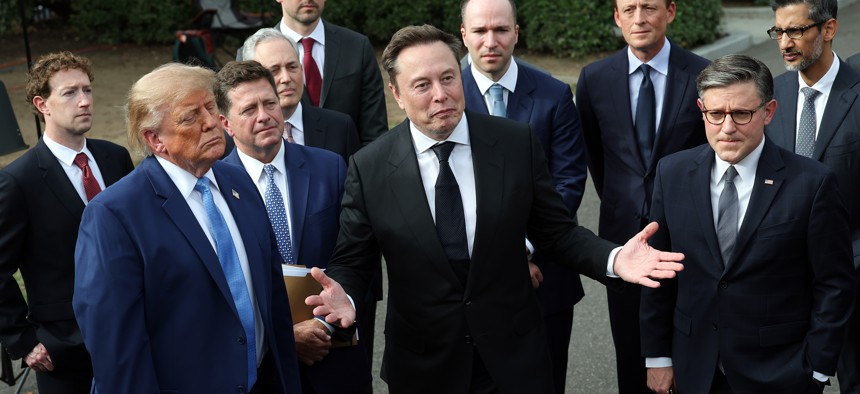
SpaceX CEO Elon Musk, center, stands with President Donald Trump, House Speaker Rep. Mike Johnson, R-LA., and others outside the White House on September 29, 2026. Kevin Dietsch/Getty Images


The US space industry will suffer for Ukraine’s Starlink outage, experts say
US allies aren’t happy: “We naturally insist that it works if we're paying for it."

Elon Musk’s decision to hobble satellite services to Ukraine’s military, and his shifting explanations for doing so, have undermined the U.S. space industry and the country’s diplomatic and intelligence partnerships, say lawmakers, foreign officials, and former senior members of the U.S. military.
“I'm an American. You're an American. We want American companies to be the most competitive,” said one former senior military official who worked in space policy, operations, and acquisitions. Episodes like the Starlink scandal “create an environment where you make more competitors.”
On Oct. 14, amid a Russian missile barrage, military operators across Ukraine found themselves unable to direct drones traveling faster than 100 mph, causing “the failure of several missions,” Ukrainian presidential adviser Serhii Beskrestnov wrote on Facebook. Without warning, Musk’s SpaceX had imposed limitations on Ukraine’s use of Starshield, the military-grade data network that runs on the company’s Starlink constellation. The service reduction, which lasted ten days, reduced Ukraine’s ability to fend off Russian missiles and jet-powered drones.
“People were killed because [there was] not enough destruction, not enough interceptors, including interceptors with Starlink, which didn't work, of course," Ukrainian President Volodymyr Zelenskyy said later on Oct. 14.
It’s not clear why SpaceX reduced service to Ukraine. Musk and President Donald Trump have been increasingly critical of Zelenskyy in recent weeks. Trump, who has reversed war-related sanctions on Russia and sought Moscow’s help to bring down domestic fuel prices, has complained about Ukrainian strikes on Russian energy plants. Musk, whose relationship with Kyiv has soured since the departure of former Defense Minister Mykhailo Fedorov, has asked for sympathy for Russian conscripts.
Musk, who promised last year that “Starlink will never turn off its terminals” in Ukraine, blamed Trump for the slowdown.
“Starshield systems are owned and controlled by the US government. Any limits on speed or usage are decided by the US military and ultimately POTUS,” he tweeted on Oct. 14.
That didn’t smell right to at least one former U.S. general.
“I honestly believe Musk thought he was acting in line with what the White House wanted. I can’t prove that, of course. But all the actions and everything people say tell me this was intentional,” said Ben Hodges, a retired general and former commander of U.S. Army Europe.
The inability to rely on SpaceX is sure to affect military decisionmaking, the former senior military official who worked in space policy said.
“From a planner perspective, obviously, you need to have confidence in your kill-chain capabilities, and so that introduces doubt, which must be incredibly difficult for the planners of the Ukrainian military.”
Congress’ concerns
In letters to SpaceX and the Pentagon, U.S. lawmakers expressed several concerns about the interruption of service, including its effects on allies.
On Oct. 19, a group of senators reminded SpaceX officials of their “contract obligations with the Federal Republic of Germany, which funds Ukraine’s access to Starlink,” and asked: “When did you notify the German government of the decision to degrade Starlink capabilities?”
Representatives from their offices did not respond to questions regarding any answer they may have received.
In an Oct. 22 letter to Defense Secretary Pete Hegseth, another group of senators noted that Ukraine relies on Starlink for intelligence-sharing. They urged the Pentagon to “expand its existing Starshield contract to ensure Ukraine has the satellite communications capacity, coverage, and reliability necessary to sustain its military operations and renew Starshield’s unlimited-speed service.” Pentagon officials did not respond to questions about the letter.
Allied government officials also expressed alarm.
"I search for the right adjective to describe whoever took this decision or group of people took this decision against a country that is literally fighting for the lives of the citizens against naked aggression," Canadian Prime Minister Mark Carney said on Oct. 23.
German Foreign Minister Johann Wadephul on Oct. 16 put the issue plainly: "Germany is paying SpaceX and that's why we naturally insist that it works if we're paying for it."
Facing mounting pressure, Trump called Musk on Oct. 23 to ask him to lift the restrictions.
On Friday, Trump said, “If there’s a problem, I'll get it straightened out.”
That same day, Musk admitted that SpaceX had put a speed restriction in place but he blamed Ukraine, which he said had used the satellite network for offensive drone strikes and thereby “violated Starlink terms of service and [the military] used it for offensive drone strikes to kill people.” Ukrainian leaders have denied this.
But as the Oct. 19 letter points out, any real or imagined Starlink terms-of-service violation should not affect the Starshield service, which is under the control of the U.S. government. Like many, the senators were confused.
“SpaceX owns and operates the underlying Starlink network and infrastructure upon which certain Starshield services rely. These circumstances raise important questions...”
By Oct. 24, Ukrainian leaders said, full Starlink service had been restored.
What next?
For Ukrainian operators, the issue is resolved for now. But one former senior military official who worked in space systems acquisition told Defense One that the episode will undermine trust in U.S. satellite capabilities.
“Flipping the switches over a combat operation, it’s definitely a significant data point… The question is: Are we making the right decisions?”
U.S. dominance in space-based imaging and satellite communications, both military and commercial, is real. Europe does not have either a private or public satellite communications system capable of replacing Starlink overnight. Starlink’s importance in helping Ukraine achieve battlefield gains is also beyond dispute.
But Musk’s actions will accelerate the development of foreign alternatives to Starlink, said the formal official. More established, smaller competitors to Starlink, such as Eutelsat OneWeb, SES, Iridium and others, could also see increased government business or support.
It’s not the first time that a U.S. decision to withhold satellite services has convinced a security partner to reduce its reliance on Washington. In 1999, India was denied access to GPS during its Kargil conflict with Pakistan.
“The request that was denied to India drove them to build their own GNSS [global navigation satellite system] capability,” the former official said.
The European Union launched its own quest for a navigation system that same year, and the Galileo navigation system went operational in 2016.
From the perspective of U.S. space firms, “You risk your momentum by giving other competitors a reason to go build their own Galileo GPS system,” the former official said.
The urgent need for sovereign satellite capability led Kyiv to sign a development agreement with Denmark’s GomSpace in April and, on Oct. 22, a letter of intent with Finnish space technology company ICEYE and Nokia.
For U.S. military operations, that’s not all bad news, the official said, as it means a more resilient network with more providers of services such as global positioning and communications.
But the United States will never again enjoy a position of near-dominance in space, they said.
“Your Apple iPhone right now takes in GPS, Russian GNSS, and Chinese GNSS, yeah. So, in one way, it makes your system more resilient. In other ways your little phone is reliant on other things, systems that probably we would not have planned to be reliant on many years ago.”