

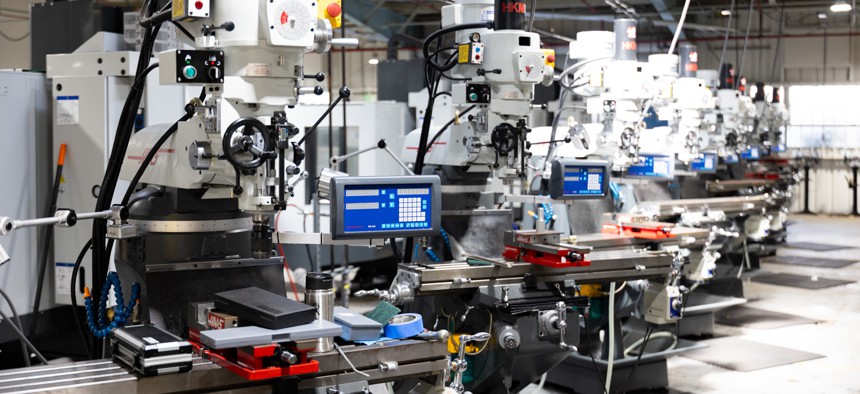
The IBAS-funded advanced manufacturing lab at Honolulu Community College, Hawaii. Courtesy / BG Workforce Solutions


Program looks to build shipbuilding, defense manufacturing capability in Hawaii
One training initiative received a $7 million investment from DOD’s Industrial Base Analysis and Sustainment program.

HONOLULU—A Pentagon-funded workforce-development program at Honolulu Community College is aiming to forge the next generation of Hawaii manufacturing industry leaders—and grow the defense industrial base in the Pacific.
Inside a warehouse space less than 10 miles from Pearl Harbor Naval Shipyard, students learn everything from how to read a blueprint to how to operate manual and automated machines. At the end of the course, they build parts for and then assemble a model submarine, the “USS Aloha,” to show that they’ve mastered every part of the process.
The program is a collaboration between the community college, the Pentagon’s Industrial Base Analysis and Sustainment program, and a Hawaii-wide workforce initiative called Ku’i Hao, with training provided by BG Workforce. IBAS invested $7 million in the project.
Master instructor Jake LaBonte is from New England, where there is a long-established culture of machinist training and factory work. It’s different in Hawaii, he said during a tour of the training facility.
“Our shop here is, in my professional opinion, one of the most advanced and well-rounded…training facilities out there, hands down,” LaBonte said. But “you can go to a guy’s garage in Connecticut, and you’ll see the same equipment in his garage, because it’s just so ingrained.”
When the first cohort of students arrived in August 2025, the curriculum didn’t quite fit the local need, LaBonte said.
“I think one of the things different about Hawaii is it’s a little bit further behind the industry…so we had to be a little bit more creative with how we kind of got people trained up.”
LaBonte and other instructors took the feedback from the students and local companies and “pretty much did a complete rewrite of the curriculum” between the first and second cohorts. Now, instead of 80 percent classroom time, the students spend 80 percent of their time in the shop.
Students start with a course on machining fundamentals. They can then choose to take one on machining with automated machines, and then progress into shorter bootcamp-style courses for specific skills, said LaBonte and Clint Hall, chief program officer for BG Workforce.
The students—eight per cohort—are military members, local students, or already employed by a local company. Two of the current students are trainers at Pearl Harbor Naval Shipyard.
“We understand that Pearl Harbor is looking to hire thousands of employees over the coming years,” said Kevin Beamish, BG Workforce’s chief operating officer, and the local companies’ individual in-house training capacity definitely can’t meet that need. The new program allows the Pentagon to invest in growing the ship repair and manufacturing base to support the force here. BG Workforce is also the implementing contractor for The Forge, U.S. Pacific Command’s expeditionary foundry on Oahu.
“It’s got to be closer to the fight, I think is what Adm. [Sam] Paparo would say,” Beamish said, referring to the PACOM commander.
The facility has already saved the military time and money, he said. A unit on the island needed parts that would cost $42,000 each and take two to three years to have built on the mainland. Instead, “we were able to get their engineer over here and make some parts.”
LaBonte and the team reverse-engineered the parts, “built them, gave them to the engineer from the unit who can quality them, and then they’ve given us license to work those into our machining curriculum. So now the students are making those parts…that goes to the unit now. They’ve got a shelf full of replacement parts that break often, and now they can fix them with local stock instead of having their assets down and not serviceable.”
And, LaBonte said, they cost only $100 or $200 to make here.
In September, Assistant Defense Secretary for Industrial Base Policy Mike Cadenazzi touted the program during a House Appropriations Committee hearing, saying the training capacity has not existed in Hawaii since the 1970s.
“We feel our workforce programs are best structured as tied directly to the needs of the community,” he said. “It’s definitely localized and tailored….We’re really thrilled wherever we can do it.”