

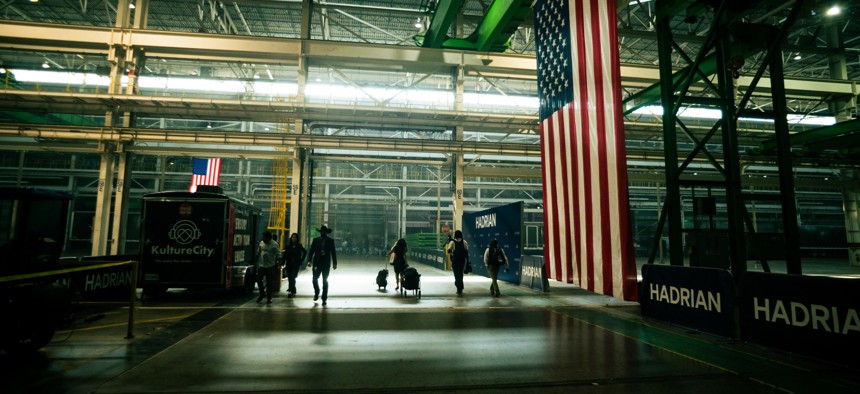
Hadrian's Factory 4 submarine-part plant in Cherokee, Alabama, on the morning of its ribbon-cutting ceremony, March 20, 2026. Garrett Lindsey


Navy bets $900M on automated factories to boost submarine production
Four-year-old Hadrian wins contract as service seeks to offset worker shortages.

The Navy is betting $900 million that highly automated factories can help it add submarines in an era when skilled workers are scarce.
The contract will support “non-recurring engineering across three facilities” to be built by Hadrian, a four-year-old advanced manufacturing company.
“This is not just another factory,” Navy Secretary John Phelan said in his prepared remarks for a Friday ribbon-cutting ceremony for Hadrian’s Factory 4 near Muscle Shoals, Ala. “This is a different model. Hadrian does not just machine parts. They build integrated production systems: raw material in, test-ready hardware out. A single system doing what used to require dozens of suppliers. Their platform allows these facilities to run continuously.”
Since 2018, the Navy has poured roughly $9.8 billion into the submarine industrial base, including funding used at private supplier firms for facility upgrades and workforce expansion, the Congressional Research Service wrote earlier this year. The new $900 million contract, funded by last year’s reconciliation bill, aims to boost production of hard-to-make parts and components using a mix of robotics and automation.
“The number-one problem that the Navy's identified is we can't find enough skilled workers, so we have to automate our way out of this problem,” Hadrian CEO Chris Power told reporters.
Dubbed Factory 4, the 46-acre facility and its up-to-1,000 employees are slated to produce components and systems for Columbia- and Virginia-class submarines before expanding to other maritime programs.
The factory will run on Hadrian’s Opus software, which the company’s website calls “the full stack, AI-powered platform for Factory Autonomy.” Power said it will be tuned to meet the exacting requirements of the Navy’s Submarine Safety Program, or SUBSAFE.
Automation and robotics will be used for welding, machining, fabrication, assembly, inspections, and tests. The goal is to automate 80 percent of the work and have processes simple enough to train workers in as little as 30 days.
Factory 4 is part of Hadrian’s $2.4 billion plan to build a total of three facilities to support Navy programs. Company officials said plans for the other two facilities, which are to focus on castings and forgings and other critical materials, will be announced in coming months.
Toward a bigger fleet
Shipbuilding has become a top priority for the White House, whose “Golden Fleet” plan calls for a larger Navy with a new frigate and a new “battleship.”
On Tuesday, the Navy’s first “submarine-production czar” described his fundamental conundrum.
“We are not at our required construction cadence, and that's the challenge ahead of me as I take on this role as [direct reporting portfolio manager for] submarines. So ultimately, as I look across the yard, I see that we have a math problem,” Vice Adm. Robert Gaucher said at the McAleese defense programs conference.
For example, it takes about 13 million hours to build a basic Virginia-class submarine and 18 million for one with payloads. A Columbia-class submarine takes 34 million hours to make.
“If you add it all up, that's about 70 million hours that we need to generate to get to that two-plus-one case,” Gaucher said, using the shorthand for buying two attack subs and a missile boat per year.
He said there are three levers to fix submarine production: growing the workforce, increasing productivity, and improving the delivery of parts and components just before they’re needed.
Over the past year, the Navy has tried to do things differently, canceling struggling programs like the frigate and pushing the use of AI in shipyards to improve scheduling and supply-chain management.
But workforce challenges persist even as major military shipbuilders boast increased hiring and wages.
The Navy “can't hire enough people and the primes can't hire enough people because there aren't enough trained people to do it…We need to automate and have people running multiple robots in a new way of doing things versus replacing jobs,” Power said. “It's about making the factory itself five to 10 times more productive, and also making that manufacturing more accessible, so that [the workforce] can be trained in 30 to 40 days,” while keeping human workers in the loop.
Shipbuilders already use robotics and automation, but Hadrian’s approach aims to employ the technologies from the beginning, rather than added on to to a traditionally manual manufacturing process.
Power said robotics and automation will enable its factories to handle unexpected orders.
“You need these factories hot and ready to go, and you can't necessarily plan everything,” he said. “Opus enables [us] to have that capacity idle in capital equipment and robotics, and not have to, say, hire or fire people.”
The factory is expected to reach full production capacity in two years with plans to deliver materials in the next year, Power said.