

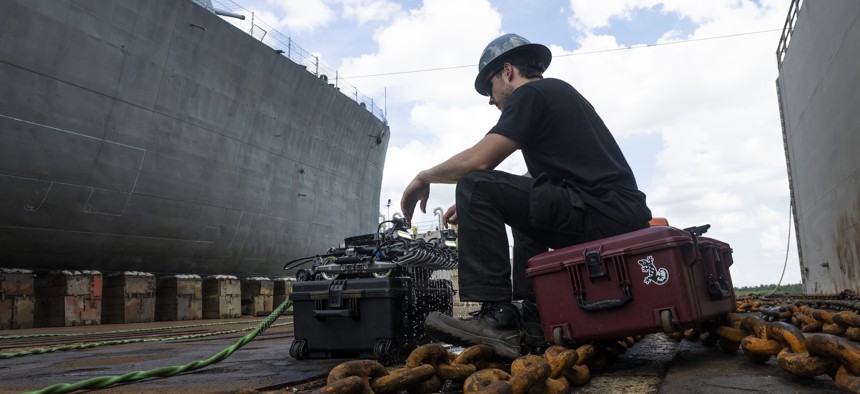
A shipyard worker and a "Toka" maintenance drone from Gecko Robotics. Gecko Robotics



US Navy to use wall-climbing robots to inspect ships
Gecko Robotics scores $71m contract.

The U.S. Navy and GSA will pay Gecko Robotics $71 million to use its drones and AI to inspect ships, jets, and other gear, part of the service’s effort to reach 80 percent fleet readiness next year and stem its shortage of ships. The company says it can identify repairs up to 50 times faster and more accurately than human inspectors—and do so even before a ship reaches its dock, which will help the Navy get the right people and parts in place.
This work is slated to be carried out across destroyers, amphibious warships, and littoral combat ships. The deal means “any DOD branch can use the AI and robotics,” the company said in a statement.
Justin Fanelli, the Navy’s chief technology officer, said during a February Govini event. "When these American companies, pure-play defense and dual-use companies like Gecko Robotics choose to do hard things and move the needle on our outcome metrics—not by percentage points, but by orders of magnitude—it results in faster, better portfolio management…We're now seeing solutions that make innovation adoption easier and in doing so save time, money and risk.”
Jake Loosararian, the co-founder and CEO of Gecko Robotics, said his company combines visual inspection with predictive maintenance to “predict what things are going to fail and how to fix them fast so that you are down less.”
Gecko Robotics, launched in 2013, builds robots that conduct in-depth inspections of infrastructure—like power plant components—or big pieces of equipment. Some robots climb walls to scour ships’ hulls even ICBM launch tubes for structural or material weaknesses that human eyes might miss. They also make drones that can analyze joints, connections, holes, and other flaws and issues.
Gecko is already working with the Navy to speed maintenance of aircraft carriers and submarines.
Speaking at the Defense One Tech Summit last June, Gecko Robotics president and other co-founder Troy Demmer described how the company speeds up the maintenance process: “We’re leveraging autonomy and AI to deploy technologies prior to a ship or a submarine coming into a dry dock facility so that we have an understanding of, ‘What's the material health of this asset? How do we make targeted, efficient repairs so that we can get that asset back in the fight?”
Under repair
At any given time, a good chunk of the Navy’s roughly 290 battle-force ships are tied up for repair: 52 in January, according to Adm. Jim Downey, NAVSEA's commander. He said just 41 percent of ships completed repairs on time in 2025, well short of the 71-percent goal. “We reset the mark for this year. I'm looking at north of 60 percent, and I'm on plan to make that,” Downey said.
It’s a problem that goes back years. The slowness and cost of maintenance is causing “significant impacts to global operations,” Rep. Ken. Calvert, R-Calif., observed in a 2024 hearing on naval readiness. Maintenance plagues virtually every service. But in a conflict with China, the effects could balloon.
Gecko’s Demmer said Integrating autonomous inspection and AI-repair analysis could help build ships, not just repair them.
“We’re deploying autonomy and robotics as well in the supply chains, way upstream of the shipyards even. So, how do we get forging and castings produced more efficiently,” he said. “Because we are talking millions of dollars being lost when that part has to get scrapped.”
Ideas like this may help the U.S. Navy, which is trying to catch up to China. Today, the U.S. has 287 battle force ships; China, roughly 400. By 2030, when China is on track to have 435 ships, the U.S. Navy is aiming for 381.
But China has far more shipyards and shipbuilding capacity: it accounts for roughly 53 percent of global shipbuilding capacity, compared to less than 1 percent for the United States, according to estimates corroborated by the Office of Naval Intelligence and Georgetown University. China’s ships are newer, require less maintenance, and when needed, that maintenance happens faster due to their robust shipyard infrastructure.
And China is also able to use portions of its commercial fleet for maritime missions. In the event of a major conflict with China, or in order to deter one as tensions rise, could the Navy move to repair or maintain ships in commercial ports? Loosararian said that he hasn’t heard Navy leaders discuss that yet. But “It is clear to me that that advantage is possible on the more commercial maritime side.”