

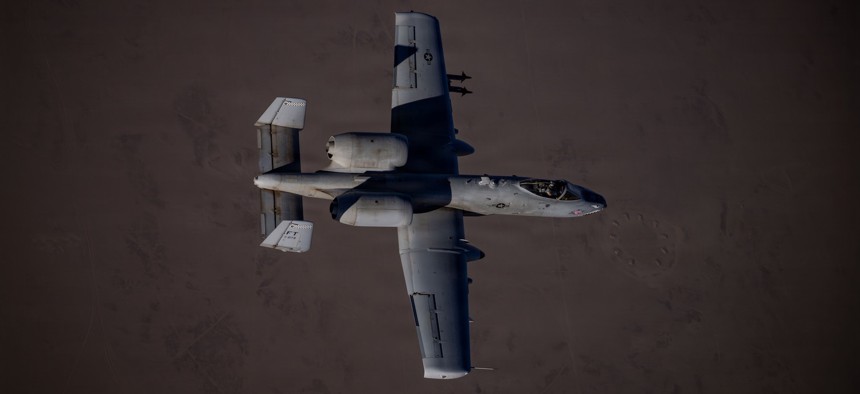
An A-10 Thunderbolt flies over the U.S. Central Command area of responsibility during Operation Epic Fury, March 9, 2026. U.S. Air Force



A-10s escape retirement once again amid continued use in Iran war
The Air Force will extend three squadrons to keep the Warthog flying through 2030.

The Air Force’s A-10 Thunderbolt IIs have escaped retirement, again.
Air Force Secretary Troy Meink announced in an X post Monday that the Warthogs will keep flying through 2030 to “preserve combat power until the Defense Industrial Base ramps up combat aircraft production.” The announcement comes as the Pentagon continues to use A-10s for rescue and close air support missions in the ongoing Iran war.
The service plans to extend three squadrons of A-10s. An active-duty squadron from Moody Air Force Base in Georgia and a reserve unit at Whiteman Air Force Base in Missouri will be kept operational until 2030, a service spokesperson confirmed to Defense One. Another squadron at Moody will also be extended until 2029.
The aircraft, which was heavily used during the Global War on Terror, has been slated for retirement multiple times since 1984, but continued to be extended instead. In the most recent National Defense Authorization Act, Congress pushed back the aircraft’s looming divestment and said the service can’t “decrease the total aircraft inventory of A-10 aircraft below 103 aircraft” until the end of this fiscal year. It also required Meink to brief lawmakers on the service’s plans for the fleet.
An Air Force spokesperson confirmed to Defense One last month that the service did not plan to divest all of its A-10s by the end of 2026, and that Meink had submitted the required briefing ahead of the March deadline as mandated by the NDAA.
The move to extend the service life of the A-10 again did not surprise Dan Grazier, a Stimson Center senior fellow and the director of the nonprofit's national-security reform program.
Grazier said he learned from internal Defense Department discussions earlier this month that the White House pushed the Pentagon and Air Force to retain the aircraft.
The White House, Pentagon, and Air Force declined to comment on the decision-making process. But Meink did praise Trump in his announcement online.
“Thank you to POTUS for your unwavering support of our warfighters and quick, decisive leadership as we equip our force,” Meink said on X. Later that day, Defense Secretary Pete Hegseth said “long live the Warthog” in a social media post.
Grazier said the aircraft’s use in the herculean effort to rescue a downed F-15 airman earlier this month likely played a role in the White House’s push. The A-10 plays a crucial close air support role in a “sandy package,” the formation of aircraft used in high-threat rescue missions.
“I can only assume that somebody briefed them up about how central the A-10 was to those rescue operations, because there is no other platform that can do the complete sandy package,” Grazier said.
Given its heavy use, Grazier said the Air Force should start looking at what platform will take on that crucial mission after 2030.
“It’s great to see the fleet being extended out until 2030 now, but the next challenge is the Air Force has to get its act together to work on a replacement program for the A-10.”
Past pushes to retire the A-10 were focused on a pivot away from close air support missions in the Middle East to a competition with China and Russia. In addition to the search and rescue missions, the Warthog has also been strafing boats in the Strait of Hormuz.