

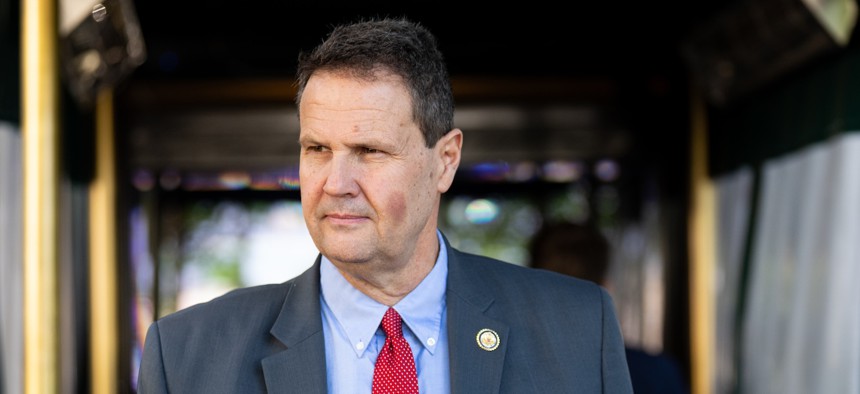
Rep. Jeff Crank, R-Colo., leaves the House Republican Conference caucus meeting in Washington on May 13, 2026. Bill Clark / CQ-Roll Call, Inc via Getty Images



Golden Dome Caucus chair says building support, funding for missile shield is a ‘tough slog’
Rep. Jeff Crank, R-Colo., told Defense One that funding the war in Iran threatens the missile-defense project.

One of Golden Dome’s most supportive voices in Congress fears that prioritizing Iran war funding along with continuous partisan gridlock threatens President Donald Trump’s plans for a sprawling missile defense shield.
Rep. Jeff Crank, R-Colo., told Defense One in an interview Wednesday evening that funding for Golden Dome is a “concern of mine.” Only about $400 million of the $17.5 billion the White House is seeking next year for the homeland missile shield is in the baseline budget, while the rest relies on funds through a Congress-controlled funding maneuver known as reconciliation. A third $90 billion reconciliation package working through the cogs of Congress significantly scaled down the Pentagon’s initial $350 billion request and primarily focuses on funding operations and replenishing munitions from the Iran war.
“I think we largely funded Golden Dome through reconciliation, and that only works if the money is there that we gave them through reconciliation,” Crank said. “So, if it needs to be used for other things, and you know, gosh, if those other things are paying for operations in Iran or replenishing depleted capabilities and things like that, then I do have a big concern."
Crank’s warning mirrors concerns by Space Force Gen. Michael Guetlein, Golden Dome’s direct-reporting program manager, at the Space and Missile Defense Symposium in Huntsville last week. The four-star program czar told attendees that if Congress doesn’t get funding sorted, “there is no Golden Dome.” Defense analysts have said that in addition to some of the more technical hurdles, such as space-based interceptors, political gridlock is one of the program’s biggest obstacles to gaining momentum.
“Spending more to reduce risks to the homeland increases risks elsewhere—through higher borrowing and taxes that impose economic risks, or through cuts to other defense and non-defense funding that carry security and political risks of their own,” AEI’s Todd Harrison wrote in a report last year. “In the end, Golden Dome’s cost will not be determined by fiscal constraints or technical capabilities, but by political choices: which risks leaders are willing to mitigate, which they are willing to trade, and which they are prepared to accept.”
Guetlein told reporters last week that there is ongoing Defense Department discussion “about how to go forward,” and officials are planning for contingencies. Crank said he supports the general’s optimism to continue building the missile shield, but also understands the fiscal reality the program faces.
“I trust Gen. Guetlein implicitly to do everything he can to do this, and I know they'll be compliant with the law in doing so,” Crank said. “But there's also only so much money, right? And if you allocate it to certain things at the department, it can't be used for other things.”
“I am concerned that if Congress doesn't appropriate money for some of the operations in Iran that are going on, that they're going to have to take it from somewhere,” he added. “I wouldn't want that to be Golden Dome, and I certainly wouldn't want it to be things like quality of life or the things that we've already funded through the reconciliation bill.”
The Colorado Republican co-chairs the House’s Golden Dome Caucus alongside Rep. Dale Strong, R-Ala. Presently, there are no Democrats in that group, according to LegiStorm. Crank has been attempting to win over his colleagues on the other side of the aisle to support additional funding for the program.
“I do think there are some on that side, and we're working to get with them. And I predominantly think it's the people that probably have in their district, they have either military facilities or contractors that are working on these types of things, so it benefits them to be for Golden Dome or to be for ballistic missile defense programs,” Crank said. “So, we're working on that. It's a tough slog.”
Crank’s district encompasses Colorado Springs, which is home to Peterson and Schriever Space Force Bases as well as Cheyenne Mountain Space Force Station, U.S. Northern Command’s alternate command center.
Last year, after a years-long political tug-of-war, Crank’s district lost U.S. Space Command’s headquarters to Huntsville, Alabama. However, the Colorado Republican told Defense One that the Space Force’s Infrastructure Portfolio Acquisition Executive is moving from Space Systems Command in California, to Colorado Springs.
The office controls $4 billion in the service’s contracts, according to a Colorado Springs Chamber & Economic Development Corporation press release. The move is expected to happen by the end of this year. It’s is one of many major Space Force investments in the area, including the construction of a new Space Force Operations Facility at Schriever, Air Force Secretary Troy Meink announced in May.
“All of those combined will be far in excess of what we would lose with the Space Command headquarters moving now,” Crank said.