

Across the line
This month’s Useful Fiction story explores how Army infantry, armor, and robotic systems might fight together.
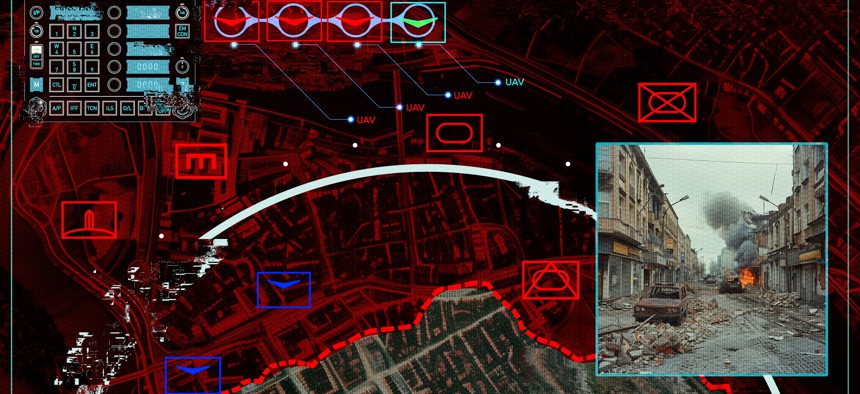
The future of ground warfare will fuse old and new. AI and robotic hardware will fight alongside heavy tanks and armored fighting vehicles. New capabilities will enable ground units to reach into and shape operations in other domains. Meshed sensors will distribute data and imagery while the tempo of observation, orientation, decision, and action will increase toward machine-speed. Modular digitized tanks, more mobile and survivable, will support forces well beyond line of sight, likely launching drones for reconnaissance and targeting. This transformation will enable soldiers to conduct missions once impossible for units of their size.
“The national bird of Lithuania is Ciconia ciconia, better known as the white stork,” U.S. Army Lt. Col. Michael Wynn said into his mic. “This is an obviously better choice than their other native birds: the pigeon and the common cuckoo.”
Wynn’s mother had been an avid bird watcher, a “twitcher” who turned family vacations into quests for new avian species to add to her life list. While he had hated every part of it in his younger days, he had lately begun to see the appeal. And as often happened with those who develop a hobby later in life, he had become an evangelist—somewhat to the chagrin of the two enlisted soldiers who shared their battalion commander’s M1A3 Abrams tank.
“Now, Poland’s national bird also has ‘white’ in its name, but a white-tailed eagle is actually mostly brown. The Haliaetus albicilla is known as the ‘king of the skies’ in these parts, which I am sure you can see might be of added meaning tonight.”
As Wynn continued to declaim on avian matters, he watched the digital lines of their departure point grow closer in his augmented-reality goggles. His view of the grassy plain ahead was lit almost to daylight by the vehicle’s night-vision system. It was as if he were riding in an open cupola.
But in fact, he was sitting under the tank’s unmanned turret with his driver and gunner, using the goggles to “see” through the new-generation multilayer armor. An overlay told him the status of his unit’s various components. His own tank, HQ66, had a fully charged battery, although the hybrid-electric propulsion system was currently running on fossil fuel in its race to the border.
“Unfortunately, we’ll have to postpone this discussion until after the mission,” Wynn said to his crew’s silent relief.
They did not realize that he spoke less to convert them to his hobby than to calm them before their combat debut. For all his focus on the more delicate aviary aspects of the natural world, he saw the tank itself as a living thing — the apex predator of the 21st-century battlefield.
“Until then, let’s keep an eye out. We’re crossing ORACLE in 3, 2, 1…” The tank crunched over the barbed wire marking the border between Poland and Lithuania –– or what the region’s new rulers called the Rus-Republic of Lithuania.
It had all started with a lie, or rather a series of them. Russian intelligence and paramilitary forces had carried out false-flag attacks, seeking to convince the Russian-speaking population that the Lithuanian government was attacking its own citizens. Real images of Russian speakers being murdered by masked men in government uniforms had been driven viral, followed by AI-driven deepfakes of government round-ups, jailings, and beatings of men, women, and even children.
Citing the misinformation as justification, Russia’s paramilitary forces seized a series of local government buildings and declared the RRL a new republic for Russian speakers. An armored division dashed from its garrison in Belarus with uniforms and vehicles already flying the RRL flag, a two-headed eagle in black rather than Russia’s gold version. In a matter of hours, NATO had a new self-claimed republic in its midst. And Russian surface-to-air missiles, radar, and land-based antiship missiles had created a bubble of anti-access/area-denial weapons not just on NATO’s Eastern frontier, but now within it.
Wynn took a quick pull of his “battle juice,” a blend of caffeine, electrolytes, and protein. It was always a good time to hydrate, and he had a sense he’d need his hands free soon.
The Article V vote had been quick and unanimous, and Wynn’s armored unit was the vanguard of the manifestation of the long-contemplated moment when NATO would actually have to go to war: Operation Baltic Protector.
“Are they going to ask to stamp our passports?” grinned Cpl. Arnold Glover, the tank’s driver, who sat at Wynn’s left elbow. Glover always had a smile on his face—the more stressed out he was, the bigger. It had made basic training a nightmare but had led to his selection to drive the command tank. Command was tough enough; the least you could do was to surround yourself with people who seemed like they were having a good time.
“I’d be happy to provide a stamp for them in return,” said Sgt. Margaret Butarski, in the kind of awkward banter that always sounded funnier inside the tank than outside. The gunner had grown up in Lansing, Michigan, in a family of auto workers; she’d taken a high-school robotics class trip to the Detroit Arsenal, seen the equipment they got to play with, and decided right then and there to enlist when she graduated.
“Let’s hope they come to their senses and you don’t have to do that.…But my sense is you’ll get your chance,” Wynn weighed in.
The battalion commander toggled his AR goggles to display the full battlespace. His formation consisted of a tank company of M1A3s, including his own; a human-machine integrated company of Robotic Combat Vehicles and their human controllers in Armored Multipurpose Vehicles; and a company of mechanized infantry in M-30 combat vehicles. Behind them moved his battalion headquarters: M-30 command vehicles and AMPVs tooled for comms and electronic warfare.
In the distance, the map showed Lithuanian forces that had been driven from their country in the initial attack, as well as the Croat, Romanian, and British units that had been joined with Wynn’s unit in the multinational battle group hubbed out of the joint NATO-Polish base in Elblag, Poland.
Rattling and scratching under the M1A3’s hull caught Wynn’s attention. What had they hit?
“Got some concertina wire caught up in the tracks,” said Butarski, who also monitored the tank’s health system and its datalinks to support forces. “It's already been flagged for repairs with the maintenance folks, but I’m guessing we’ll just grind out before it comes to that.”
Wynn hoped that a few errant yards of steel wire wouldn’t undo his central role in this historic armored operation. Even more, he hoped it would be the only thing needing repairs when this was all over.
The next digital line in the terrain was just ahead, TROPICANA, marking their estimates of the enemy’s engagement range. The new vehicles had masking capabilities to reduce their thermal and electromagnetic signature, which had allowed them to sneak up to the border without detection, but at some point, there was no way to completely hide a column of armored vehicles, especially from a watchful human eye.
His concerns were quickly validated when his AR rig lit red with notices of incoming air and artillery fires. Alarms sounded inside the tank.
Surrounded by advanced armor, Wynn could feel the hull vibrate as a Russian top-attack artillery round missed and detonated behind them. Without being commanded, Glover began to zig the tank slightly to the right and zag to the left, erratic movements that wouldn't cost much speed, but could perhaps complicate the spotting job of whoever or whatever was targeting them.
While the fires could mostly be evaded by speeding out of the kill zone, there was no way a tank could outrun the swarm of more than 300 drones that had gathered and rapidly flown toward the NATO unit. Wynn’s battle management software quickly sorted the threats in his AR feed.
Micro-drones that were essentially aerial versions of a 73-mm Grom shell. Commercially derived quadcopters armed with downward-firing missiles, designed to penetrate a tank or IFV’s thinner upper armor. A formation of 4-foot Russian Lancet IV and Eaglet drones, cruise-missile-like systems that skimmed just a few meters above the ground. Stacks of heterogeneous swarms, controlled by different types of software, coming in from multiple directions and speeds, swirling around a battlegroup itself dodging and weaving through complex terrain as fast as it could go.
How quaint it must have been back when all this drone stuff started, thought Wynn. How simple it must have been, to have to deal with the threat of a solitary FPV quadcopter or even a swarm of homogeneous drones, all just following the same algorithms, going after just one fixed target.
Set on auto-mode, the battlegroup’s defensive systems responded almost as quickly as the swarm had appeared. Counterdrones began leaping into the air, disrupting the swarm and crashing into targets. The M-30s’ 50-mm cannons fired off guided rounds that chased their quarries. Wynn’s M1A3 opened up with a sound like a chainsaw as they each fired hundreds of rounds that might have been “dumb” but could saturate a target.
The fast-moving red digital dots layered over the drones in Wynn’s AR were woven with a webwork of tracer lines and fiery explosions, some tiny and some large. Unseen, another battle played out in the electromagnetic spectrum as EW jammers and counterjammers fought for momentary dominance at machine speed.
Trying to make sense of it all, Wynn's brain unconsciously rendered it almost like a fireworks display, while the conscious part knew it to be a far more lethal dance of hardware, software, and networks.
An explosion marked the loss of a tank in the allied unit racing alongside. He knew that this was the expected price to pay, then felt guilty for being glad it had first happened to another unit. He toggled back to paternalistically check on his two human crew members, who jostled in their seats as Glover took more evasive action.
The formation plowed ahead, soon leaving the fighting behind, the robotic systems’ munitions or batteries expended. The quiet lasted only moments, just a few meters past the map line marked BUSCH, when a salvo of antitank missiles was detected coming at them. Three Russian unmanned ground vehicles that had been hiding on the second floor of a parking garage adjacent to a small apartment building now revealed their position as they fired on the American armor. Seconds later, Wynn heard a slapping sound and then a rattling of shrapnel on the turret as the tank’s Integrated Active Protection System fired a few feet above his head, taking out a missile.
Then robot turned against robot with counterfire coming from one of his unit’s RCVs, which had sped ahead to screen the force. Its anti-armor missile slammed into a cement pillar and collapsed the whole parking garage on top of the enemy UGVs.
“Three-for-one special on aisle nine!” screamed Butarski joyfully.
The task force moved on and minutes later another digital line marked they had reached their second waypoint on the way to Kaunas, Lithuania’s second-largest city.
“We’re making good time, sir,” observed Butarski, as Glover and each of the vehicle drivers in the formation steered to the northwest in a staggered move.
“Yep. As long as we don’t get any more traffic congestion like that, we should make it.”
A mission clock ticked down in the lower corner of Wynn’s combat AR view, as it did for every other officer and senior enlisted member of the task force.
The task force had less than two hours to cover the 45 kilometers to the southern outskirts of Kaunas in south-central Lithuania. With no opposition, it would be an easy drive. But if anything slowed them down, the armored force would miss its window. And literally hundreds of lives depended on them making it to their objective on time.
Wynn was confident they could ultimately find and destroy the mobile S-1000 air-defense system hidden in Kaunas that had turned the airspace above Lithuania into a no-go zone for NATO aircraft. The key was to do it at just the right point in the larger operation they were supporting: not so soon as to tip their hand and let the adversary figure out how to fill in the hole that would open up in their A2AD bubble, but not too late for the flight of NATO C-17s and escorting F-35s that needed to fly safely through that hole.
The S-1000 had created an aerial kill zone above not just the breakaway RRL, but also extended out to the Lithuania-based battlegroup that had originally responded to the crisis. Air losses had been steep, while the force of German, Belgian, Dutch, and Norwegian ground units that were now surrounded by Russian and aligned forces outside of Kaunas, running low on plasma, blood, and painkillers — to say nothing of munitions. And the only way that the airdrop resupply — and hopefully a CAS mission — could reach them was if the complex air defenses were taken out from the ground. Modern multidomain warfare had evolved well beyond what the writers of AirLand Battle had contemplated back in his grandfather’s day.
• • •
For Master Sgt. Andre Washington, it was shaping up to be his second “war.” He’d been at the Battle of Chi Ma on the Vietnam-China border. He’d been a platoon leader at the time, gripping his rifle so tight he doubted he could have hit anything he aimed at if not for the high-speed fire control system on his trusty M7.
Though he’d spent a lifetime in the Army now, his stomach was still tight as his M-30 moved forward, but he at least knew what they were getting into. Inside the M-30s following Abrams tanks, he and the other infantry soldiers used helmet-mounted AR displays that allowed them to “see through” the armor that protected them. The soldiers could swap between tracking the formation’s movement through the lightly forested region and following the fight up-close.
Washington had come up in the Army in an era when the infantry had referred to the old M2 Bradleys as “teleportation devices” –– as soon as the rear ramp of the Bradley clicked closed you lost all sense of what was happening outside the vehicle until you were teleported to your destination. On arrival, a similar click indicated the ramp was opening and you were about to dismount into a whole new world with no clue what was happening around you.
What he saw on his AR feeds only made him more nervous. Not that would let his soldiers know it. He willed himself to be the picture of calm for the other five soldiers in the back of the M-30 who kept discretely glancing at him hoping to gauge his disposition. And Washington knew, for all the technology and the firepower of today’s modern combat vehicles, it was still the infantry that ultimately won battles. And he made sure his troops –– and their commanders –– never forgot it.
Amid the building tension, Washington knew his troops were doing all right. The soldiers’ biometric sensors monitoring their vitals would alert him and the platoon’s doc if anyone was in a bad way. Washington didn’t yet know exactly when or where the M-30 would stop to let out its lethal cargo and move into a support-by-fire position, but he did know this: When the ramp went down, it would be he and his soldiers who ultimately destroyed the targets in Kaunas.
• • •
Pillars of smoke curled skyward above the southern outskirts of Kaunas and rendered the bleak night sky a blank, starless void. Burning buildings at the intersection of the 130 roadway spoke to recent fighting, likely an operation by stay-behind Lithuanian military units or even NATO Special Operations Forces conducting a behind-the-lines operation, details which would be above Wynn’s clearance.
He took a moment to check the software update for the M1A3’s traction-control system as they were going to be moving from a high-speed run across highways and grass fields to the rubble-strewn confines of Kaunas’ densest neighborhoods. Another scan showed him the status of the rest of the force’s software updates for the traction control. One of the M-30s had not completed the download; that happened from time to time. While moving fast in tight urban environments, inches of positioning or clearance could matter for these massive, armored vehicles and you had to seek every advantage you could.
As the task force came to a fork in the highway, Wynn’s unit moved towards the digital line marked YANKEE, while the allied units went towards CITI. They had originally been labeled the opposite, but Wynn had made sure they were renamed during the op-plan meeting. It was meaningless to the other nationalities, but he knew his own unit would have been made superstitious by following the path of the cursed Mets –– New York’s second-best baseball team, only because there was no third choice.
The split would allow the two elements to make a pincer-like approach to the regular and irregular forces defending Kaunas. The other part of the NATO battlegroup would head west and then hook northeast while the American element would push east and then hook back to the west.
In a world where you had to assume everything was observed, this would allow a deception. The embattled NATO elements who first responded to the Russian invasion were now encircled at the civilian airfield south of the city along the Nemunas River, which would be the obvious target of the forces. But Wynn’s force was actually going to have to drive right by them, bypassing the encircled forces to their west by following the Europos highway to cross the sole undamaged bridge into the city’s southeastern area. This would give them a run straight at the S-1000 air-defense system that they knew by EM emissions to be moving about somewhere in the Centras district, also near the river.
The deception was based not just on direction and speed, but also weight, of all things. The old Abrams and even Russia's new Armata were a good 10 tons heavier than the new M1A3s, enabling the newest generation U.S. tanks to move faster and go places the heavier tanks could not. The more survivable M-30s also allowed the infantry who would be essential in this urban fight to finally keep up during the sustained race toward the densely populated target area.
At a four-way intersection centered around a six-story office building with a facade of shattered green glass and torn rebar, Wynn watched two young boys, not more than 10, run across the street holding hands. They wore matching blue and white school uniforms smeared with dirt. One was missing his left shoe. Before Wynn could remark, they disappeared from view beneath a half-open garage door. He wondered if he was so tired now that he was seeing things, but he knew this sort of tragedy was present throughout the city. Placing a mark on his tactical map indicating “civilians in need” was all he could do for the moment.
A rocket raced toward the tank from behind before exploding when it was downed by the APS system. Classified as an older RPG-9, Wynn wondered why someone had taken the pot shot at the tank and then he hoped the shrapnel from the strike didn’t jeopardize the two kids he’d seen. They needed to get this mission done as fast as possible, for everyone’s sake.
“Pushing Kilo One and Two ahead to BUSCH,” he messaged the command group. Two small drones, including one launched from Wynn’s tank, launched to scout ahead to the next waypoint, the bridge leading deeper into the city. The visuals beamed back showed no defenders on it, which was suspicious enough. Their EM sensors then confirmed what was now obvious, picking up signals from explosives rigged on the bridge.
Speed didn’t just kill now, it was life. There was no time for sending infantry ahead to secure the bridge, and so one of the RCVs moved to the front of the column. It had an extensive electronic warfare package onboard that would jam the detonators. Hopefully.
“One minute to the bridge,” said Glover. It was an oddly calm moment in the skies above them, perhaps because they were closing in on the Russian positions. The intelligence specialists in the 2-shop had said that the Russian EW systems were so powerful that they often interfered with the very drones designed to protect them, a classic problem of electronic deconfliction that continued even in this AI era.
The first American RCV crossed the bridge, but as soon as it reached the north side, a missile slammed into the unmanned vehicle, disabling it in a cloud of shrapnel. Responding to the loss of the RCV –– and the data provided by the platform on the missile that destroyed it –– a second, following RCV took evasive action and pushed the location of the missile’s shooter to the rest of Wynn’s force.
A red icon appeared on Wynn’s screen, indicating a recoilless rifle team firing from the inside of a 4th floor condo, rapidly trying to reload. A missile streaked out from the M-30 that was in the best firing angle and destroyed the threat.
The column then raced across the bridge, but as they made it to the other side, the location of FENWAY changed in the digital map display.
“Sir, you seeing that?” asked Glover. Updated intel must have found that the S-1000 was on the move again, not surprising given what was coming at them. “Should I go towards the new route?”
“As fast as you can,” replied Wynn, and braced for a swerving slalom turn around a smoldering municipal bus that passed in a white-hot blur in his thermal-vision overlay.
Wynn began tapping out a series of commands to redirect the rest of his unit along the new route and opened up a voice channel with the Romanian colonel leading the other half of the pincer movement. A generation ago this kind of shift in route and target would have forced them to slow or stop outright and regroup. Now his commands raced through the formation at machine speed –– ground robots talking to M-30 mission computers talking to drones, all the while keeping headquarters updated. It once would have been the work of half a dozen soldiers but instead, it happened automatically –– almost seamlessly.
A glance at the mission clock in the corner of his vision, which he confirmed with the 11-year-old Casio G-Shock he bought during his Armor Basic Officer Leader Course at Fort Moore, Georgia, indicated they might just have enough time.
• • •
On his AR, Wynn cued the latest intel that informed the shift. A drone’s-eye view, as well as a fusion model based on social media from Lithuanian civilians who had not evacuated the city, showed six mobile Russian S-1000 mobile launchers along with a command vehicle, long-range radar vehicle, and engagement radar vehicle, distributed in the courtyard of a large multiblock apartment complex just off of the ordinarily busy Karaliaus Mindaugo road that followed the Nemunas River. It made sense. The original FENWAY positions they had held to the north at the technical university had provided better angles to target approaching aircraft. The new FENWAY would try to take advantage of cover from the residential buildings ringing the area. The OSINT also reported at least three enemy Armata tanks were somewhere in the area, likely concealed in an underground garage or covered alleyway.
Approaching the target from the east, three of Wynn’s RCVs advanced in a bumper-to-bumper line, accompanied by two flights of EW and small strike drones. Simultaneously, British robotic ground vehicles approached from the west, the vanguard of the rest of the NATO task force.
“Someone’s ground radar is lighting us up,” said Butarski.
“There’s no hiding, at least not for long,” said Wynn. “Push the RCVs forward, I want to force the Russians into revealing where those Armatas are.”
The RCVs distanced themselves from each other and switched up their thermal and electronic signatures to appear to the Russian AI battle systems as if they were two M1A3s and an M-30. It was a simple ruse, but it would be enough to provoke the autonomous responses in the Armata’s defensive systems to pinpoint where the three tanks hid.
At the same time, the other M-30s quietly approached on electric drive from the north, stopping two blocks away to dismount their infantry squads. One of the M-30s continued on ahead in its semi-autonomous mode, guided by a crewman who took shelter in an abandoned storefront bakery. Using a glove-like controller and AR goggles, he steered it to the corner of a shuttered high-end women’s dress store, where it set up to provide covering fire. A mesh network linked the M-30s, the soldiers, and the tank, allowing them to keep up local communications in spite of the Russian jamming that intensified the closer they got to FENWAY.
Master Sgt. Washington and his team took up positions along the storefronts of the city, lashed into Wynn and the M-30 operators via an earpiece and other hardware. Machine-gun fire rang out from the east, and Washington saw one of his soldiers fall and spin to the right, the rifle flying from his hands. Washington felt as if the round had hit him, even as he barked out commands. An instant later, two soldiers sprinted to the wounded comrade and dragged him to cover, the soldier dazed from the rounds that had slammed into his body armor. Wynn’s AR feed lit up with automated biometric and human-driven message traffic as the master sergeant called for support. On Wynn’s map and then with a drone’s-eye view, he watched two of the nearby M-30s moving into a protective posture while a specially equipped RCV dashed forward to retrieve the wounded soldier.
Once the soldier was evacuated to a casualty collection point on the other side of the river, Washington’s squad continued to work its way towards the next intersection. They launched a handheld drone the size of a hummingbird, which silently hovered just a few inches off the ground before disappearing around the corner.
“You see that, sir?” Washington asked, the words immediately sounding in Wynn’s ear, as they each watched the feed of what the micro-UAS was beaming back. It showed the barrel of an Armata tank sticking out from a pile of rubble and furniture.
“Nasty,” said Butarski, who watching the same feed. “Looks like they intentionally brought a house or something down around themselves as cover.”
“That one’s ours,” Wynn said. “Claim it, Butarski.”
Glover inched their Abrams forward, now advancing using its silent-drive electric mode, past the friendly infantry. The American tank would slew around the corner and find the target on their left. It would be a snap shot with their 120-mm cannon, but Butarski was ready. She still had not actually “seen” the Armata tank with her own eyes, but her Next Generation Intelligence Fire Control System, using data feeds from their own systems and existing geospatial data, already effectively had, while also modeling the ballistics of the shot even before laying the main gun on target.
“Nice and quiet,” muttered Wynn, talking not to his crew but to his tank itself. “Tank, sabot.”
“50 meters until the turn,” said Glover, speaking in a whisper, as if the Russians might somehow be able to hear inside the tank.
“Copy, copy,” said Butarski, in a normal voice.
Wynn felt the autoloader powering up, a humming vibration in the seat of his pants. Yet part of his attention was already elsewhere, managing the machine-driven targeting process for the Russian S-1000 batteries. He was that confident in his crew. Or maybe just that consumed by the larger mission goals.
“Twenty meters,” said Glover, still whispering.
Butarski grunted acknowledgment, all her focus now on the micro-drone’s view of the dug-in tank. “IDENTIFIED TANK!” Butarski barked the instant she confirmed the target with her optics.
“FIRE!” ordered Wynn as the tank reached the intersection and Glover gunned it forward. As crossed into the open, its turret automatically spun to the left, guided by the fire-control system. The main gun roared, rocking the turret. Displayed both in the drone’s view and their own, the Armata in the rubble exploded, its turret ripping open and belching fire into the hull of the destroyed tank.
“TARGET!” Butarski said as the autoloader whined. Glover braked the tank hard, then spun it around on its axis to burst through the now-cleared street.
Small-arms fire poured down from damaged storefronts and apartment windows onto HQ66, the M-30s, and the Army infantry. The dismounted enemy troops, now bereft of the key to their ambush plans, were unwilling to give up the fight. HQ66’s APS automatically unleashed its protective explosive umbrella to strike down an incoming antitank missile fired from a nearby balcony by a group of men in red tracksuits. Before Butarski could lay the main gun across to fire at the Russian paramilitary position, the balcony was evaporated by a spray of 50-mm fire as the American M-30s and Washington and his infantry surged into the street.
“APS is Winchester,” said Butarski, reporting that they had taken so much incoming fire their defensive system was now out of rounds.
“Butarski, I’ll do the reload for a Ranger pudding,” Glover shouted. The gelatinous concoction of MRE coffee, creamer, cocoa beverage powder, sugar, and crackers, mixed together in a mess tin, had become the tank crew’s unofficial currency for any arduous chores.
“Make it two and you have a deal … Designating target, a sniper –– two windows to the right of that big red sign.
“Sniper, delay detonate,” said Wynn.
Butarski quickly responded with “Identified” and Wynn with “Fire!” and the main gun again roared. This seamless verbal coordination kept the “human in the loop” for these lethal engagements.
Nothing could compare to this, Wynn thought. Between the ear-splitting sounds of combat and the hard driving, it was unlikely he’d have all his hearing by the time he retired. No protective helmet could prevent that. But these kinds of moments made it all worth it.
That moment of reflection –– reveling in the action –– was interrupted when an M1A3 one street over from them took a direct hit from a top-attack shoulder-fired missile. The turret exploded in a geyser of fire and sparks as its upper layer peeled back like the top of a can. Wynn heard the explosion as a faint sharp bang but watched it all happen from a drone’s eye view.
“Come on, come on,” he said, willing the crew to safety from the tank. The turret’s fire suppression system prevented any secondary explosions but still nobody stirred. The tank’s feeds were all down. It wasn’t until a squad of Washington’s soldiers pulled the crew out of the hull and Wynn saw that they were only slightly injured that the battalion commander got his focus back on the mission.
Feeling sweat run down his back, Wynn forced himself to remain focused on situational awareness for HQ66 and also the mission itself. Rather than a rallying flurry of orders over the radio, he tapped out a set of commands and confirmed the Russians who fired that missile no longer threatened Wynn’s force.
“Let’s continue mission,” was all he said to Butarski and Glover.
Having cleared the initial ambush, the tanks and fighting vehicles raced faster down the street, the infantry running alongside, using the cover the M1A3s and M-30s provided. The adrenaline from the combat around him kept Washington moving like a young private, not the 41-year-old he had become. When a swarm of eight loitering drones charged toward the tank from a launch box hidden in a smoldering municipal bus tipped onto its side, Washington’s soldiers accompanying the tank engaged the swarm with their M7s and M250s. Guided by AI software built into their optics, the soldiers’ burst fire downed the simple drones in moments.
Three more blocks and the team’s sensors finally picked up FENWAY. Peeking over the roofline were the large radar, antennae, and launch tubes of the S-1000 vehicles, which couldn’t be hidden under camouflage or rubble.
The firing computer found a location that afforded the tank a position to engage the Russian target and Glover edged the vehicle over. For urban operations, it was a long-range shot and an unusual one, the kind that only a tank with the most modern sensors, precise targeting, and main gun could make. In the past, it would have been an unorthodox use of an armored vehicle, but experience everywhere from Iraq to Ukraine to Gaza had shown them the 120-mm cannon could be a precision weapon akin to a massive sniper rifle.
“Butarski, I’m on the main gun,” Wynn said. “Sabot for all targets.”
Wynn quickly worked through the firing solution and sequence of which elements of the S-1000 complex he wanted to hit first. He would start with destroying the command vehicles and move on from there.
“Acknowledged,” Butarski said. “Slightly unorthodox firing solution, sir.”
“Noted. Stand by,” said Wynn. “ON THE WAY!” The main gun roared again.
Butarski had fired the armor-defeating sabot round through the deserted apartments on the corner of the compound. Designed to defeat layers of advanced armor, the rounds passed easily through wood and plaster to then smash into the lightly armored truck-like command vehicle.
Immediately after the vehicle’s destruction, the task force’s sensors showed the end of the aerial threat, but also that the jamming in the area had dropped precipitously with the destruction of the S-1000’s sophisticated EW systems. Seven more shots over the next minute and Wynn ordered the HQ66 to dash to a new location near the infantry to their south as the NATO forces began to withdraw.
“And now the sky is clear,” said Wynn, despite the low gray clouds starting to appear in the early morning light. “Time to go.”
They could have kept fighting by pressing deeper into Kaunas, but there was no need for further engagement in close, urban combat. Instead, now the beleaguered NATO battlegroup could now be easily reinforced, and the combined three NATO units would be able to encircle the remaining Russian units. If the Russian-backed insurrectionists wanted to fight on, they would have to do so without air defenses. NATO’s ground forces, on the other hand, would now be reinforced by the alliance’s full suite of close air support, surveillance, and resupply.
Washington and his fellow infantrymen readily passed their defensive positions to the fresh friendly troops now pouring into the area. His soldiers fell back to re-supply and recover, offering a moment for the veteran soldier to take stock. One minor casualty and a rattled Abrams crew while seizing a significant city. Amazing what the Army could accomplish nowadays. Still, he thought, two battles and two different conflicts were enough for him. His next official action would be to fill out some retirement papers.
Meanwhile, Wynn’s group of armored vehicles pulled back along the same cleared route, this time at a much slower pace. Wynn’s tank was the last to cross the same bridge over the Nemuras they had dashed across earlier, the explosives having been removed by EOD in the interim. As HQ66 reached the other side, an update pulsed across his AR rig, showing the incoming dots of the NATO strike fighters followed by a flight of six C-17s.
“Hey, sir, look down at the riverbank,” Glover said. “You're going to want to see this.”
Wynn slewed his AR around and the display filled with the white of a Ciconia ciconia. He took advantage of the respite and opened his hatch. The air stank of smoke, burning plastic, and explosives, but as he added another bird to his own life list, he felt a rare moment of calm.
P.W. Singer is Strategist at New America and the author of multiple books on technology and security. August Cole is associate fellow at the Royal United Services Institute in London, non-resident senior fellow at the Atlantic Council. They are co-founders of Useful Fiction.