

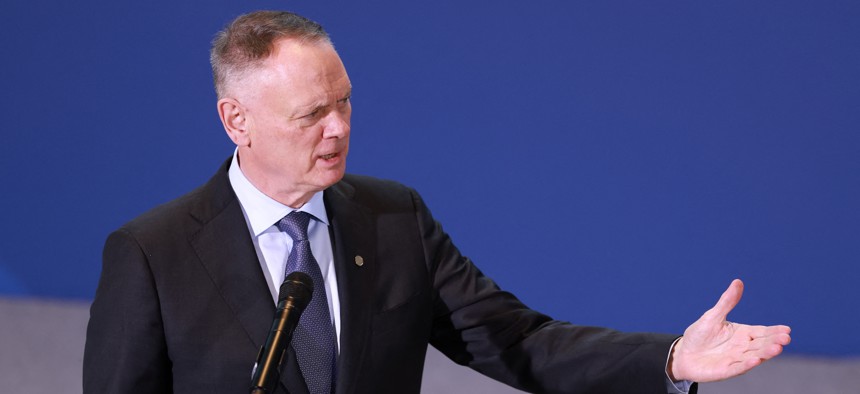
Canada's Defence Minister David McGuinty at a summit of the so-called "Coalition of the Willing," a group of Ukraine's most significant allies and supporters, at the Chancellery in Berlin on November 19, 2026. Kenzo TRIBOUILLARD / AFP via Getty Images


Canada joins NATO innovation fund, promises ‘business as usual’ with US
But the investment is a pointed reaction to the Trump administration’s dwindling cooperation with its northern ally.

HALIFAX, Nova Scotia—Hours after news broke that the United States would limit defense cooperation with Canada, the Canadian government announced plans to pour 100 million Canadian dollars into a NATO defense-innovation fund. “As far as we're concerned, it's business as usual,” Defense Minister David McGuinty said when asked about the news.
It was a calm reply about an extraordinary development between formerly close allies, but in one sense, it was quite true. As the Trump administration reduces its contributions to the alliance —and in some cases threatens military action against its members—they are increasing their efforts to build their own militaries and industry.
The Canadian decision pushes total commitments to the NATO Innovation Fund past 1.1 billion euros. Joining the fund also makes Canadian defense startups eligible to draw upon it, giving them another source of capital and access to the fund’s network of venture capitalists.
The NIF is a way to connect startups with investors and military users across the alliance to “help successful solutions reach scale,” Tarja Jaakkola, NATO’s assistant secretary general for defense industry, innovation, and armaments, said at a recent NATO conference in Izmir, Turkey.
In June 2024, for instance, German ground robot maker ARX Robotics raised 9 million euros in a seed round. The NIF led the round and provided more than half the money. In April 2025, ARX raised 31 million euros in a Series A round led by HV Capital. In July, Austrian venture capital firm Speedinvest led an 11 million euro extension, bringing its Series A total to 42 million euros.
But competition for the money is stiff. In April 2025, NIF partner Patrick Schneider-Sikorsky said the fund had seen “thousands” of deals and invested in about 10 companies.
Canada’s pledge is a bet on collective action. The funds could have gone directly to Canadian firms, and there’s no guarantee that any of the money will come back home.
There is “no pro rata in the NATO Innovation Fund. It is finding the best technologies that best address the capability needs of the alliance,” NIF President Ari Kristinn Jónsson said here on Saturday.
The announcement came hours after a White House news conference at which President Donald Trump again accused Canada, the United States’ second-largest trading partner, of unfair trade practices.
“For some reason they feel emboldened and we can’t let them feel that way anymore,” Trump said.
Over the summer, the president imposed 50-percent tariffs on several types of Canadian products, claiming that Canada discriminates against American autos, alcohol and cheese. But, as PBS has reported, Trump’s argument “rests in large part on retaliatory actions taken by Canada after the U.S. president imposed tariffs on Canada under the pretext that it should do more to stop fentanyl smuggling.”
Shortly afterward, the Washington Post reported that Pentagon leaders had issued a secret memo restricting military cooperation between the United States and Canada.
Canadian officials said they had learned of the memo from news reports and had yet to see it.
In Halifax for the 18th Halifax International Security Forum, Sen. Mike Rounds, R-S.D., said the memo was months old and limited only flag officers’ participation in social events. Rounds said it “does not impact any DoD personnel that are in Canada today. It does not impact NORAD. It does not impact NATO operations or [the Five Eyes intelligence sharing partnership]]. Does not impact general or flag officer meetings.”
McGuinty pointed to more than 70 years of military cooperation between Canada and the United States.
“We have Canadian vessels interdicting drug trafficking in the Caribbean, working alongside American vessels. So that cooperation remains ongoing,” he said, adding that, as far as he knew, cooperation through NORAD and intelligence-sharing agreements continued as before.
“As far as we're concerned, it's business as usual.